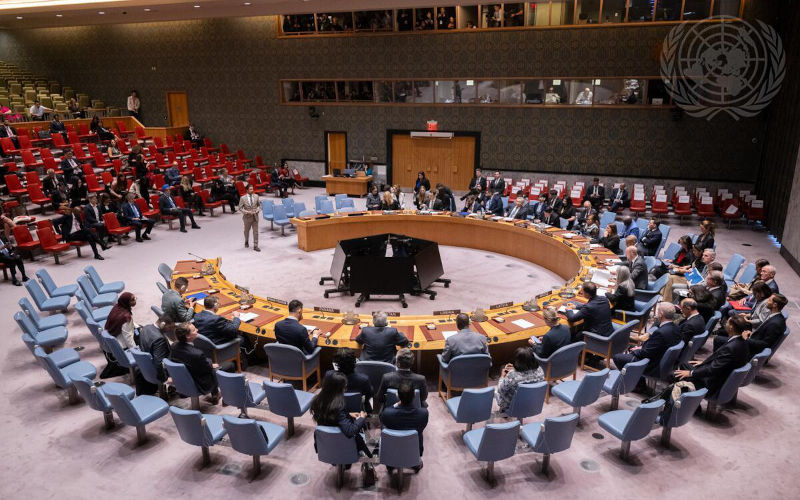
Australia is campaigning for a Security Council seat on a promise to defend international law. Yet Albanese condemned Russia by name while saying nothing comparable about US actions – even after Trump threatened from the same UN stage to “annihilate” Iran.
Prime Minister Anthony Albanese used his recent United Nations address to make a pitch for a seat at the Security Council. He highlighted how the world was spinning into conflict, but refused to name the one nation that has been most responsible for this.
The world is being torn apart by US aggression, using its military, trade and AI as weapons, and Albanese failed to mention this even once in his UN address.
The speech came only a day after US President Donald Trump used his address to threaten to annihilate Iran and send its people “to hell”, bragged about the war spoils he has taken from Venezuela, threatened a coup in Cuba, and finished with calling the International Criminal Court “evil” and AI regulations a globalist conspiracy.
In the face of this, the silence from Australia’s prime minister was deafening.
Albanese rightfully called out the belligerence of Russia. But why would anyone believe his claims to work with middle powers to confront aggression when he is so obviously unwilling to call out the aggression of the US that was platformed just 24 hours before his address?
Throughout his speech Albanese referenced the great challenges of our time – climate change, AI, war – only to provide no answer to any of them. Even when the prime minister made a generic call to regulate artificial intelligence, the rest of the world knows that he has zero track record on this in Australia. That week OpenAI hacked into a secure government database, and as yet has faced no punishment for it.
He referenced Australia’s commitment to nuclear non-proliferation, which are big words from a government that still refuses to sign the Treaty on the Prohibition of Nuclear Weapons. It also rings hollow as Australia, through AUKUS, keeps pushing the boundaries of existing treaties. The rest of the world are not interested in the propaganda; they can see Australia trying to acquire nuclear submarines powered by weapons-grade uranium.
Albanese spoke about the importance of international law despite being the first country in the world to support Trump’s illegal war on Iran and refusing to join countries like Canada and the UK in banning trade with illegal Israeli settlements. Words that are so disconnected from actions are not persuasive; they are jarring.
He spoke about the threat of climate change, especially to our Pacific neighbours, yet has continued to ignore their calls to stop opening new coal and gas. His first act after the last election was to greenlight a globally significant gas hub in north-west Australia. The world knows this too.
The only tangible action Albanese pointed to was the social media ban for under-16-year-olds. This is a policy that has failed to meaningfully reduce the number of children using social media, sending many of them into entirely unregulated adult spaces they would not have accessed without Labor’s “ban”.
All the speech showed was the hollowness of Australia’s current political leadership – unable to act on the issues they know are a problem and unwilling to name the key actor that is destabilising the world.
Why would anyone expect Australia to stand up for international law, when Labor cannot even name one of the countries most responsible for its decline? The world has no reason to believe in the Australian Government. Often domestic actors have to work with Labor and so view the government with a favourable eye. Foreign countries don’t have to play this game, nor give Australia the benefit of the doubt when the government’s rhetoric falls short of its actions.
This speech was meant to be a pitch for a seat for Australia at the UN Security Council. Any fair-minded observer would say that, based on this speech, it might be better if the chair was left empty.

David Shoebridge
Senator David Shoebridge
- State: Member of the Legislative Council (NSW) from 2010 to 2022.
- Federal: Elected to the Senate for New South Wales, 2022.
Committee service
- Joint Select: National Anti-Corruption Commission Legislation served from 29.9.2022 to 10.11.2022
- Joint Standing: Implementation of the National Redress Scheme served from 6.3.2023 to present; Migration served from 25.3.2024 to present
- Joint Statutory: Law Enforcement served from 26.7.2022 to present; Australian Commission for Law Enforcement Integrity served from 26.7.2022 to 1.7.2023; National Anti-Corruption Commission served from 9.2.2023 to present; Human Rights served from 4.7.2024 to present
- Senate Legislative and General Purpose Standing: Legal and Constitutional Affairs: Legislation served from 26.7.2022 to present; Legal and Constitutional Affairs: References served from 26.7.2022 to present; Economics: References served as Substitute member from 28.9.2022 to 30.11.2023; Finance and Public Administration: Legislation served as Substitute member from 9.3.2023 to 31.7.2023; Foreign Affairs, Defence and Trade: Legislation served as Substitute member from 22.6.2023 to present; Economics: Legislation served as Substitute member from 30.11.2023 to 28.2.2024; Finance and Public Administration: References served as Substitute member from 7.12.2023 to present
- Senate Select: Australia’s Disaster Resilience served from 1.12.2022 to present; Adopting Artificial Intelligence served as Deputy Chair from 27.3.2024 to present
Parliamentary party positions
- Australian Greens. Served: 01.07.2022 to present
- Australian Greens Spokesperson for Justice, Defence and Veterans’ Affairs and Digital Rights from 17.6.2022 to 15.5.2023.
- Australian Greens Spokesperson for Justice, Defence, Veterans’ Affairs, Digital Rights and Science from 15.5.2023 to 25.3.2024.
- Australian Greens Spokesperson for Defence and Veterans’ Affairs, Digital Rights and IT, Home Affairs, Immigration, Citizenship and Multicultural Affairs and Justice (includes Attorney-General and Drug Law Reform) from 25.3.2024.