
Australia cannot credibly claim climate leadership while expanding coal and gas exports that accelerate global heating, deepen Pacific vulnerability and lock in further human suffering.
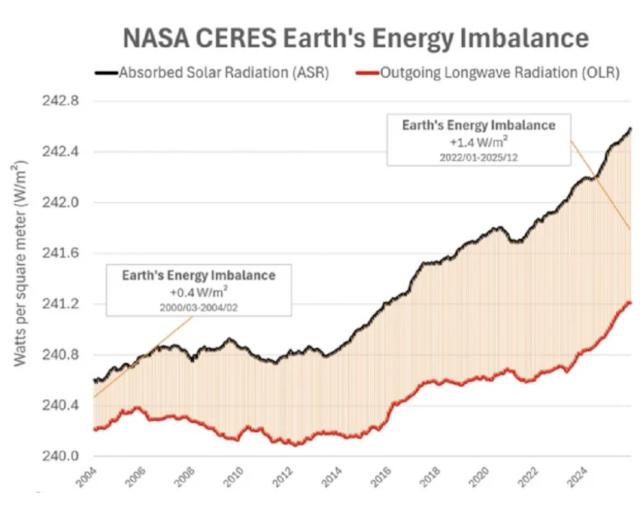
For years the Earth has been absorbing more energy from solar radiation than it has been emitting to space, due to increasing atmospheric carbon concentrations from fossil fuel use. As a result, the Earth is getting hotter at an accelerating rate. The only solution is to reduce fossil fuel use and draw down carbon from the atmosphere. Any other solution is window-dressing.
Prime Minister Albanese and his entourage were in Fiji this week for the Pre-COP Leaders meeting, intent on spruiking Australia’s climate leadership role and bolstering our claim to be the security partner of choice in the Pacific. Integrating these themes into concern for climate security has become fashionable, providing devious political players with the ability to escalate destructive militarisation under the guise of humanitarian concern to manage climate impacts, which in the Pacific are now genuinely existential for many countries.
The Pacific nations are rightly angry at Australia’s duplicitous climate policy. The government has done some good in accelerating the growth of renewable energy, for example with incentives for solar and battery installation, and in transforming the electricity grid away from fossil fuels. On the other hand, those benefits are vastly outweighed by its insistence on massive expansion of gas and coal projects, primarily for export, thereby maintaining our position as the world’s third-largest fossil fuel exporter.
The government has been fully briefed by experts and its own agencies on the existential threat of climate change – the greatest threat the world faces, with the potential to wipe much of humanity from the face of the Earth. It is here now, accelerating and rapidly moving beyond human influence, as the current unprecedented Super El Niño and escalating catastrophic climate impacts – for example most recently in Europe, Nepal, Asia and China – have demonstrated only too clearly.
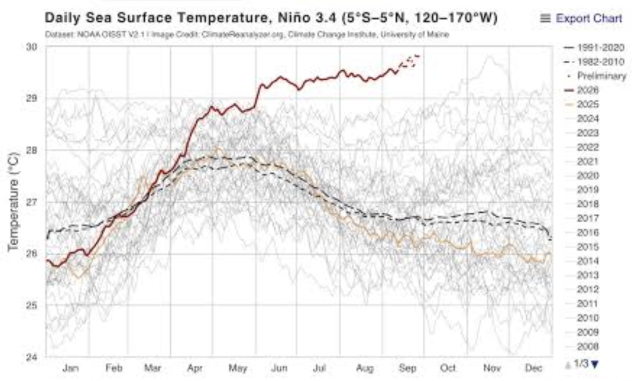
Heat accumulated in the oceans due to the Earth’s energy imbalance (EEI) is now being released into the atmosphere at an unprecedented rate, contributing to the Super El Niño. As a result, temperatures in the Niña sector of the Central Pacific are breaking all previous records by a large margin. The resulting climate impact is unclear, but likely to be devastating in many regions.
Despite 40 years of climate negotiation, precisely nothing has been achieved in terms of key outcomes. Renewable technology solutions have been highly successful, but thus far largely meet increasing energy demand, not the imperative of reducing legacy fossil fuel use which created this threat.
Those key outcomes, which must be the absolute priority of serious climate policy, are the reduction of global carbon emissions, and of atmospheric carbon concentrations, at emergency speed. Both continue to rise at worst-case rates, aided and abetted by Australian exports.
The fact that most emissions from the 37 new projects or expansions approved by the government since its initial election arise from exported fuel and thus do not have to be officially accounted for by Australia is irrelevant. This is a global problem, where increased emissions anywhere in the world impact upon the entire global population, including Australia. The largest-ever coal mine extension, for Hunter Valley Operations, just approved by the NSW Government, is indicative of the total indifference of government, and proponents Glencore and Yancoal, to the millions of deaths and human suffering which will result.
Yet Energy and Climate Minister Bowen, revelling in his forthcoming lead role at COP31, has the temerity to declare that fossil fuel phase-out is not on the COP agenda. Thereby confirming, before it even starts, that this COP, along with so many others, will be a failure in any meaningful sense, which is exactly what the fossil fuel industry wants.
Australians are continually told by political players that the first priority of any government is the safety and security of the people. Achieving that priority is now entirely dependent upon serious climate action.
Government hypocrisy in maintaining the charade of Australia as a global climate leader is beyond belief, particularly its insistence that Australia is doing its utmost to assist “Our Pacific Family” in overcoming the immediate existential impact on Pacific islands.
By approving fossil fuel projects, the government is deliberately, consciously, making Australians complicit in killing millions of people here and overseas, and destroying the livelihoods of far more, for the sake of ingratiating itself with the Trump regime and its tech bros and military/industrial psychopaths. After 40 years of global negotiations and mounting climate impacts, with the climate science confirmed long ago, this is a crime against humanity.
The security dimension of our Pacific strategy compounds the hypocrisy. It is conducted on the unquestionable assumptions that the emergence of China as a superpower is the greatest threat to Australia, our only way forward being total reliance on the US as our strategic protector. Hence our grovelling subservience to cement the US relationship despite the obvious failure of the US to reciprocate any real commitment, manifest as never before by Trump.
The $368 billion investment in AUKUS, if it ever materialises, is something we cannot afford given the escalating costs of climate impacts and adaptation which far exceed current provisions. Australia needs to think hard about its priorities. Unbounded militarisation with unreliable, declining allies should not be one.
If a climate change lens is applied, current government policy has to be turned on its head. After years of global procrastination, when the so-called ‘orderly transition’ could have worked, the only solution to the scale of the climate challenge we now face is emergency action by governments, business and communities coming together to address it. That requires unprecedented co-operation and collaboration globally, rather than the escalating conflicts which are worsening the climate threat with the massive emissions they create. That may seem improbable given the current state of the world and the weakness of global leadership, but it is essential if global climate catastrophe is to be averted.
The one country that has taken up climate leadership, and clearly will continue to do so, is China, where climate action is embedded in its renowned long-term planning backed by strong government commitment. China also happens to be Australia’s largest trade partner, a fact the government all too often ignores when spruiking the ephemeral benefits of AUKUS.
Sensible Australian government climate policy, and Pacific policy, should expand that trade relationship to encompass maximum climate co-operation with China, and Asia more broadly, rather than reversion to the womb of an outdated US Alliance. Particularly when the US refuses to accept that climate change even exists, let alone being the greatest threat to humanity.
The time for obfuscation around the real action required to address climate change ceased long ago. Australia, the Pacific and indeed the world should no longer put up with the timidity, lack of principle and deviousness being demonstrated by Albanese, Bowen and the multiple other climate deniers in our polity and elsewhere.
In today’s world, their actions are, without doubt, crimes against humanity.
Fossil fuel expansion must stop, and fossil phase-out begin, now.

Ian Dunlop was formerly an international oil, gas and coal industry executive, chair of the Australian Coal Association and CEO of the Australian Institute of Company Directors. He is a member of the Club of Rome and Chair, Advisory Board, Breakthrough National Centre for Climate Restoration. Executive Committee member of the Australian Security Leaders Climate Group.