A UK national security assessment warns that ecosystem collapse threatens food, water, health and geopolitical stability – and that no country will escape the consequences.
The global ecosystem that supports life on Earth is degrading rapidly and faces collapse – with dire consequences for world food, national security, natural disasters and disease outbreaks.
The outspoken warning, in a recent report, comes not from science or the environmental movement but from a citadel of conservatism, the UK Government’s defence and security arm.
Cascading risks of ecosystem degradation are likely to include geopolitical instability, conflict, migration and increased inter-state competition for resource,” states the report entitled Global biodiversity loss, ecosystem collapse and national security: a national security assessment, published by His Majesty’s Government.
Critical ecosystems that support major global food production areas and impact global climate, water and weather cycles are most important for national food security. Severe degradation or collapse of these would highly likely result in water insecurity reduced crop yields, a global reduction in arable land, fisheries collapse, changes to global weather patterns, release of trapped carbon exacerbating climate change, novel zoonotic disease and loss of pharmaceutical resources,” it said.
Major world ecosystems, such as coral reefs, have already begun to fail. Other collapses will follow them ‘from 2030’, the report admonishes. It provides the following map:
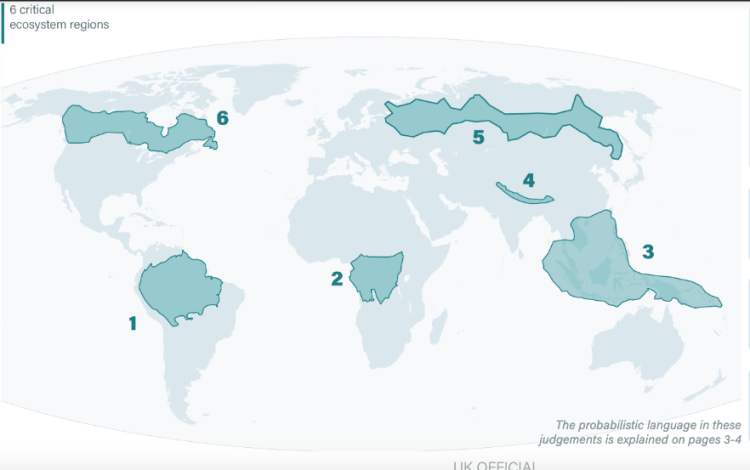
All countries are exposed to the risks of ecosystem collapse within and beyond their borders,” the report says, noting that food security is likely to be among the first dominoes to fall.
Similar warnings have been sounded by science for over 50 years, since the Club of Rome’s Limits to Growth report of 1972. More recently they were crystallised by the Intergovernmental Science-Policy Platform on Biodiversity and Ecosystem Services (IPBES) in its 2019 global assessment report. They have been uniformly ignored by governments, industry and by society at large, as humanity hastens blindly towards self-destruction.
In Britain, it is true, the present monarch, Charles III, had been offering personal warnings about all these things for most of his earlier career as heir to the throne – to a largely ecologically deaf British populace, which included its defence establishment. Now, it appears, there may be something of a Road to Damascus opening up in one of the bastions of careless capitalism.
Across the Atlantic, the US defence establishment – cowed by the jackboot autocracy of Trump and Hegseth – is forbidden even to mention things like climate and environmental quality. At the same time the US has torn up the environmental law which protected both its wilderness and the good health of its people.
Meanwhile, China released a new Environmental Code in March 2026, proclaiming measures to rein in air, water, soil, marine, chemical and other forms of pollution, major programs to restore forests, grasslands, rivers, wildlife and deserts, and has established itself as world leader in green energy and green transport as the basis for its economic expansion. China has evidently been reading the same data as the British Government, while America lingers in the dark – for all the brilliance and insight of its scientific enterprise.
A similar cognitive dissonance is playing out worldwide, with major energy producers such as Russia, Saudi Arabia and the Gulf States defending their right to wreck the planet while designing fantasy megacities such as Neom/The Line, to be built with the proceeds of ecological destruction.
Meanwhile smaller nations such as Costa Rica, Bhutan, the Maldives, Pacific Island states like Kiribati and Tuvalu and Scandinavian countries including Sweden, Iceland, the Netherlands, Finland and Denmark campaign with increasing fervour for a more sustainable world.
If the UK Government is correct in its assessment, no country is going to escape the instability that global ecological decline and collapse will unleash – and most will feel it well before the mid-century.
“The world is already experiencing the impacts of biodiversity loss, including crop failures, intensified natural disasters and infectious disease outbreaks.
“Ecosystem degradation is occurring across all regions and ecosystems. The average size of monitored wildlife populations declined by 73 per cent between 1970–2020. Populations of vertebrate species have declined by an average of 68 per cent since 1970. Freshwater species have shown the largest losses, falling 84 per cent in the same period.
“The rate of extinction is tens to hundreds of times higher than the average over the past 10 million years. It suggests that a sixth mass extinction may be underway.
“With current trends, global ecosystem degradation is highly likely to continue to 2050 and beyond. There is a high degree of uncertainty around the timing and pathways of ecosystem degradation, given the number and complexity of the drivers involved.
“Food production is the most significant cause of terrestrial biodiversity loss. As the global population grows, reaching 9.7 billion by 2050, the impact of food production on natural systems will intensify and it will become even more challenging to produce sufficient food sustainably.”
This last statement underlines the glaring flaw in most of these reports – and the reason so few governments will touch them.
Behind the man-made destruction that is engulfing the planet is the terrifying arithmetic of overpopulation, overconsumption and over-pollution. The bald fact that the Earth already has four times more people than it can physically sustain. This is a topic most governments are far too timid to broach.
However the UK report at least rebuts one of the most prevalent false claims of the commercial classes, that environmentalism is opposed to economic progress.
“Nature is a foundation of national security,” it states, inviting a global re-think of what indeed constitutes national security in the 21st century.
“Increasingly scarce natural resources will become the focus of greater competition between state and non-state actors, exacerbating existing conflicts, starting new ones and threatening global security and prosperity.”
The report acknowledges a ‘high degree of uncertainty’ about exactly when key ecosystems will collapse or reach their tipping point – but an equally high degree of certainty that it is going to happen sooner or later.
“There is a realistic possibility some ecosystems start to collapse by 2030 or sooner, as a result of biodiversity loss from land use change, pollution, climate change and other drivers.”
The UK study does not detail the solutions to the threats it warns about. But it invites everyone on the planet to reconsider the nature of ‘security’ in a world where the old definitions are no longer sufficient and nationalistic militarism can no longer prevail.

Julian Cribb AM is an Australian science writer and author of six books on the human existential emergency. His latest book is “How to Fix a Broken Planet” (Cambridge University Press, 2023)