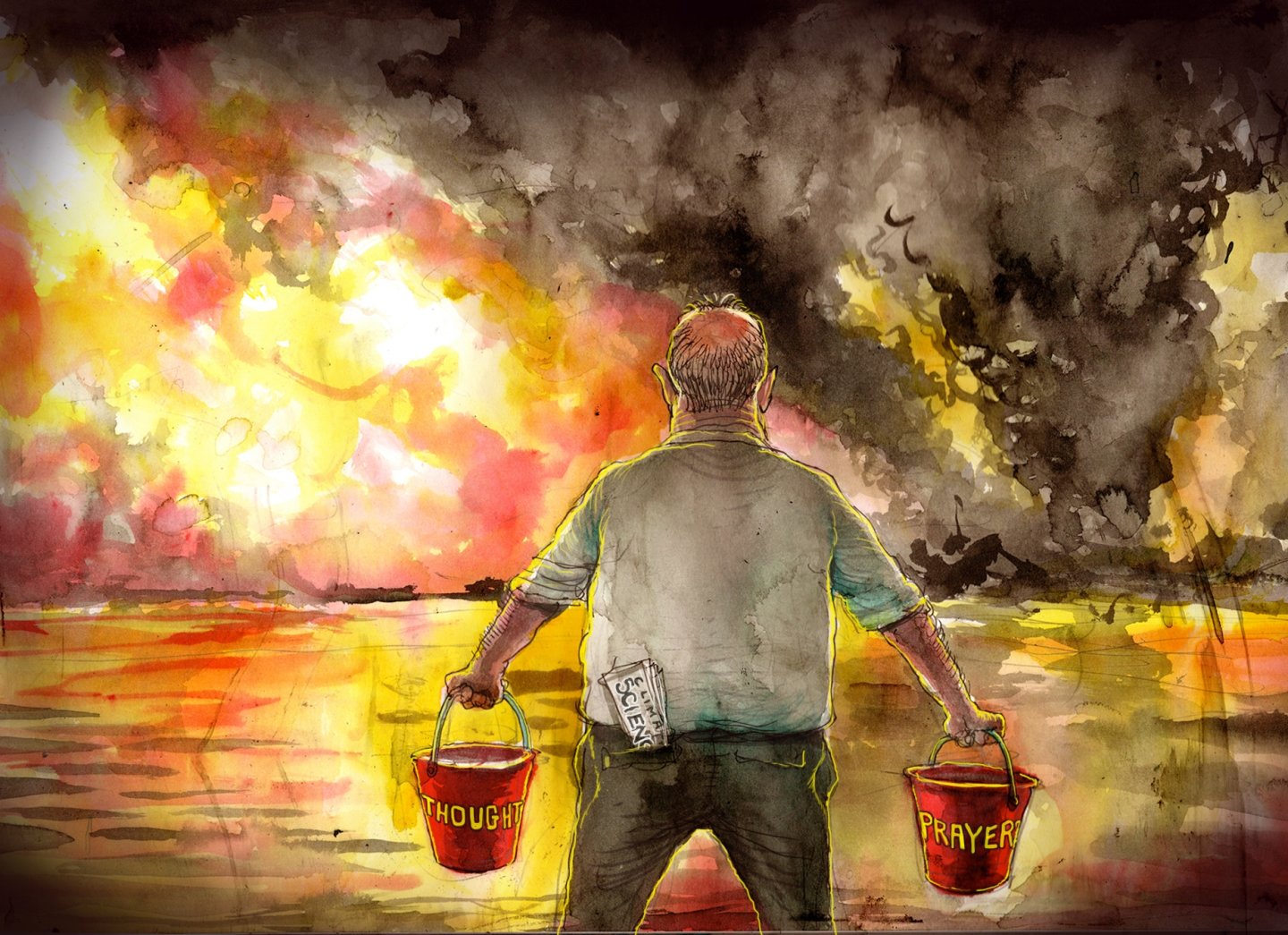
A way to break us out of the ossified and toxic parliamentary culture and the fearful stupor of the electorate. A way to restore fluid and functional governance. (more…)
Category: Climate
-
ANDREW GLIKSON. Portents of continental-scale fires
The effects of encroaching deserts and of fire storms on terrestrial forests, originally developed under moderate conditions distinct from those emerging under rapid global warming and extreme weather events, may have been underestimated. Average global temperatures do not tell the story — it is the increasingly frequent weather anomalies which do. Powerful psychological factors prevent many scientists from expressing their worst fears, a phenomenon dubbed as “scientific reticence”.
-
JACK WATERFORD. Now is not the time for keeping mum about Scott
The Canberra bushfire of January 2003 burnt, in an afternoon, nearly three times as many houses as have been consumed in NSW in this terrible week of 2019 as fires have raged in north-eastern NSW.
-
LESLEY HUGHES. If not now, when?
We don’t need name calling. But we do need to talk about climate change and bushfires. (more…)
-
TRENT PENMAN, KATE PARKINS, SARAH McCOLL-GAUSDEN. A surprising answer to a hot question: controlled burns often fail to slow a bushfire (The Conversation 15-11-19)
As sure as night follows day, this week’s bushfires prompted inevitable debate about whether fire authorities should have carried out more hazard reduction burning, and whether opposition from conservationists prevented this. (more…)
-
PETER SAINSBURY. Sunday environmental round up, 17 November 2019
Fire chiefs and health professionals stand up for action on climate change. Fly ash from coal burning causes major problems in Indonesia. The International Energy Agency identifies the main trends influencing energy supply over the next 20 years.
-
South Australia’s stunning renewable energy transition, and what comes next (Renew Economy 5-11-19)
The eyes of the energy world are upon it, but the renewable energy transition in South Australia is probably one of the misunderstood, misreported and under-appreciated achievements of our time. (more…)
-
BOB DOUGLAS. Responding to Greta’s Challenge
“How dare you pretend that this can be solved with just ‘business as usual’ and some technical solutions? …You are failing us. But the young people are starting to understand your betrayal. The eyes of all future generations are upon you. And if you choose to fail us, I say: We will never forgive you.We will not let you get away with this.” These were the words of sixteen-year old Swedish schoolgirl, Greta Thunberg as she addressed the United Nations climate conference on 25th September this year. (more…)
-
CÉSAR RODRÍGUEZ GARAVITO. The Solution to the Climate Crisis
Homo sapiens suffers from a cognitive defect in that we have evolved to deal with immediate and concrete threats, but not ones that happen to us slowly over time, like climate change. Those with Asperger’s syndrome see the world differently, and it is interesting to think that the rest of us might have to learn something from people disabled and often mocked. (more…)
-
JOHN KERIN: The Latest Commonwealth Government Drought Package.
The latest ad hoc response to the current drought cannot be criticised in terms of the politics of the situation we are now in. If it rains in, say, by March, or in the first six months of 2020, then we will be back to the status quo of drought policy. We simply don’t have a National Drought Policy, nor can I see one being agreed between the Commonwealth and the States which will ever be agreed by all parties and commentators, or which may have predictability or flexibility. The debate about the Murray Darling Basin plan, after30 years of development, is in the same basket. There are so many actors with so many responsibilities that everyone cannot be satisfied. (more…)
-
LIN CRASE. Australia’s drought relief package hits the political spot but misses the bigger point (The Conversation 7-11-19)
There are two basic components to the Morrison government’s latest A$1 billion package response to the drought affecting large parts eastern Australia. One part involves extra subsidies to farmers and farm-related business. The other involves measures to create or upgrade infrastructure in rural areas. (more…)
-
PETER SAINSBURY. Sunday environmental round up, 10 November 2019
Nearly all about climate change this week: 20 fossil fuel companies responsible for producing 35% of all greenhouse gas emissions and confusing the public and politicians about the causes of climate change; the USA starts the formal process of withdrawal from the Paris agreement: will others follow? is the Paris agreement dead in the water regardless?; and security companies making big profits from climate migrants. Finally, our sea eagle chicks fledge and Richard Flanagan talks about birds.
-
CO2 is rising at the fastest rate since 66 million years ago.
As the CO2 level rises to 408 ppm and the total greenhouse gas concentrations in the atmosphere, including CO2, methane and nitrous oxide, reaches about 500 parts per million CO2-equivalent, the stability threshold of the Greenland and Antarctic ice sheets, currently melting at an accelerated rate, is exceeded. Under warming drought conditions, firestorms currently engulfing California, large parts of South America, Siberia, Australia and elsewhere are a direct consequence of the extreme changes in the composition of the atmosphere.
-
Australia is defenceless against an advancing foe (Croakey, 05 November 2019)
Our Government maintains the primacy of the economy in all its deliberations. Even when mental health gets attention through the Productivity Commission it is with a view to “improving mental health to support economic participation and enhancing productivity and economic growth,” rather than with the primary purpose of alleviating suffering. (more…)
-
Australia could fall apart under climate change. But there’s a way to avoid it (The Conversation, 06 November 2019)
Four years ago in December 2015, every member of the United Nations met in Paris and agreed to hold global temperature increases to 2°C, and as close as possible to 1.5°C. The bad news is that four years on the best we can hope for is holding global increases to about 1.75°C. We can only do that if the world moves decisively towards zero net emissions by the middle of the century. (more…)
-
ANDREA HAMBLIN. More than 11,000 scientists endorse a global ‘climate emergency’ declaration (New Daily, 06 November 2019)
The Australian parliament voted against it.
But now 11,000 people who might know one or two more facts than a bubble of politicians have confirmed it is, indeed, happening: the whole world is in the midst of a climate emergency. (more…)
-
TOM SWANN. Morrison’s claim of an Australian gold in per capita renewables is not true (Renew Economy 27-10-19)
Despite promises to cut emissions, Australia’s emissions are still rising. But at the United Nations General Assembly in New York last month, prime minister Scott Morrison rejected criticism by claiming that “Australia now has the highest per capita investment in clean energy technologies of anywhere in the world”. (more…)
-
PETER SAINSBURY. Sunday environmental round up, 3 November 2019
The articles this week provide follow-ups to previously reported items: the NSW government changes legislation to promote climate change; the world’s largest reinsurer models the risks posed by climate change and walks away from coal; melting glaciers are but one manifestation of the changes wrought by climate change in mountain areas; December’s Conference of the Parties climate change meeting moves from Chile to Spain; and 2019 certain to be one of the hottest years on record.
-
CRISTY CLARK. Clean ocean win shows it’s worth dreaming big. In a time when bad news abounds, it is welcome that someone’s audacious plan to tackle a seemingly insurmountable environmental problem is having success
In 1997, oceanographer and boat captain Charles Moore made a shocking discovery. After deciding to cut through the North Pacific Gyre on his way back to California from Hawaii, Moore gazed into the ocean and, instead of pristine waters, found a vast vortex of floating plastic debris.
-
JOHN MENADUE. The National Party has deserted country people on Climate Change, NBN, Health Services and more.
The Nationals have a serious problem. It is not just a problem of Michael McCormack’s beige leadership and being pushed aside by Scott Morrison on key country issues like the drought. It has failed on numerous policy fronts. (more…)
-
JEREMY SMITH. Our Climate Crisis
While local drought-affected communities are declaring a climate emergency, present proposals to mitigate the impacts of drought fail to address the real crisis. They do not recognise that this drought is not just another variation on ‘normal’ conditions, but a step towards a new climate. More radical and comprehensive planning and action are required. (more…)
-
LUCY ROBINSON. Climate protests have roots that go deep into the rich history of British social change (The Guardian 13-10-19)
Extinction Rebellion draws on a radical lineage that brings together a range of beliefs and ages. (more…)
-
STEPHEN LEEDER – GRETA THUNBERG- A child shall lead them.
Swedish teenager Greta Thunberg has changed the conversation about global heating. Her passionate concern and emphasis on its likely impact on people her age has stirred public concern in a fresh way. How dare we, she asks of us older generations, respond with complacency, arrogance and inertia to such a threat? Wisdom, concern, and attention to the science can enable us to respond much better. (more…)
-
PETER SAINSBURY. Sunday environmental round up, 27 October 2019
A report on levels of peace around the world demonstrates that climate change is associated with conflict and forced migration. On-demand bus services and electric vehicles are proving popular, economical and good for the environment. Is social collapse arising from inaction on climate change inevitable and if so how do we prepare for it? Deforestation continues to rise despite declarations of intent to the contrary.
-
BRUCE CHAPMAN. Drought Policy: A Different Way
It is said that little is certain in life except death and taxes. In contemporary Australian public policy debate we can add another inevitability: that during terrible droughts governments will spend large amounts of taxpayer resources to address farmers’ legitimate anxieties concerning the effects. (more…)
-
JOHN KERIN. We have no drought policy.
The current Coalition response to just another drought is pathetic,short term, divisive and dishonest. All it is doing is managing the drought politically. (more…)
-
LINDA BOTTERILL. A national drought policy should be an easy, bipartisan fix. So why has it taken so long to enact a new one? (The Conversation 10-10-19)
In a country as dry as Australia, surely it is a no-brainer that we have in place a coordinated, national drought response that can be rolled out the same way that the Natural Disaster Relief and Recovery Arrangements are triggered when the country experiences cyclones, floods or bushfires. (more…)
-
PETER SAINSBURY. Sunday environmental round up, 20 October 2019
Investments in renewables are increasing but not fast enough. Oil and gas companies continue investing to produce yet more greenhouse gases, including burning coal underground to produce gas in SA. On current trends Australia’s economy is going to take a big hit from climate change, particularly the property and agricultural sectors. Rising sea level is one among multiple threats to Pacific islands. Don’t come back as a tiger in Laos.
-
MARYANNE SLATTERY. The only thing as certain as drought in Australia is the stupid call to build new dams (The Guardian, 15 October 2019)
In Australia, the only thing as certain as drought is the subsequent calls by politicians to build new dams.
Right on cue, the prime minister announced a $1bn commitment for new dams on Sunday. (more…)