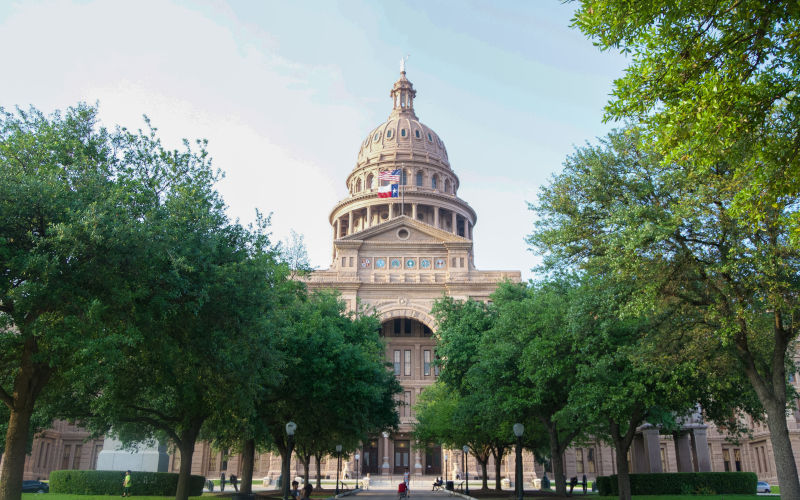
Texas may still lean Republican, but shifting party identification, economic discontent and doubts about Donald Trump’s leadership are giving Democrats new reasons to believe the state could become competitive.
Once upon a time, a long time ago, in America Democrats had a lock on the Texas Senate seats and the State.
Robert A Caro’s brilliant and monumental biography of LBJ – The Years of Lyndon Johnson: Means of Ascent – showed how a combination of factors – from strategic use of funding opportunities created by the New Deal to some pork barrelling and to outright corruption kept the state on the Democrat lists.
LBJ was also instrumental in getting civil rights legislation passed even, as he confessed, at the cost of losing the South.
No longer is that the conventional wisdom.
Yet once more there are suggestions that Texas could swing to the Democrats. The last time there was heavy speculation about Texas and the Senate was when Democrat Beto O’Rourke was standing against Ted Cruz and lost narrowly.
Now The Economist has analysed likely outcomes in the Senate at the mid-terms. It assumes the Democrats will keep Michigan, Georgia, New Hampshire, North Carolina and Minnesota.
Maine, Ohio and Iowa are uncertain. Florida, Alaska and Nebraska are likely Republican wins with Texas ranked as uncertain.
The Texas election is between Democrat James Talarico and Texas Attorney General, Ken Paxton after Trump mobilised MAGA against Paxton’s opponent in the Republican candidate election.
Elliott Morris has run the Texas numbers and finds that Democrats need to flip about one in 15 Republican voters to win with help from higher turnout and independents.
He estimates, combining 2020 and 2024 data, that the party breakdown in Texas is 42 per cent Democrat and 48 per cent Republicans.
He also suggests that party ID is moving against Republicans with Gallup’s research suggesting the split has gone from Republicans plus one to Democrats plus five in 2025.
Morris also suggest that the President’s party voters typically fall off in midterms and enthusiasm among the out-party surges.
“Even if Talarico goes 50-50 with independents he could win with a favourable turnout environment or a national swing,” he said.
Another factor is that Paxton has a scandal-ridden stint as Texas Attorney General which might have been why Trump favoured him over his opponent when Republicans voted on who their candidate should be.
Non-Americans may also have a misleading impression of Texas. It is no longer just a State full of big hats, big spreads and good old boys. Austin, the State capital, for instance is a major centre for IT and has a significant cultural infrastructure.
Texas is a rich state, voters there are still being hit by the impacts of Trump’s policies as are other Americans. G. Elliott Morris research has found that 69 per cent of Americans say they decided not make purchases in the past month because of the cost. Texas is not immune.
Some 49 per cent say groceries are contributing ‘a great deal’ of household financial stress while 33 per cent say they have experienced some stress. Housing costs, utilities, health care and health insurance, housing and emergency or retirement savings are being hit.
Who is to blame? According to Donald Trump it’s Joe Biden. Yet 41 per cent of Americans say Trump and his administration are most responsible for cost-of-living problems – far more than blame Biden (16 per cent). Some 63 per cent of Americans say the economy is in poor condition.
Morris also points to research from a variety of pollsters: Quinnipaic has Trump’s economy approval at 33 per cent, Fox News had an economy disapproval at 71 per cent and New York Times/Sienna at 64 per cent disapproval.
In March 2025 voters gave Biden slightly more blame for inflation than Trump, but by April 2026 54 per cent blamed Trump.
Paul Krugman in his regular blog said: “let’s look at it rationally (I know rationality has a well-known liberal bias). The 19 per cent of Americans who support MAGA, many of whom literally believe Trump was sent by God, say the economy is good. The other 81 per cent of Americans say that it’s very bad. Which group is more likely to have economic perceptions that are warped by politics?”
Krugman also cited research which showed that 63 per cent of adults thought the economy was getting worse; 87 per cent of Democrats said it was worse; 65 per cent of non-MAGA Republicans thought the economy was getting worse; while only MAGA Republicans (50 per cent) said it was getting better.
Meanwhile Americans are losing confidence in Trump’s mental fitness for the job. According to the Pew Research Center 61 per cent of adults (including 30 per cent of Republicans) say Trump has become erratic with age, and only 45 per cent call him mentally sharp enough for the job (down from 54 per cent pre-2024), and just 32 per cent are extremely or very confident in his mental fitness. Among independents, the “mentally sharp” percentage has cratered from 53 per cent to 36 per cent.

Noel Turnbull has had a 50-year-plus career in public relations, politics, journalism and academia. He blogs at http://noelturnbull.com/blog/