One Nation’s polling surge could create serious instability after the next federal election, with the party’s growing Senate prospects threatening to disrupt the balance of power and test Australia’s political institutions.
South Australia, Farrer, and the latest opinion polling have put One Nation ahead of any third force in Australian politics in the past 80 years, even the Greens and the Democrats, let alone the Australia Party, the United Australia Party, the Centre Alliance, or the Nuclear Disarmament Party – all of which have had parliamentary representation.
It is tectonic that a minor party is now polling higher than one or even both major parties. We have less than two years to see how it will play out in a Federal election and how well Australia’s institutions, especially the Parliament, the media, and the political parties themselves can cope.
It is especially important because One Nation regularly displays destructive Trumpian characteristics, such as accepting expensive aircraft as donations; accepting other large donations from the big end of town; prattling off ill-thought-out xenophobic and nativist policies; swinging between inconsistencies with impunity; ignoring valid criticism; attacking norms; and so on.
Australians should be wary. Just as President Donald Trump has shown his true disruptive and destructive colours after getting power in 2024, so will One Nation if it gets any power in 2028, such as in the Senate.
We are getting samples of that now.
In the past week, three One Nation MPs behaved like cats in the kitty litter as they qualified and contradicted each other over a “policy” that would expel “foreigners” from their houses so Australians could occupy them. It had an alarming similarity to stuff from 1930s Germany.
Would permanent residents be allowed to own homes? Would there be any grace period for them to get citizenship?
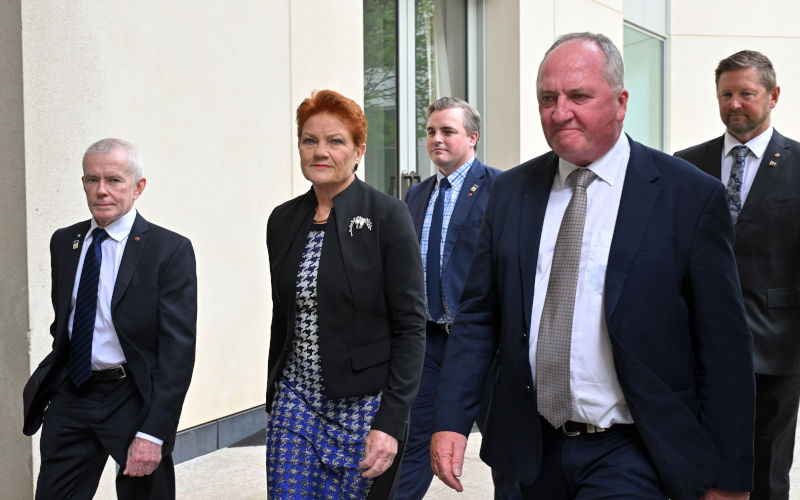
One National leader Senator Pauline Hanson, National Party-deserting One Nation MP Barnaby Joyce, and NSW One Nation Senator Sean Bell made such a hash of it that even friendly right-wing media interviewers were forced to stop recording interviews and send them away to straighten it out – like a naughty schoolboy being told to do his homework.
Perhaps they should have just admitted that a dog ate their homework, because that is what it looked like. Three One Nation MPs with five versions of a shoot-from-the-mouth headline grabber that was made to appeal to some of the worst instincts of the electorate.
Hanson’s sub-judice comments last week on the Ben Roberts-Smith case displayed similar Trumpian disrespect for the rule of law.
Beware. After the performance on housing, One Nation MPs and their staff might take stock. They will certainly be learning some more lessons, Trump style, on how to use social media to win elections.
Since the big shift in support, the media has been getting more demanding and investigative. One Nation’s reaction to that has been similar to Trump’s – exclusion, boycotts, and abuse. Also, Hanson has played the victim by asserting that media questioning and exposure of One Nation’s shortcomings is a great big conspiracy to deny struggling Australian workers their champion’s ability to work on their behalf.
One Nation will not use the recent experience of media questioning to sharpen up its act and make its policy base more consistent and coherent because that would make One Nation look more like a slick major party. Not being like a slick major party gives One Nation its perception of authenticity.
One of Hanson’s major assets is her enduring capacity to successfully fake authenticity. But it is a pretence.
One Nation has certainly benefitted from the natural human need to belong. As opinion polls and election results go One Nation’s way it has been seen to be more acceptable – the herding and bandwagon effect. But its real agenda is not to help working Australians or less well-off Australians. Its voting record shows that.
Sure, the Murdoch media has been particularly hard on One Nation, but that is principally because One Nation poses a threat to its traditional mates in the Coalition.
Big wealth, on the other hand, is developing a symbiotic relationship with One Nation and is pouring money that way. It is like an insurance policy. What if One Nation got into a position of some power and began to really act in favour of the battling working Australians it purports to represent? That would cost big wealth.
And getting some power is looking increasingly likely, especially in the Senate.
In 2028 those senators elected in 2022 will be up for re-election. There is no way all of the Coalition’s three senators in NSW and South Australia and Labor’s three senators in Western Australia will be re-elected. Nor will the Victorian UAP senator. That is four senators almost certainly going straight to One Nation. With the four existing ones, that makes eight.
It gets worse for the major parties. To get two Senate seats in a state they would need 28.6 per cent of the vote. On present polling, they might not get there in every state. In Queensland in 2019, for example, Labor did badly and only got one senator.
That possibility is open in other states and for the Coalition unless their support improves.
The trouble for the major parties is that in the Senate they do not get many preferences. People who vote for minor parties and independents tend to put the major parties pretty much last. And the major parties would need preferences if their primary vote fell shy of 28.6 per cent.
At present, the Labor government can pretty much get its whole legislative agenda through the Senate with the support of just the Greens. After 2028, if Labor or the Coalition replicated the 2019 Queensland result in a couple of states, having the Greens on side would not be enough. It would be at the mercy of more than eight One Nation senators or would have to rely on the Coalition or maybe the two independents to get legislation through.
Given the fractious, unforgiving, and uncompromising nature of politics these days, that possibility look paralysing.
As to the House of Representatives, Labor got nearly two thirds of the seats with just 35.6 per cent of the primary vote in 2025. If that primary vote fell a few percentage points (which polls suggest it will) the seats would fall like ninepins – as the Coalition found out by getting just 29 per cent of the seats with 31.4 per cent of the votes in 2025.
Tectonic political times are ahead.
Republished from Crispin Hull

Crispin Hull
Crispin Hull has written for The Canberra Times for 30 years on a huge range of topics, but mainly legal and constitutional. He was Editor for seven years. He taught journalism at the University of Canberra, and is the author of ‘The High Court of Australia 1903-2003’ and ‘Canberra – Australia’s National Capital’. He is also a marine rescue skipper on the Great Barrier Reef with Marine Rescue Queensland.