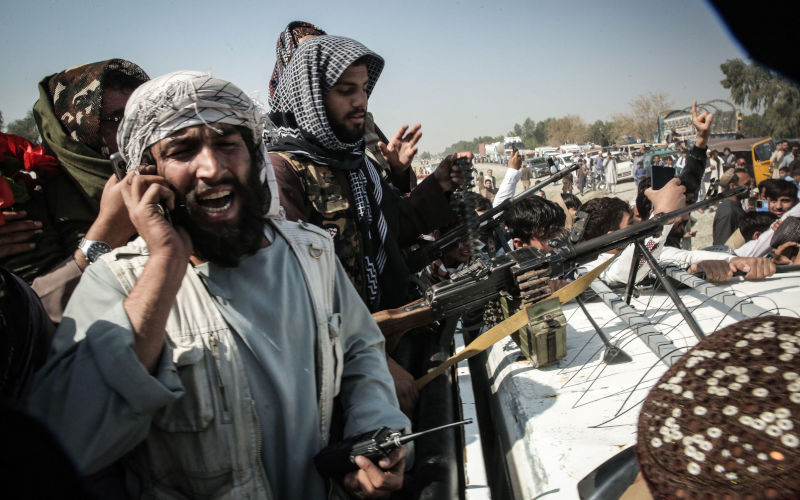
Five years after returning to power, the Taliban remains deeply repressive, while growing tensions with Pakistan, armed opposition groups and a deepening humanitarian crisis are putting new pressure on its rule.
Acting in the name of a self-centred version of Islam, the group has made no effort to modify its hardline ideological beliefs in favour of a more humane and inclusive approach to governing.
Nor has it refrained from hosting many like-minded violent extremist groups. The United Nations has issued repeated warnings about the resurgence of terrorism from Afghanistan.
The Taliban is also facing growing security challenges from within its own ranks and a cluster of armed resistance forces. Relations with its former patron, Pakistan, have completely broken down, with the country’s defence minister declaring an “open war” on the group earlier this year.
Rather than moderating it’s rule, the Taliban has only hardened its brand of Islam, which is not practised anywhere else in the Muslim world, and tightened its repressive, misogynist and regressive rule.
It has also taken advantage of geopolitical rivalries in the region and beyond to govern without any form of popular legitimacy or need for international recognition. Only Russia has so far formally recognised the Taliban government, but many others, including China, have boosted their diplomatic contacts with the country’s leaders and pursued economic and trade ties with them.
Taliban leaders were also invited to Brussels in recent months to meet with European Union officials over the outflow of Afghan refugees to the bloc – a visit heavily criticised by rights groups.
Millions of Afghans now live outside the country – most in neighbouring Iran and Pakistan. About half a million have applied for asylum in the EU since the Taliban came back to power, and many host countries have been keen to deport them.
Inside Afghanistan, meanwhile, most citizens are facing unprecedented poverty, mass unemployment, spiralling inflation and a severe lack of basic goods. Some families have found it necessary to sell a child to survive.
The pressure has only intensified with US President Donald Trump’s decision to shutter the US Agency for International Development (USAID) and Pakistan’s closure of transit roads into the country.
Washington has pursued an ambiguous policy towards the Taliban. Trump has demanded the return of the Bagram airbase in Kabul and US$7 billion worth of military assets left behind by departing US forces in 2021.
Yet Washington has maintained dialogue with the militia. The UN has also indirectly delivered billions of dollars in funds from the US government to the Taliban’s coffers over the past five years.
Pakistan’s turn against the Taliban is rooted in the group’s support of the Pakistani Taliban (Tahreek-I Taliban Pakistan, or TTP). Islamabad accuses the Afghan Taliban of providing TTP members with a base of operations to launch attacks across the border. It has retaliated by launching airstrikes on its neighbour.
Islamabad now seems determined to maximise pressure on the Afghan Taliban by bombing its bases – at a high cost of civilian casualties. It has also hosted meetings with some of the Taliban’s opponents.
This comes at a time of increased fighting in the north-eastern province of Badakhshan between the Taliban and followers of a dissident commander, Juma Khan Fateh, over control of resources and local grievances against the group. Senior Taliban officials have been assassinated in the region.
There are a number of armed opposition groups operating there. These groups remain fragmented, though some reports indicate the resistance is expanding.
It is not clear where all this will lead. The Taliban is rattled, but these opposition forces have a way to go to demonstrate a sufficient degree of coordination and a united national agenda. The Taliban is also more deeply entrenched and much better equipped than it’s opponents.
Most Afghans would be pleased to see the back of the Taliban. But for the opposition to be seen as a viable alternative, it will need to build trust with the people and provide hope for the future. The history of Afghanistan shows how hard this has been to achieve.
Republished from The Conversation


Emeritus Professor of Middle Eastern Studies, Australian National University; The University of Western Australia; Victoria University