After 1,000 days of genocide and 78 years of occupation, negotiations have not delivered peace. They have bought time, absorbed outrage and given Israel political cover to continue the destruction of Palestinians.
By today’s standards, 1,000 days are enough to build cities from nothing, ignite revolutions and reshape entire regions. But in Gaza, the 1,000 days since October 7 2023 have become nothing more than a relentless cycle in which death, displacement and destruction are reproduced every second before the eyes of a watching world. This is neither an accident nor the result of institutional failure. It is the product of a political design that has turned time into one of the most ruthless weapons of war – normalising atrocity until an ongoing massacre becomes an ordinary daily routine.
This cycle of genocide cannot be separated from its historical context. These 1,000 days are merely the most brutal concentration of 78 years of continuous occupation that has uprooted an entire people from their land and sought to erase their identity by every possible means.
For nearly eight decades, negotiations, partial solutions and interim agreements have served as the preferred tools for containing Palestine, while enabling the gradual seizure of land. This last war has stripped away any illusion that international diplomacy was ever pursuing a genuine solution. It was managing the conflict, granting the occupying power more time to complete the elimination of the Palestinian cause.
A close examination of the negotiation rounds held during these 1,000 days of genocide makes one fact unmistakable: international diplomacy has become a partner in Gaza’s genocide. The halls of foreign capitals and mediation efforts shifted from instruments meant to stop the bloodshed into platforms for managing the timing of the crime and providing the political cover necessary to complete the destruction of Palestinians. The endless cycle of negotiations, futile debates over temporary ceasefires and repeated revisions of draft agreements is the same deception that has been practised for 78 years. It is a strategy designed to absorb global outrage, while purchasing time with Palestinian blood in order to impose a new demographic and geographic reality.
Since the Nakba, through successive peace initiatives and continuing into July 2026, the negotiating table has consistently served as a functional instrument for absorbing international outrage over settlement expansion, the erosion of Palestinian rights and granting the occupation the time and legitimacy needed to seize what remains of Palestinian land.
This historical deception is perhaps most clearly exposed in the trajectory of the Oslo Accords. Launched in 1993 as a temporary framework intended to last only five years, Oslo continued for more than three decades without delivering any political outcome for Palestinians.
What began as promises of statehood and self determination evolved into a permanent diplomatic shield that Israel used to accelerate settlement expansion across the West Bank, intensify the Judaification of occupied Jerusalem and impose a suffocating blockade on Gaza, while Palestinian negotiators remained trapped in an endless cycle of meetings and futile security coordination. The same negotiating trap now being laid for Gaza to absorb the blood of its victims has, for decades, transformed occupation into a sustainable project backed by international support.
Over these 1,000 days, dozens of rounds of indirect negotiations moved from one capital to another, including Cairo, Doha, and Paris, involving mediators from Egypt, Qatar, the United States and later Türkiye. They produced nothing beyond fragile ceasefires that quickly collapsed, allowing the machinery of war to resume with even greater intensity. The process began with a brief seven-day truce in November 2023, followed by successive proposals, including the May 2024 initiative, which received conditional Palestinian approval based on a permanent ceasefire. Israel rejected the proposal, insisting on renewed occupation demands, including security corridors such as the Philadelphi Corridor betwen Gaza and Egypt.
When a phased ceasefire took effect in January 2025 and included eight rounds of prisoner exchanges, Israel resumed its military campaign and effectively abandoned the agreement in March of the same year. The pattern was repeated in October 2025 with a new 20-point American proposal that produced another fragile ceasefire stripped of meaningful political substance because the core political issues remained suspended between intransigence and deliberate delay.
This repetitive cycle of more than 15 documented major negotiation rounds was not political failure. It was a deliberate mechanism that stripped negotiations of their value as an instrument for genuine peace and transformed them into a political routine that provided cover for continuing military operations and repeated invasions. The devastating consequences of this calculated manipulation of time have been borne by Gaza’s civilians.
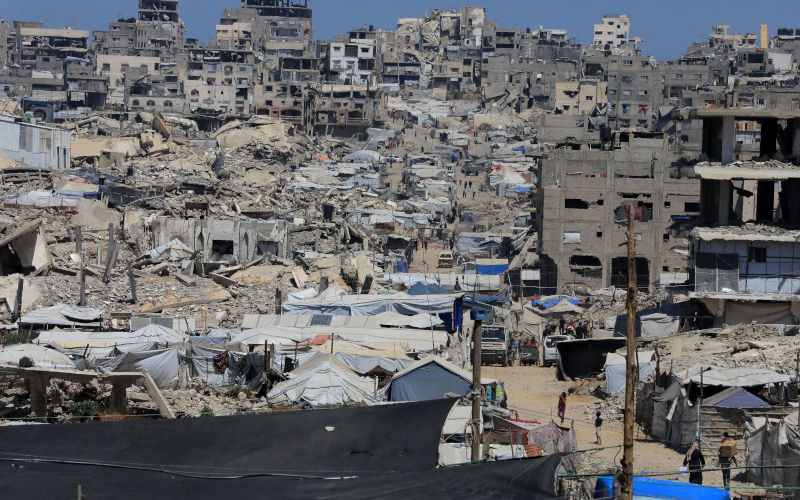
Over these 1,000 days, more than 73,000 people have been killed, alongside tens of thousands who have been wounded or remain missing. More than 90 per cent of Gaza’s infrastructure has been destroyed, while over 1.9 million people have been displaced into overcrowded tents, which lack the most basic necessities of life. Systematic starvation and severe shortages of medicine have left an entire generation with profound physical and psychological trauma. Education and every aspect of normal life is at a standstill.
These past 1,000 days have served as the guillotine that severed every principle and slogan long championed by western governments, led by the United States. The ideals of human rights, international law and freedom of expression have all shattered against the reality of Gaza.
The evidence has demonstrated that the international system is not merely incapable of acting. It is complicit in this diplomatic deception through its deliberate reluctance and its separation of law from any meaningful mechanism of enforcement.
The United States, which has led this deception for decades and elevated it during this war, has turned its veto power, military support and unconditional backing into a political shield that legitimises genocide, while bringing the moral foundations of the postwar international order to irreversible collapse.
This blatant complicity is nowhere more visible than in the conduct of the United States at the UN Security Council. Washington used its veto six times to block resolutions calling for an immediate, comprehensive and unconditional ceasefire, including in February and November 2024. It repeatedly justified its position by linking an end to the mass killing with negotiations over captives, while reducing humanitarian aid to a tool of political and military coercion.
The United States also became complicit in Gaza’s starvation by placing conditions about political concessions on the flow of food and medicine, while allowing Israel to shut border crossings and sever Gaza’s lifelines during critical negotiation periods, as occurred in March 2025, in order to pressure Palestinian negotiators. All the while, it sheltered behind misleading phrases such as ‘temporary humanitarian pauses’ instead of demanding a genuine and comprehensive end to the genocidal war.
Perhaps the starkest contradiction, exposing both the nature of this international system and the conditions under which its diplomatic machinery is moving, becomes clear when Gaza’s 1,000 days are compared with developments on other fronts across the region. Once the conflict expanded beyond Gaza and began threatening the direct interests of major powers, disrupting their economic stability and geopolitical calculations, only 40 days of military escalation were needed before international actors rushed to impose a solution. A direct and unexpected agreement was reached between the United States and Iran, through which Washington compelled Israel to fully halt its military operations and attacks against Iran and Lebanon.
Within a matter of weeks, every American and Israeli argument about the complexity of the battlefield and the impossibility of achieving a ceasefire suddenly disappeared because the conflict had begun threatening vital supply routes, international shipping lanes, global supply chains, energy markets, oil prices and the security and prosperity of their regional allies. International determination emerged not to save civilian lives or uphold justice, but to protect their own societies and preserve economic stability.
In Gaza, however, because the blood being shed is Palestinian and carries no measurable cost for their financial markets or domestic consumption, 1,000 days of devastation have still not been enough to awaken the conscience of this complicit international order or compel its military machinery to stop.
Today, after 1,000 days of continuing genocide and 78 years of displacement and exile, speaking once again about new rounds of negotiations or placing hope in postwar political arrangements amounts to extending the political crime and participating in the deception of Palestinians.
Gaza’s thousand days have closed the door on the past and stripped away the illusions surrounding the Western-led international order. There is no longer room for ambiguous terminology or cosmetic solutions.
Continuing to rely on the traditional mechanisms of this international system is a losing proposition. Any path that does not begin with an immediate and uncompromising end to the ongoing atrocities and the dismantling of the 78-year occupation is merely an extension of the killing, granting another 1,000 days in which not only Palestinians, but the remaining stability of the entire region, will be consumed, leaving the politics of deception to produce nothing but further inevitable explosions.

Refaat Ibrahim
Refaat Ibrahim is a Palestinian writer from Gaza and the founder of The Resistant Palestinian Pens ( https://resistantpens.org/ ). A graduate in English Language and Literature from the Islamic University, he writes about political, social, and cultural issues in Palestine. Through his work, he amplifies Palestinian voices under occupation, believing writing is a bridge between truth and people’s hearts and minds.