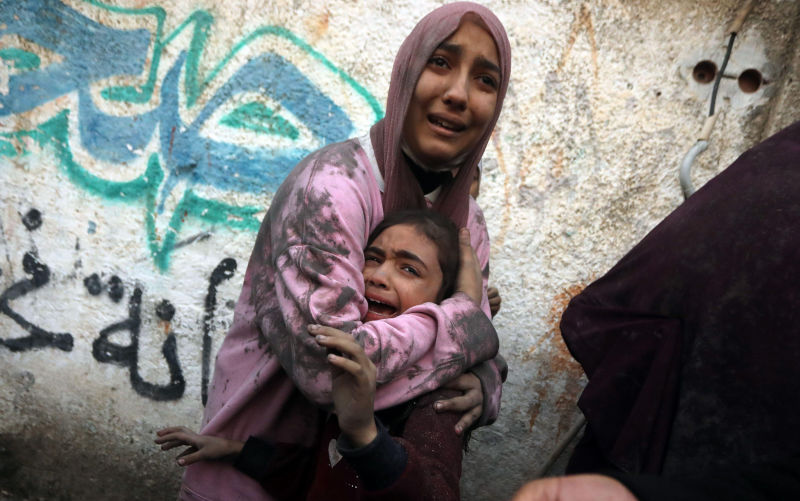
When people ask, “Why are children always the first to suffer in war?” I find myself thinking about Gaza.
Right now, the reported death toll in Gaza has reached over 60,000. A conservative estimate says that at least 18,000 to 20,000 of those killed have been women and children. That’s nearly one-third, and when you dig deeper, when you listen to the doctors and health workers in Gaza, the families who’ve survived, the journalists who have reported, you hear the same thing again and again – children arriving with identical injuries, bullet wounds to the head. Precision strikes, not the kind of injuries you’d expect from random blasts or collapsing buildings.
This isn’t just a tragic outcome of war, of genocide, it starts to look premeditated.
History shows that in most genocides women and children have been the target of brutal killings, rape and systematic violence. These acts aren’t accidental.
In genocide, the aim is to wipe out a people entirely and that means destroying the future they carry.
Children are killed to erase the next generation.
Women are raped or murdered to break families, to stop lineage, to shatter identity.
This is not about being “caught in the crossfire”. It’s about being placed directly in the path of destruction, on purpose.
UN human rights experts have emphasised a systematic campaign of violence in Gaza, where women and children account for the majority of verified deaths, leading some academics and advocates to frame these killings in terms of gendercide or femi-genocide.
These aren’t just political statements; they’re attempts to make sense of violence that seems deliberately aimed at erasing both the present and the future of a people. Whether or not the world agrees on what to call it, the pattern is clear: women and children are not being spared, they are being struck first.
In Gaza, entire families have been wiped out, not one or two members, but three, four, five generations in a single strike. Whole surnames erased from civil registries. Homes bombed while people slept. Pregnant women dying alongside the children they carried. Hospitals reduced to rubble. It’s hard to process, let alone explain, but we have to try.
If we fail to speak plainly, truthfully, about this, if we pretend these deaths are just “civilian casualties” or “tragic mistakes”, we risk hiding the truth. We allow calculated violence to pass as unfortunate consequence. We avoid the discomfort of asking “Is this part of a strategy?”
Human beings are capable of so much more, but when war descends into genocide, the brutality is disturbingly similar. The logic is cold, if you want to destroy a people, you start by killing the children and you make sure the women cannot create life again.
However, many governments and media outlets still use soft, vague language when talking about Gaza. They refer to “strikes” and “targets” and “operations”, but how do you “target” a refugee camp? How do you “strike” a classroom full of children and call it self-defence?
This isn’t just about numbers. It’s about what those numbers mean. About half of Gaza’s population are children, nearly one million under the age of 18. When around a third of those killed are children and many of the rest are women, we’re not talking about military combatants. We’re talking about real lives, real people, who should never have been in the line of fire.
When this kind of suffering drags on, we often become numb. We talk about “humanitarian aid” and “diplomatic solutions”. All of that matters, of course it does, but it doesn’t undo what’s been done. It doesn’t bring back the babies, children, sons, daughters, grandparents and friends. It doesn’t comfort the parents who lost every child they had and loved.
There’s a fracture in how the world responds. Compassion seems to come with conditions. When white children die, grief is immediate, but when black or brown children die, the world pauses, asking for context, verification, justification. How many children need to die before that hesitation ends, before we say enough?
It’s not easy to write about this. It shouldn’t be, but it’s far harder to stay silent, especially when the deaths of women and children are not just predictable but seem to be happening by design.
So, when people ask why children suffer first in war, maybe we need to stop saying “because war is cruel” or “because they’re vulnerable”. That’s only half the story.
The full truth is far more disturbing, much more disturbing – they suffer first because someone chooses it, because someone believes it is necessary to win, because someone thinks that by killing women and children, they can destroy a people entirely.
In Gaza, we are witnessing the cost of that thinking. This is a campaign to erase. Unless we are brave enough to see the pattern and speak out against it, we will keep repeating this horror, this repetition of the past, again and again.
The views expressed in this article may or may not reflect those of Pearls and Irritations.

Meg Schwarz
Meg Schwarz holds a Postgraduate Diploma in Counselling and Psychotherapy and brings over 35 years of experience championing social justice, advocacy and consumer engagement. Based in South Australia, Meg has dedicated her career to working alongside diverse communities, including refugees, people with disabilities and individuals with complex trauma backgrounds.With a strong passion for equality and human rights, Meg specialises in fostering meaningful communication, empowering voices through advocacy and creating inclusive spaces for dialogue. Her skills in stakeholder engagement, strategic communication and community development have earned her recognition as a trusted and compassionate leader in her field.