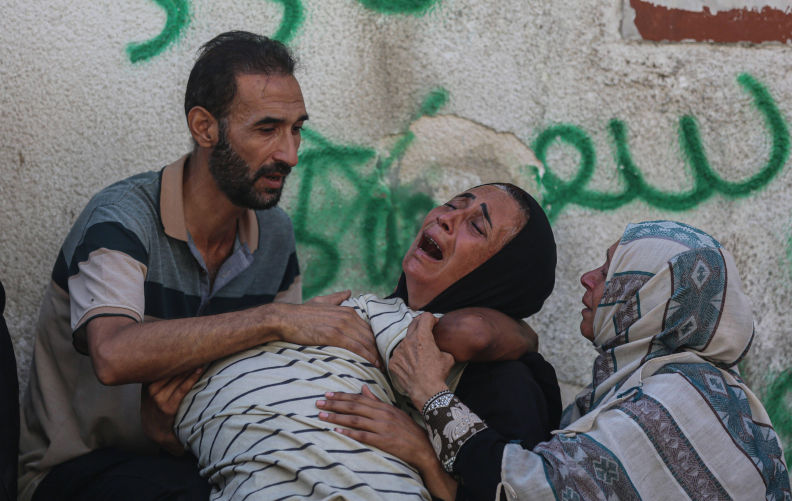
The suffering in Gaza has forced many people to question whether human rights are truly universal, or whether some lives and some grief are still treated as more politically urgent than others.
I know that many people are trying to understand how so much suffering can occur in full view of the world and why that visibility hasn’t been enough to stop it. We once believed moral courage could reshape the world. I certainly did.
For much of our history, many of us were raised with a certain story about the world.
We were taught that international law was important and that human rights were universal.
We grew up listening to the words of Martin Luther King Jr and Nelson Mandela and believed that, however slowly, justice bent towards those willing to demand it.
We were also assured that “never again” meant we would never again endure the atrocities of the wars and genocides we had experienced and studied in history books; that if enough people witnessed injustice, governments would eventually act; and that countries and our leaders, no matter how imperfect, would ultimately respond to moral pressure and the absolute imperative to protect human life.
Gaza has shaken that story for many of us.
It’s not only the enormity of suffering that has unsettled us, but the experience of watching that suffering and discovering that visibility alone doesn’t guarantee protection.
I think that Gaza forces us to confront the uncomfortable possibility that, despite our claims of universal human rights, we’ve developed hierarchies of concern, and hierarchies of grief.
Some suffering is personalised and we learn names, see family photographs and hear stories. Other suffering becomes statistical with death tolls rising where entire communities are described in numbers – and grief is transformed into data.
Many of us remember international campaigns against apartheid in South Africa and we remember economic sanctions, sporting boycotts, divestment movements and the ordinary people who refused to accept that politics should be separated from morality. We also remember being taught that international pressure was critical, that solidarity could reshape the course of history and that “silence in the face of injustice carried its own consequences.”
Whether those memories are idealised or not, I think they shaped our/my understanding of community and responsibility.
However, many people watching Gaza today are finding themselves asking extremely difficult questions, to the point that they switch off.
Why does this feel different?
Why do some crises provoke decisive international action while others produce statements of concern?
Why do some deaths interrupt the political status quo while others appear to be absorbed into it?
What I have asked for three years is this – whose grief compels action and whose grief becomes background noise? – not whose grief is real, because grief is always real – it’s not linear.
Parents burying children don’t grieve less because of their nationality, ethnicity or religion. They grieve because they’re human.
So whose grief is treated as politically urgent? Whose suffering is framed as intolerable? Whose fear demands immediate protection and whose devastation becomes part of the landscape of international affairs? Are we ranking whose grief matters?
These are really uncomfortable questions because they absolutely challenge the stories we tell/are telling about ourselves and they ask whether our commitment to universal human rights is actually universal, or whether it weakens when confronted by political alliances or the limits of our own ‘circle of concern.’
I honestly don’t know all the answers, but I know that many people are trying to understand how so much suffering can occur in our world and why that visibility hasn’t been enough to stop it.
I wonder if that’s why Gaza has affected so many people so profoundly; it hasn’t only exposed the devastation of war; it’s shaken our faith in the idea that knowing is enough, that witnessing inevitably leads to action and that the promise of “never again” extends equally to everyone.
If the promise of universal human rights depends on who is suffering, how universal was it ever meant to be?
Meg Schwarz
Meg Schwarz holds a Postgraduate Diploma in Counselling and Psychotherapy and brings over 35 years of experience championing social justice, advocacy and consumer engagement. Based in South Australia, Meg has dedicated her career to working alongside diverse communities, including refugees, people with disabilities and individuals with complex trauma backgrounds.With a strong passion for equality and human rights, Meg specialises in fostering meaningful communication, empowering voices through advocacy and creating inclusive spaces for dialogue. Her skills in stakeholder engagement, strategic communication and community development have earned her recognition as a trusted and compassionate leader in her field.