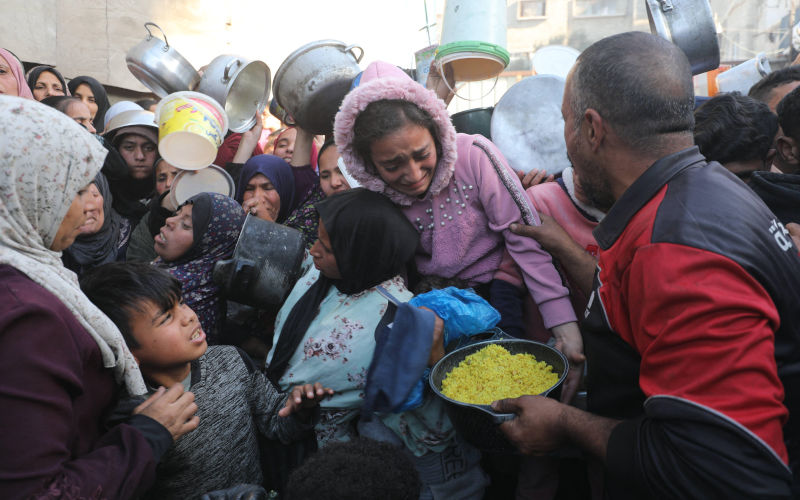
Gaza’s privatised aid system concentrated food distribution at militarised sites guarded by private contractors. Humanitarian relief cannot protect civilians if reaching it exposes them to danger.
For six months in 2025, the Gaza Humanitarian Foundation operated a radically different model for delivering food to Palestinians in Gaza. Instead of distributing aid through hundreds of established humanitarian sites, the foundation concentrated distribution at just four heavily secured sites. Three were in a military zone in southern Gaza and one was in central Gaza City. Armed private security contractors helped operate the system.
The foundation didn’t disclose its donors but received at least US$30 million from the US government. Many established aid organisations refused to cooperate, citing concerns about transparency and independent oversight.
The foundation says it distributed 187 million meals and demonstrated there was a better way to deliver aid to Gaza, which is reported to be adopted in US President Donald Trump’s peace plan.
My new research shows this privatised, militarised model should stand as a warning against the risks of transforming humanitarian relief in occupied territories from an instrument of protection to one of control.
Humanitarian assistance in occupied territories must comply with international humanitarian law and human rights obligations. These are designed not merely to put food in civilian hands, but to protect the people receiving it.
Under these laws, the occupying power bears extensive obligations towards the civilian population. These include ensuring access to essentials such as food and medical supplies, and facilitating humanitarian relief where the population is inadequately supplied.
An occupying power can regulate humanitarian operations for legitimate security reasons. It can inspect consignments, verify their humanitarian character and take measures to prevent aid being diverted for military purposes.
But those powers have limits.
Humanitarian relief must remain impartial and needs based. Civilians must be treated humanely and without discrimination. Relief operations must also be sufficiently independent of political and military objectives to retain their humanitarian character.
This is where the Gaza Humanitarian Foundation model becomes legally problematic.
Before the foundation began operating, humanitarian assistance had been distributed through more than 400 UN-coordinated sites across Gaza.
The foundation replaced this network with four large distribution sites. Their location was crucial. Civilians south of Wadi Gaza could reach them only by using routes that took them through heavily armed Israeli military units and bases. People in northern Gaza faced long journeys. Access was particularly difficult for vulnerable people, including women, children, older people and people with disabilities.
Distribution was also unpredictable. At times, civilians received only minutes’ notice that a site was opening. Sometimes those sites would remain open only for very short periods.
This transformed receiving food into a potentially dangerous journey.
International humanitarian law requires aid to be distributed according to humanitarian need. A system that makes access particularly difficult for some of the most vulnerable civilians raises serious questions about whether it satisfies that requirement.
The Gaza Humanitarian Foundation model also relied heavily on private security contractors. Safe Reach Solutions provided security logistics, while UG Solutions secured distribution sites and interacted directly with Palestinians.
AP News suggested that some contractors had little or no humanitarian experience. They were also armed, with rules of engagement provided only after distribution operations had already begun.
Private security companies are not automatically incompatible with humanitarian operations. They can, for example, protect civilians, escort aid convoys and secure humanitarian facilities. But the distinction between protecting humanitarian operations and performing military or governmental security functions is important.
My research argues activities such as coercive crowd control, intelligence gathering, security screening and the use of force in civilian settings risk crossing that line.
Reports that contractors monitored people considered ‘suspicious’, shared information with the Israeli military and operated alongside facial-recognition surveillance, further blurred the distinction between humanitarian assistance and security operations.
The consequences were serious.
Aid distribution points became sites of crowding, stampedes and shootings. Thousands of Palestinians were reported killed or injured around distribution sites and aid routes.
Israel disputed casualty figures, saying live fire near humanitarian centres was prohibited, except in response to an immediate threat to life.
Whatever disputes remain about individual incidents, the broader legal question cannot be avoided. A humanitarian system should reduce civilian vulnerability. It should not require hungry civilians to expose themselves repeatedly to foreseeable danger to obtain food.
There is another important lesson from the Gaza Humanitarian Foundation experiment.
Governments increasingly rely on private companies to perform functions once carried out by states or established humanitarian organisations. But outsourcing a function does not necessarily outsource legal responsibility.
Under the Fourth Geneva Convention, an occupying power remains responsible for the treatment of protected civilians by those acting under its authority or control. This means that replacing an established humanitarian network with a privately administered system does not remove the occupying power’s underlying obligations to keep civilians safe.
Beyond Gaza
The Gaza Humanitarian Foundation operated for only six months, but its significance may extend much further. The danger is that highly militarised private aid systems become a model for humanitarian assistance in future conflicts and occupations.
Humanitarian relief cannot be judged simply by how much food is delivered and distributed. It must also be judged by who can reach that food, what risks they must take to obtain it, whether assistance is distributed according to need, and whether the system protects human dignity and civilian life.
When access to food becomes connected to surveillance, forced movement, confinement or exposure to violence, the boundary between humanitarian assistance and military control begins to disappear.
This can be incompatible with international humanitarian law, but also with the central reason for relief operations to exist in the first place: to get essential goods to innocent civilians in war zones.
Republished from The Conversation

Shannon Bosch
Associate Professor Shannon Bosch obtained her PhD in the field of International Humanitarian law and obtained her LLM in international law at Cambridge University (UK). Her research focusses on international law and international humanitarian law.