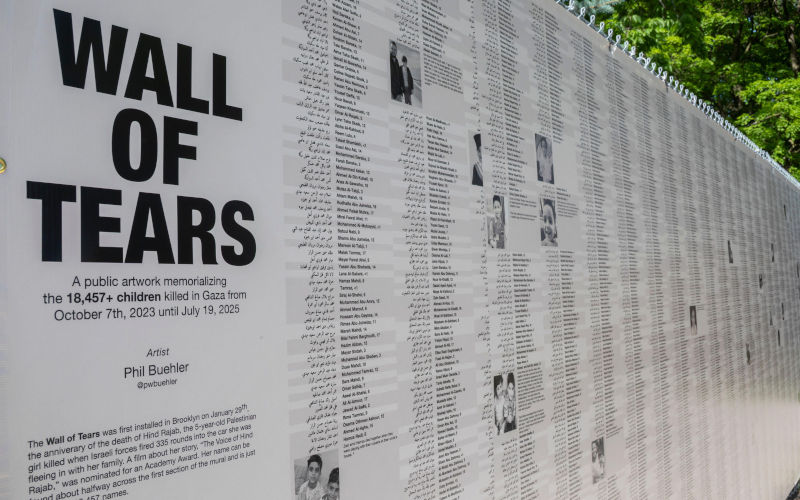
The Wall of Tears names more than 18,000 children killed in Gaza. Sue Wareham writes that remembering them should transcend politics, and that every child deserves dignity, accountability and commemoration.
The ‘Wall of Tears’ display, which lists the names of over 18,000 children killed in Gaza since October 2023, was recently displayed in Perth, including for a day in the WA Parliament.
At least two WA parliamentarians used the occasion to make personal attacks (reported by the ABC here) on those who simply want to remember these children and honour them with a name.
Children are war’s most vulnerable and hidden victims. They play no part in causing wars, suffer disproportionately from their ravages, and have no voice with which to end them.
It seems now that even remembering the children killed in Gaza is a step too far for some, perhaps because there are so many such children.
The following is an edited version of an open letter sent on 27 August from MAPW (Australia) to two WA parliamentarians, Mr Lachlan Hunter MLA and the Hon Simon Ehrenfeld MLC. The letter is published here.
This letter addresses some of the grave concerns held in relation to your comments on the Wall of Tears exhibition.
In the Legislative Council on 19 August, Simon Ehrenfeld said that the exhibition was propaganda against Israel and that “many of these children were used by Hamas as combatants in the war”.
While no evidence has been provided to support this claim, it is in any event irrelevant to the Wall of Tears exhibition. The capacity to grieve the killing of a child, or of over 18,000 children, should not depend on who did the killing. To attempt to excuse or downplay the killing of a child on the basis of claims such as Ehrenfeld’s is a deeply disturbing distortion of our most basic responsibilities towards society’s most vulnerable members.
The vulnerability of children during conflict is recognised under international humanitarian law, under which they retain special protection – because of their status as children – and every child’s death warrants investigation, accountability and commemoration.
Further, in the Legislative Assembly on 19 August, Lachlan Hunter MLA said that using the term genocide was antisemitic.
Mr Hunter must be aware that a UN Commission of Inquiry concluded in September 2025 that Israel is committing genocide in Gaza. That conclusion followed a detailed legal analysis under the Genocide Convention and identified four relevant genocidal acts, including killings, the infliction of serious physical or mental harm, the deliberate imposition of destructive living conditions and measures intended to prevent births.
Since January 2024 the International Court of Justice has also issued a series of binding provisional measures against Israel in the case brought by South Africa under the Genocide Convention.
If Mr Hunter questions high-level assessments by independent, reputable bodies, then he should challenge them through substantive argument rather than baseless claims.
In addition, Australia is a party to the Genocide Convention, whose parties undertake to prevent and punish genocide. That obligation requires Australians, including public officials, to be able to discuss and respond to credible allegations and findings of genocide. Mr Hunter’s comments risk preventing such discussion, suppressing vital evidence, eroding laws and norms, and limiting Australia’s ability to fulfil its obligations to prevent mass atrocity, wherever it occurs.
It is unacceptable for an Australian parliamentarian to undermine Australia’s international responsibilities in this manner.
Mr Hunter described the organisers of the Wall of Tears exhibition, Perth Doctors Medical Aid for Palestine, as engaged in preaching hate. This is a scurrilous and false accusation for which there is no evidence whatsoever.
The doctors’ purpose is the welfare of children, all children, in line with their professional obligations. Health professionals must use their expertise and influence to protect and advance the health of people and populations. In situations involving mass civilian harm, the collapse of health systems, and attacks on healthcare – such as in Gaza – health professionals must advocate, remind governments of their obligations, and oppose violations. Perth Doctors Medical Aid for Palestine are fulfilling this obligation.
Documenting and naming the dead is an important practice in social responses to atrocity. It has direct precedent in the commemoration of atrocities against Jewish people. Yad Vashem’s Hall of Names has spent seven decades identifying five million of the six million Jews murdered in the Holocaust, individually, by name. Yad Vashem describes this work as restoring the victims’ human identities against an intended erasure.
The Srebrenica Genocide Memorial lists by name the 8,372 people killed in July 1995, with each name read aloud every anniversary. Memorials in Cambodia, Bali, New York and around the world list atrocity victims by their names; a shared form of resistance to the reduction of individual lives to statistics.
When Australian parliamentarians judge the commemoration of the killing of children according to who the children are, our country is fast losing its moral compass.
Dr Sue Wareham OAM has spoken and written widely on peace and disarmament issues, and is President of the Medical Association for Prevention of War (Australia). She is a former Canberra GP. FB: @MAPWAustralia, T: @MAPW_Australia