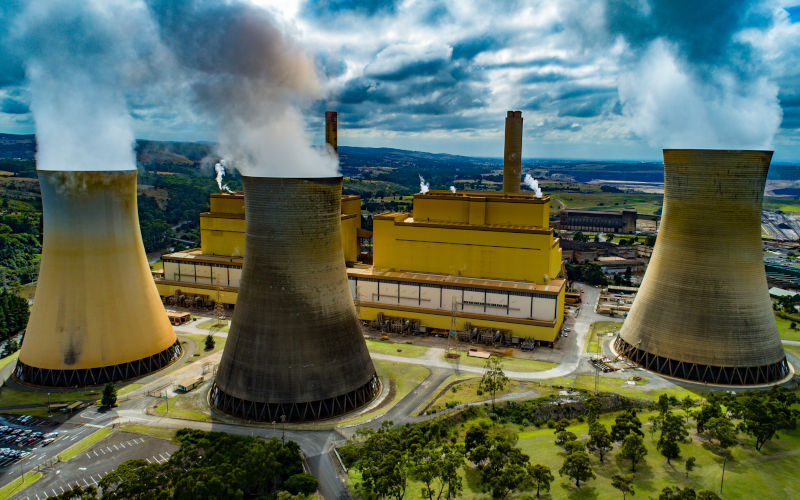
With the Yallourn power station closing and electricity demand rising, abandoning major renewable and transmission projects could add billions to Victoria’s power costs and leave new supply years behind.
Pledges by Victoria’s conservative opposition parties to review or roll back major energy policies of the present state Labor government would likely push up electricity prices by billions of dollars and require years to reset, renewable energy advocates say.
Stephanie Bashir, chief executive of Nexa Advisory, said households and businesses would pay significantly more for electricity if the government’s major transmission projects – VNI-West and the Western Renewables Link – were torn up as part of a retreat from renewables.
“If we do rely on gas and expensive generation as a backup because we’ve cancelled or are delaying renewables, we will end up with a $33 billion additional cost in wholesale [power prices] for Victoria alone,” Bashir told journalists in a Monday seminar organised by the Smart Energy Council and the Climate Media Centre.
“So staying the course is really critical in Victoria,” said Bashir, formerly a senior director, public policy, at AGL.
Tennant Reed, director for climate change and energy at the Australian Industry Group, said developing alternative supplies of energy for the state would not be easy, particularly as power demand was rising rapidly.
“It would be difficult to make major changes to the generation mix from the current plans within the next five years,” Reed told the journalists.
Part of the urgency is that the state’s second-largest plant, Energy Australia’s Yallourn brown coal-fired power station, remains slated to close by June 2028. The company on Monday confirmed it had no plans to alter the timetable.
The state Liberals have conceded that the state will need more gas if they won office and implemented plans to cancel VNI-West, among other projects. One Nation, whose popularity has soared to rival or exceed that of major parties in Victoria and nationally, said on Monday it would build new coal plants, invest in gas and lift a ban on nuclear energy if it secured government in the state.
Reed said Victoria had seen wholesale power prices in the state fall “very significantly from the peaks of a couple of years ago”, and had been lower than the rest of Australia for about five years. Fossil gas prices were also off 2022 “extremes”, in the wake of Russia’s invasion of Ukraine, and had tracked those of other states.
The rush to add new batteries at home and at utility scale had also driven expensive gas out of the power sector, with gas generation down 60 per cent between 2017 and 2025, according to a chart presented using AEMO data.
Residential use of gas in Victoria – the state that uses the most for heating – is down about a fifth in recent years, while industrial use was off 30 per cent, Reed said. Some of the latter’s decline was because some industrial users had shut down.
While political parties might pledge to lift gas output, actual resources in Victoria were limited, Reed said.
“We have produced most of the gas [in Bass Strait] that there ever was in that resource,” he said, adding that the potential for onshore conventional gas was “small relative to consumption”.
“If that gas was all there and if it was produced over a 30-year resource life, it would be quite a small additional increment of production relative to what consumption has been,” Reed said.
Reliability risks for the grid were also increasing, with Victoria attracting about 2.8 gigawatts of data-centre demand, according to proposals tracked by the Australian Energy Market Operator, Reed said.
“The moves by the federal government, in cooperation to some degree with the states, to require new data centres to bring new energy resources to market adequate to meet their new demand – that is quite an important thing to get right, to ensure we don’t have demand outpace supply,” he said.
Bashir said that regardless of the data centres coming online, AEMO was forecasting a shortfall due to the closure of Yallourn.
“Therefore, we do need the transmission to be built on time to avoid that shortfall,” she said. “The transmission is important because our reliance currently on the existing generation means we will require importing from other states to support us.”
An Energy Australia spokesperson reiterated that Yallourn would retire on 30 June 2028.
“We gave seven years’ notice so the market, AEMO and governments had time to prepare, and we’ve invested to keep the plant running reliably right through to retirement,” he said.
“Between now and 2028, our focus is on safe operations and supporting our people through the transition.”
The energy session also heard from Craig Henderson, a farmer from western Victoria who has spoken up elsewhere – including at Renew Economy – about intimidation and bullying landholders can face if they agree to host transmission lines and renewable energy projects on their properties.
Henderson said renewables-related investments would help slow or reverse the long-term decline in regional towns.
Yarriambiack shire, for instance, had lost 28 per cent of its businesses in the last 17 years, and Buloke shire had lost 12.7 per cent. Those drops compared with an increase of almost 42 per cent in the state’s businesses, he said.
The population in Yarriambiack shire – where the WestWind Energy project has lately won approval – has decreased about 15 per cent in 17 years during a time Victoria’s populace had grown by 43 per cent.
Buloke shire, meanwhile, had been receiving roughly $11.5 million annually in rates until a couple of years ago. “If they get all their projects up there’d be an additional $6 million,” he said. “So you can see the diversity of income coming into the shires that can help these financially starved areas.”
Opponents of these projects should be asked what other sources of investment would spur growth in regional populations and their economies, a point also made recently by Sam Coupland, mayor of Armidale in northern NSW.
“What’s the alternative to the capital and prosperity these projects would bring?” Henderson said. “They will bring jobs, mitigate risks to our agricultural businesses, diversify the rate base for our shires [and] local government, create legacy effects like construction of accommodation, medical and aged care.”
“How will we stop the loss of services, education facilities, availability for staff?” he said. “All these things will continue to deteriorate without these new projects.”
Republished from Renew Economy

Peter Hannam
Peter Hannam is a veteran journalist whose work spans almost four decades and includes stints outside Australia, including time in China, Japan, Singapore and Mongolia. He has lately reported extensively on energy, climate and environmental issues in Australia, and also worked for the federal Climate Change Authority as a special media advisor.