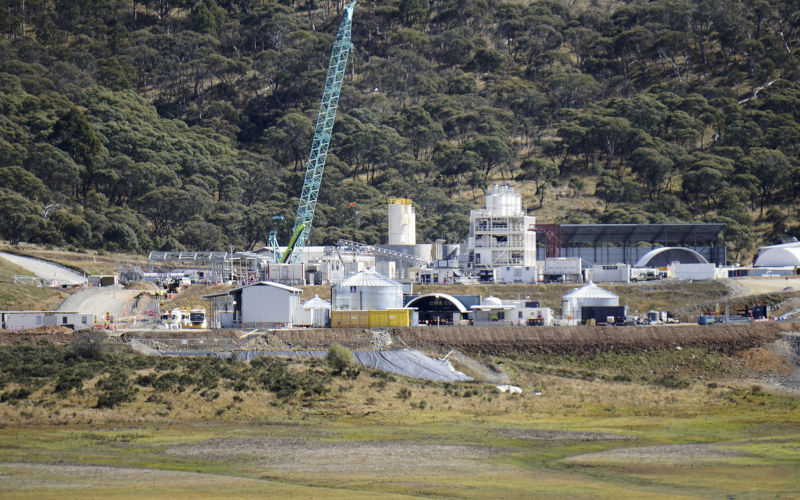
Snowy 2.0 has suffered huge cost increases and delays, but its vast storage capacity and long working life could still make it a valuable part of Australia’s renewable grid.
The final cost estimate for Snowy 2.0 has been released. The conversion of the original Snowy hydroelectric scheme to a large pumped hydro energy storage scheme will cost A$22–25 billion and will be completed in late 2029.
Much media coverage has focused on the major blowouts in cost and time. When the scheme was announced in 2017, then-prime minister Malcolm Turnbull gave a rough costing of just $2 billion – extremely low for a project this size – and said it could be finished in four years. Engineering issues, stalled tunnelling machines and surging construction costs all contributed to the blowouts.
The project has endured a remarkable amount of negative press, including from renewable energy advocates. Some of it is warranted – early cost estimates were overly optimistic. Some is debatable, such as claims it won’t work as advertised.
But let’s zoom out. Snowy 2.0 is about 80 per cent done. It will likely be finished within three years. Once up and running, it will convert the original Snowy scheme into a giant rechargeable battery, able to back up solar and wind overnight and during calm and cloudy weather. It will arrive in time to allow ageing coal plants to retire. Once up and running, it will last 150 years. $22 billion sounds like a lot – but it translates to about $5 per Australian per year of operation.
As more and more renewables enter Australia’s power grids, we will need much more energy storage. Building grid-scale batteries with the same energy storage as Snowy 2.0 would cost three times more than the final cost ($22 billion). But batteries last 20 years, while Snowy 2.0 will last for 150 years.
Why do we need so much energy storage?
Renewables currently provide about 50 per cent of the power in the National Electricity Market, Australia’s largest power grid. The government’s target is 82 per cent by 2030 (mostly solar and wind).
Reaching this goal will require much more storage. That’s because over half the demand for electricity is overnight (defined as 4pm to 8am). During these hours, solar output is minimal or non-existent. Wind provides some power, but not enough.
Coal plants currently meet most of the overnight demand. But Australia’s coal fleet is ageing rapidly and will not be replaced. Almost all will close over the next ten years.
How can we keep the lights on overnight as coal exits? We can use wind (which is intermittent), gas (expensive and responsible for high emissions), or store energy for use overnight and on cloudy days.
Energy storage has shot to prominence in recent years, driven by rapid falls in battery costs. Home batteries and battery-electric vehicles are surging in popularity with consumers.
In the grid, batteries are muscling in and taking a role once occupied by gas-powered plants to cover short spikes in demand. Because batteries can do this job more cheaply than gas, electricity costs are falling for everyone, not just the owners of batteries.
So why do we need pumped hydro?
Batteries are an increasingly cheap way to store energy short term, meaning minutes to hours. But they’re an expensive way to cover longer periods, such as overnight and during cloudy days.
This is where pumped hydro can help.
Pumped hydro turns a normal hydroelectric plant into a giant water battery. When power prices are low, water is pumped uphill to a high reservoir. When power prices rise, water is run downhill through turbines to produce power. These schemes excel at long-duration storage, as very large volumes of water can be kept in dams and released as needed.
Every year, Australia’s science agency, CSIRO, releases GenCost, an update on changes to the costs of all components of the clean energy transition.
The latest figures show pumped hydro can store and release power much more cheaply than batteries can. The cost advantage is highest now, but it will still be there in 10 and 20 years’ time. That’s because the steep falls in battery costs are expected to taper off.
Pumped hydro typically lasts five to ten times longer than batteries. Keeping water behind a rocky dam is an extremely cheap and durable way to store energy long term compared with extracting metals to make batteries. Pumped hydro also stimulates the local economy more than imported batteries do.
Time to take a longer view
Once up and running, Snowy 2.0 will roughly quadruple Australia’s total rechargeable electricity storage.
Behind the 45-metre-high wall of its upper reservoir, Tantangara, is up to 254 gigalitres of water. That’s about 50 per cent of the water in Sydney Harbour (500GL).
This enormous volume of water represents 350 gigawatt-hours of storage – the equivalent of the energy available in the batteries of seven million electric vehicles.
To stop climate change from worsening, we have to stop burning fossil fuels. To do that, we have to triple or quadruple how much electricity we produce so that we can electrify transport, heating, industry and other sectors.
Almost all of this new electricity will come from solar and wind. We will also need large-scale energy storage so renewable power can be released at night or as needed.
Energy storage is becoming a solved problem. Batteries and pumped hydro can do the job of storing power over shorter and longer periods.
As electrification gathers pace, Australia will need more pumped hydro projects – some as large as Snowy 2.0. The good news is that the technical issues and tunnelling problems Snowy 2.0 has faced have taught us a great deal about how to overcome them.
The key challenge the engineers of Snowy 2.0 faced is the need for a 27-kilometre-long tunnel. Australia has hundreds of excellent options for off-river pumped hydro sites between Brisbane and Melbourne, located close to transmission lines and away from national parks and rivers. These options require much shorter tunnels than Snowy 2.0, meaning they would be much quicker to build.
Snowy 2.0 is no longer a bargain. But it’s still a very good long-term investment.
It’s Australia’s first large hydro project for many decades. Much has been learned, and we now have a highly skilled workforce.
Like the Sydney Harbour Bridge, Snowy 2.0 will still be working a century after the controversy over cost blowouts is forgotten.
Republished from The Conversation

Andrew Blakers
Andrew Blakers (AO FAA FTSE FRSN) is Professor of Engineering at the Australian National University. He was winner of the 2026 Abdullah Bin Hamad Al-Attiyah International Energy Award for Lifetime Achievement for the Advancement of Renewables and the 2024 Clunies Ross Technology Innovation Award. He was joint winner of the 2023 Queen Elizabeth Prize (the top global engineering prize) for PERC solar cell technology.