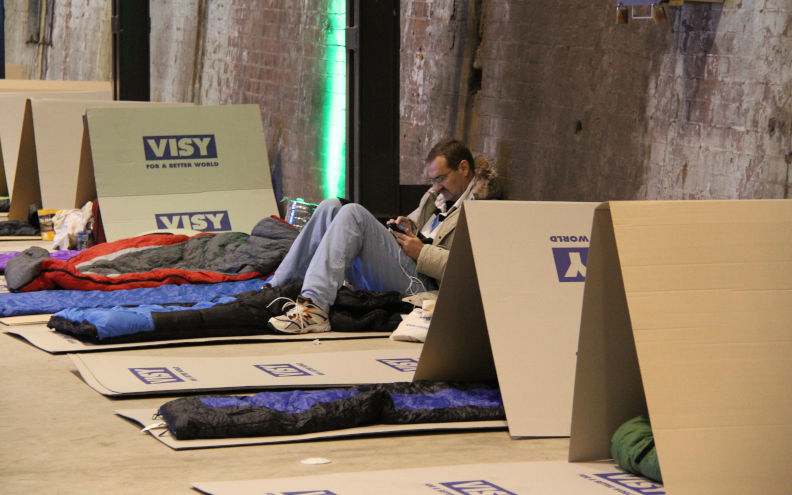
Fundraising sleepouts may raise awareness, but homelessness is fundamentally a systems failure driven by housing shortages, inadequate support services and political inaction.
I understand why events like CEO sleepouts exist. They raise money, generate media coverage, and bring homelessness into public conversation in ways that might not otherwise happen. Many participants are genuinely motivated, and some go on to become effective advocates for housing and homelessness reform.
But I have become increasingly uncomfortable with these campaigns; not because homelessness deserves less attention, but because I think we owe the issue far greater honesty. Honesty about what actually ends homelessness. Honesty about what counts as symbolism. And honesty about how certain awareness campaigns can quietly distort public understanding of the very problem they claim to address.
Sleeping outside for one night is not homelessness. It is a controlled simulation of discomfort. Participants know exactly when the event ends. They know they are returning home the next morning. They retain their income, their professional networks, their healthcare, their identity documents, their safety, and their housing security. The cold is temporary; the experience is bounded.
Real homelessness is not primarily about one difficult night. It is about chronic instability, accumulated trauma, and the exhausting work of surviving systems that are fragmented, underfunded, and often inaccessible. People experiencing homelessness have typically exhausted every available option before sleeping in a car, couch-surfing, staying in unsafe relationships, cycling through temporary accommodation, or sleeping rough – not as a choice, but because there is genuinely nowhere else to go.
It is also worth noting that most homelessness is invisible. The people captured in these statistics include those staying with friends because the rental market has no viable options, people moving between couches after escaping family violence, those living in caravan parks after sudden rent increases, people cycling between motels and temporary accommodation and those discharged from hospital into homelessness because health and housing systems remain fundamentally disconnected.
These experiences cannot be meaningfully replicated through a fundraising sleepout.
One of my deeper concerns is that campaigns like CEO sleepouts can, often unintentionally, frame homelessness as a charitable issue rather than a systems failure.
Australia does not have a compassion shortage. What we have is a housing shortage, a severe affordability crisis, fragmented service systems, chronic underinvestment in prevention, and support services operating under demand levels they were never funded to absorb. Increasingly, we also have governments and institutions that appear more comfortable managing homelessness than ending it.
That distinction matters enormously. When homelessness becomes primarily associated with charity campaigns, public attention can drift away from the structural reforms that are actually required – significant increases in social and affordable housing supply; properly resourced supportive housing models; genuine investment in prevention and early intervention; integrated health and homelessness responses; adequate income support; tenancy sustainment programs; and coordinated, outcomes-focused systems with measurable targets
Fundraising has a role. Services need resources. Communities want to contribute. But charity cannot substitute for policy, and symbolism cannot substitute for reform.
There is also a deeper problem with how these campaigns position people. Media coverage typically centres executives and senior leaders: their discomfort, their reflections, their courage for participating. Meanwhile, the voices of people with actual lived experience of homelessness are secondary: cited, perhaps, but rarely given meaningful power.
People with lived experience are too often invited to share their trauma but not their expertise. They become subjects of storytelling rather than leaders in system design, policy development, or institutional decision-making. At the same time, highly visible corporate participation can function as a form of social performance, in which organisations receive reputational benefit simply for engaging in symbolic acts of empathy, without being held to any meaningful standard of accountability for change.
These campaigns invite harder questions than they typically ask: are we centring lived expertise or corporate visibility? Are we genuinely educating the public, or are we simplifying an issue that demands complexity? And are we building sustained pressure for structural reform, or are we generating annual awareness cycles that feel good but change little?
Awareness without structural change eventually becomes repetition.
The uncomfortable truth is that Australia already knows homelessness exists. The public sees it daily. What we lack is not awareness, it is sustained political urgency and the institutional courage to act proportionately to the scale of the problem.
Many of the required solutions are well understood and increasingly well evidenced:
- Housing First approaches that prioritise stable housing as the foundation for all other outcomes;
- supportive housing with integrated wraparound services;
- coordinated By-Name Lists that track every person experiencing homelessness and drive active case management;
- integrated health and homelessness responses;
- genuine prevention and early intervention systems;
- robust data infrastructure and clear accountability frameworks; and
- measurable reduction targets with government commitment
The evidence exists internationally and, increasingly, within Australia. The barrier is not knowledge, it is will. And a CEO sleeping on a footpath for a single night does very little to generate the political will this problem requires.
I am not arguing that people should care less about homelessness. I am arguing that caring is not enough, and that we should stop treating symbolic expressions of empathy as meaningful contributions to ending it.
If CEOs and corporate leaders genuinely want to make a difference, there is a more meaningful agenda available to them:
The should publicly advocate for significant housing investment and the policy reforms that would produce it, and use institutional influence to back supportive housing developments in your communities. The should hold governments accountable for measurable homelessness reduction targets, and invest in lived-experience leadership rather than treating people who have experienced homelessness as props in awareness campaigns. And the should demand systems capable of ending homelessness – not merely managing it indefinitely
Homelessness will not end through annual gestures of empathy. It will end when housing is treated as essential infrastructure, when prevention matters as much as crisis response, when systems are designed to collaborate rather than compete, and when governments are finally willing to make decisions proportionate to the scale and urgency of the crisis.
I am less interested in symbolic discomfort than in structural courage. We should be demanding far more than caring. We should be demanding change.

Fabian Webber
Fabian Webber is a community-sector leader dedicated to driving systemic change across housing, health, and homelessness in Central Queensland. As Program Development Manager at Roseberry Qld and Project Lead for the region’s CQ Zero initiative, he champions data-driven, person-centred approaches to ending homelessness, integrating Advance to Zero methodology with strong place-based collaboration. Fabian also serves as Chair of the CQ Housing & Homelessness Alliance, working closely with local councils, health services, and government partners to strengthen coordination, influence policy, and expand regional housing solutions.