The federal budget increases investment in emissions reduction, batteries and clean energy infrastructure, but leaves major fossil fuel tax concessions and gas industry profits largely untouched.
The Federal Budget looks to be a well-crafted effort at trying to balance multiple competing challenges.
It provides some serious momentum on tax reform, by reducing capital gains tax concessions and introducing a new 30 per cent tax on discretionary trusts, closing a massive loophole at the top end of Australia’s wealth scale. The budget restrains spending growth (particularly the NDIS), whilst funding more military, First Nations ($1.2 billion) and health system spending. It is also investing to build new housing supply to reduce the massive intergenerational inequity of the housing crisis. All of this while trying to prevent a systemic increase in public indebtedness over the longer term. Additionally, there was a fair investment in measures to reduce the immediate costs relating to Trump’s war on Iran and the resulting threat of Australia’s exposure to now hyperinflationary and scarce fossil fuel imports.
On the face of it, there was little excitement for those of us focused on the growing climate crisis and need for greater investment in speed and scale of climate solutions – principal among these an acceleration of our transition to clean, low-cost renewable energy. There was a key theme: lots of budget allocations to sustain our addiction to imported fossil fuels, no big measures to better tax the war-profiteers in the gas industry or pivot to permanent, domestic zero-emissions solutions.
Unfortunately, a new 25 per cent levy on LNG exports was ruled out pre-budget, as was long overdue reform of the $11 billion annual imported diesel fuel rebate – jettisoned to appease fossil fuel and mining vested interests.
Meanwhile, the Petroleum Resource Rent Tax (PRRT) continues to fail to deliver, despite global LNG prices doubling since Trump’s war started, and is forecast to generate a pathetic A$1.6 billion per annum over the four years to 2029. This budget lets the gas multinationals keep their war profiteering gains, socialising the costs of fossil fuel extraction, privatising and offshoring the gains. And we continue to pour $19 billion each year into subsidising fossil fuels.
The budget does include a new $7.5 billion Fossil Fuel and Fertiliser Security Facility plus a $3.2 billion Australian Fuel Reserve in response to the massive and ongoing imported energy security threat to Australia this latest war has highlighted, whilst the government had already announced a three month 60 per cent cut to imported diesel and petrol excises as a temporary cost of living relief measure.
The Treasurer referenced again that we should expect reform of the superannuation performance test. We entirely agree. This simple reform is key to unlocking clean energy infrastructure investment capacity from the $4.5 trillion in funds held in super. We are currently relying on foreign investor capital to fund the majority of flows into Australian renewables, and yet the Treasurer has just imposed a new tax to undermine foreign investment here. We need to leverage capital to boost our decarbonisation progress, not raise new barriers.
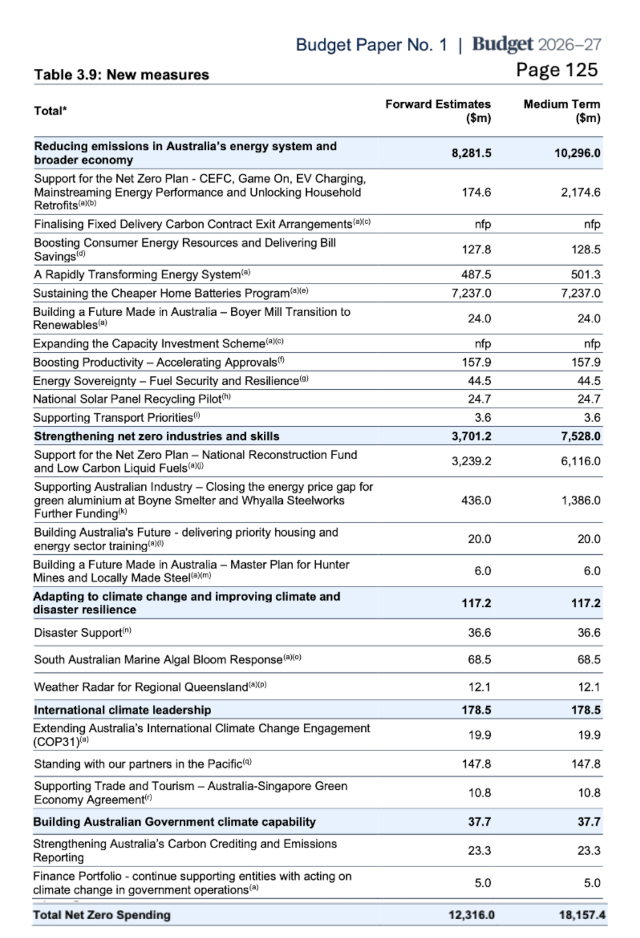
But before those of us focused on the climate crisis get too despondent, it is pleasing to see almost hidden on pages 121-127 of Budget Papers that when the December 2025 MYEFO and 2026 Budget are put together (admittedly, this was almost all in MYEFO 2025), Treasurer Jim Chalmers has invested another $12.3 billion over the forward estimates in new emissions reduction endeavours this past year. This builds on the $6.9 billion in the 2025 Budget, the $24.3 billion in the 2024 Budget, the $4.6 billion in the 2023 Budget and $24.9 billion in the October 2022 Budget.
An additional $12.3 billion is a material uplift on the Albanese Government’s series of investments and budget allocations. Now the single largest item is the $7.2 billion Cheaper Home Batteries Program – a raging success, with 390,000 home and small business battery deployments totalling 11 gigawatt hours (GWh) of cumulative storage added to our national grid in just 10 months. Batteries are now the key price setter in our electricity system and driving electricity prices substantially down for all.
Over the next decade, this Budget (plus MYEFO 2025) adds $18.2 billion of gross new funding to emissions reductions spend, with two-thirds of this in the forward estimates. Deceptively, the $2-3 billion of cuts are reported elsewhere and accidentally left out here. Major identifiable items include:
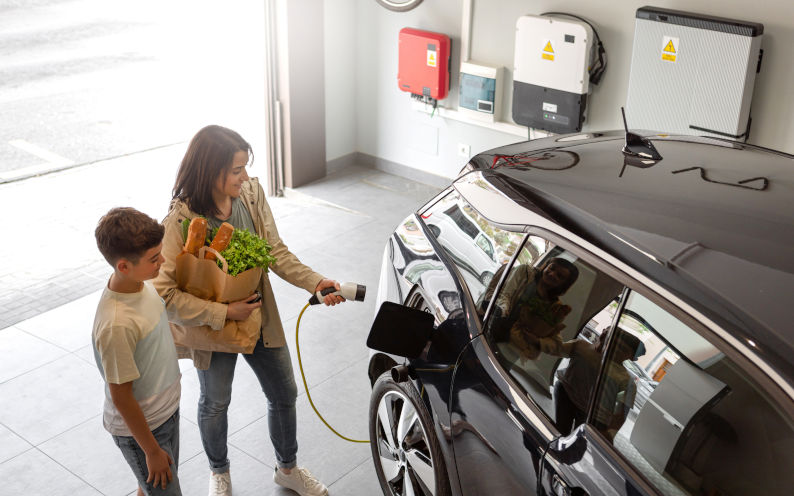
- $40 million for extra EV charging. This needs to be lifted tenfold, or even a hundred-fold!
- $2.1 billion additional combined new funding for the CEFC, mainstreaming energy performance and unlocking household retrofits. This figure is gross of the $1.9 billion sensibly cut from the Hydrogen Headstart set aside in previous budgets, and we’ll probably see further cuts on green hydrogen next year as well, given reality has now replaced hopium on commercialisation timeframes;
- $1.1 billion in new funding for low carbon liquid fuel;
- $5 billion to cover the cost over the coming decade of lowering the hurdle rate for the National Reconstruction Fund Corporation’s $5 billion Net Zero Fund (to 1 per cent below the cost of debt), plus the funding cost on $1 billion of interest free loans to offset the skyrocketing cost of imported diesel;
- $2 billion to decarbonise Rio Tinto’s Boyne smelter (shared with the Queensland government);
- $223 million extra funding down the drain for Sanjeev Gupta’s Whyalla Steelworks debacle;
- $501 million extra for rapidly transforming the energy system;
- $158 million for accelerating net zero approvals;
- $148 million for standing with our partners in the Pacific and delivering on Australia’s COP31 role;
- $23 million for strengthening our carbon crediting and emissions reporting systems. We absolutely need greater integrity on carbon pricing, and hopefully in the Safeguard Mechanism review later in 2026, we’ll see a new legislated Australian Carbon Credit Unit (ACCU) price floor that progressively ratchets up ahead of inflation); and
- $117 million more funding to cover some of the rapidly rising cost we all bear of the climate crisis, namely $37 million for disaster support, $12 million for weather radars and $69 million to address algal bloom.
Prior to this budget, we have tracked $82 billion of budget and capital allocations to Future Made in Australia (FMIA) into cleantech, decarbonisation, electrification and resource value-adding by the Albanese government since 2023, plus another $8 billion of budget allocations across the states. We tracked $15 billion of deployment of this capital in calendar year 2025, as well as another $6 billion year-to-date in 2026. The pace of capital deployments has definitely lifted in the last 18 months.
Nevertheless, Australia needs to go much faster, and with greater scale, and until we get a whole-of-economy carbon price rising significantly over time, taxpayers will have to fund the bulk of national interest investment in decarbonising our energy supply and industry. We need to think ‘China speed, China scale’ to realistically align with climate science, and leverage the massive investment, employment and export opportunities as we position ourselves in the emerging global net zero world economy.
The cost of not doing so is untenable, and will be mostly felt by future generations, undermining the goal of intergenerational equity – a feature of this Budget that needs to be central to every Australian Budget going forward.
Tim Buckley
Tim Buckley is director of leading independent think tank Climate Energy Finance (CEF) and a former MD of global investment bank Citigroup.
Blair Palese
Blair Palese is founder of the Climate Capital Forum, Director of Philanthropy at Ethinvest, and was previously named one of The Australian’s Top 100 Green Energy Players.