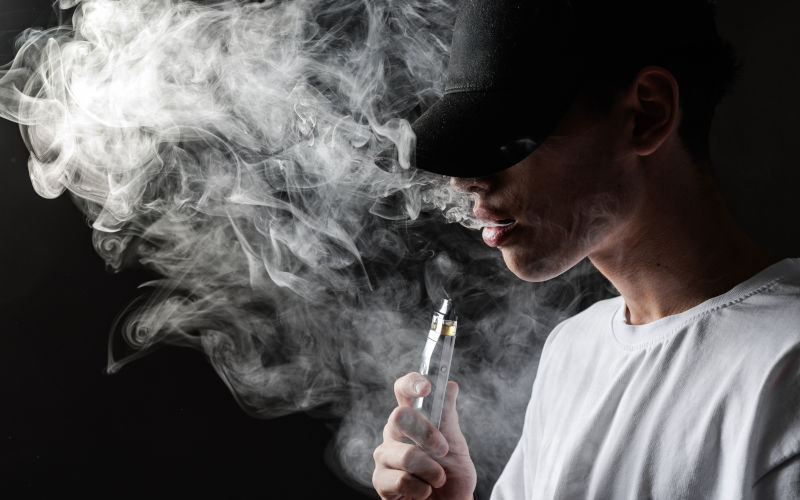
Australia’s sky-high cigarette excise and severely restricted legal access to vaping have helped fuel a vast illegal nicotine market, undermining public health, law enforcement and government revenue.
Things that can’t go on forever, don’t. Australia’s sky high cigarette excise and absurdly restricted availability of safer vaping can’t go on forever.
Australia’s tobacco control policy should primarily aim to reduce its 24,000 smoking-related deaths per year as fast as possible. This requires rapidly reducing smoking rates. For some years, Australia has pursued a policy that has been, by international standards, both extremely radical and extremely hegemonic in that Australian governments, the health establishment and most mainstream media all sang from the same song sheet.
Current tobacco control policy relies heavily on exorbitant cigarette excise and severely restricting the availability of nicotine vapes. For some years, both these policies have had catastrophic unintended consequences.
Thanks to a 282 per cent increase in cigarette excise since 2013, Australia’s legal cigarettes are among the most expensive in the world. This steep increase has been accompanied by a boom in the illegal supply of cigarettes. The Illegal Tobacco and E-Cigarette (ITEC) Commissioner estimated that 50-60 per cent of cigarettes and 95.7 per cent of vapes in Australia are now supplied illegally.
More recently, the Australian Bureau of Statistics estimated that 80 per cent of nicotine in Australia is provided by illegal sources. Extortion and arson of cigarette retailers is now rampant. Rates of insurance for premises damaged by arson, and sometimes also for neighbouring shops, are now exorbitant. Six homicides are alleged including an uninvolved bystander trapped in a house set on fire in error.
The shift to black market cigarettes now punches a $7-12 billion hole in the annual federal budget. These unintended consequences are unacceptable and politically unsustainable.
The core problem for vape policy in Australia has always been that cigarettes, which kill up to two out of every three long-term smokers, are readily available while much safer (but not completely safe) vapes are almost impossible to buy legally. Yet the highly regarded Cochrane review finds high certainty evidence that smokers are more likely to quit by vaping nicotine rather than by using the gold standard quit smoking aid, nicotine replacement therapy.
Many studies in various countries of smokers who managed to quit have found that the most popular quit smoking aid was vaping nicotine. The combination of the high effectiveness of vapes as quit smoking aids in association with their impressive popularity is the reason why smoke-free nicotine products have generally had such a spectacular impact on reducing smoking in populations.
When there is strong demand for a commodity but its legal supply is banned or severely restricted, supply almost always shifts to illegal sources, as is occurring with both cigarettes and vapes. Yet Ministers and the health establishment continue to assert that law enforcement will stop cigarettes, tobacco and vapes entering the country and being distributed. Only about 1 per cent of containers entering Australia are X-rayed. How can law enforcement make a difference to the availability of illegal cigarettes, tobacco and vapes now flooding into Australia? Supporters of current policy advocate a law enforcement ‘crackdown’. But what does that mean when Australia’s borders are so porous? What happens to the Australian economy when our ports are frozen by X-raying enough containers to make a real difference?
Vaping opponents say Australia’s tobacco control is working and point to the recently released National Drug Strategy Household Survey (NDSHS) estimate that daily smoking in adults (+18 years) in 2025 was 5.8 per cent, compared to 8.8 per cent in 2022-23, and 20.1 per cent in 2001. The 2025 NDSHS results may be reliable and the NDSHS is highly regarded, but how confident can we be of the 2025 results when most of the cigarette market is now illegal? Also, some other recent large surveys suggest smoking may be increasing.
Another worry is that nicotine in Australian wastewater has increased 40 per cent since 2017 (while our population has only increased 14 per cent since 2017). Moreover, in a number of countries where vaping or other smoke-free nicotine products are popular, smoking rates plummeted. So it may be that the NDSHS results are accurate but vaping contributed greatly to the decline in smoking?
Since 2014, a number of international tobacco companies have been transforming from combustible cigarettes to safer, smoke-free nicotine products. According to tobacco company official reports to financial regulators, by 2025 these products accounted for 42 per cent and 18 per cent of the revenue earned by Philip Moṟris International (PMI) and British American Tobacco (BAT) respectively, the world’s largest and second largest traded tobacco companies. PMI say they are on track to achieve 66 per cent of their revenue earned from smoke-free nicotine products by 2030. Cigarettes will soon be obsolete. Tobacco companies relying on selling cigarettes risk going broke. PMI’s cigarette shipment volume (billion units) decreased 33 per cent from 927 in 2012 to 617 in 2024 while their shipment volume (billion units) of smoke-free heated tobacco products increased 1,900 per cent from seven in 2016 to 140 in 2024. This transformation of the tobacco industry is now rapid and accelerating.
It is now as inevitable that smoke-free nicotine products will replace combustible cigarettes as electric vehicles will replace cars powered by internal combustion engines.
Yet the ridiculous arguments in favour of supporting Australia’s extremist policies continue. It’s time Australia added to its tobacco control policies a reduction in cigarette excise to levels low-income smokers can afford. This will reduce the black market and its associated criminal activity and, in time, increase government revenue. With a smaller black market, law enforcement will be more effective. Also, lifting restrictions on access to smoke-free products with age restrictions equal to cigarettes will put into practice the commitment to harm reduction that has been such a successful cornerstone of Australian public health policy.

Dr Alex Wodak, AM, is a physician and has been a Director of the Alcohol and Drug Service at Sydney’s St Vincent’s Hospital, President of the Australia Drug Law Reform Foundation, Board Member of Australia21 & the Australian Tobacco Harm Reduction Association.
Emeritus Consultant, st Vincent’s Hospital, Darlinghurst, NSW, 2010 Tobacco Harm Reduction Adviser to the Harm Reduction Australia Board.