
Australia’s 40-year economic outlook rests on a productivity rebound that may never arrive. Without it, governments face bigger deficits and harder choices about funding the services Australians need.
The main purpose of the Intergenerational Report (IGR) is to consider the longer-term economic and fiscal challenges facing the government budget over the next 40 years.
The economic projections underpinning the IGR are based on Treasury’s assessment of the outlook for population growth, labour force participation and productivity, while the budget projections reflect Treasury’s assessment of the financial implications if the government’s present policies are maintained.
On this basis the key assumptions underpinning the recently released IGR are:
- Population growth is expected to be 0.9 per cent per year over the next 40 years, down from 1.4 per cent over the past 40 years.
- The population is expected to age, with the number of Australians aged 65 and over almost doubling, and fertility gradually declining to 1.34 children by 2065-66. Population growth will therefore be almost entirely dependent on net overseas migration, which is assumed to be 235,000 per year over the long run.
- Labour force participation is projected to continue to rise, but more slowly than in the past, reflecting increases among women and older Australians.
- The long-run increase in productivity is assumed to be 1.2 per cent per year – the same as the previous IGR in 2023. The main justification is the adoption of AI and Australia’s cost advantage in producing and using renewable energy.
Based on these assumptions, real GDP is projected to grow at an average annual rate of 2 per cent over the next 40 years, lower than the average of 3 per cent over the past 40 years. Nevertheless, by the end of the IGR projections, the real Australian economy is projected to be more than twice the size and living standards to be 55 per cent higher than today.
However, the budget would remain in deficit throughout the next 40 years, with the deficit falling to 0.3 per cent of GDP in 2036-37 before increasing again to 1.8 per cent of GDP in 2065-66. Gross government debt is projected to decline from 33.1 per cent of GDP in 2025-26 to a low of 22.2 per cent in the mid-2050s, before rising again to 27.4 per cent by 2065-66.
The overall tone of the IGR is that this would represent quite a good outcome, especially compared to the rest of the developed world. But that raises the question of how credible these projections are.
Productivity growth
As the IGR says, “Productivity growth is the key driver of living standards”, but then goes on to acknowledge, productivity growth “has slowed across advanced economies since the mid-2000s, including Australia”.
The IGR then contains an extensive discussion about what governments can do to encourage faster productivity growth, such as facilitating innovation, supporting investment, the development of human capital and skills matching, and regulatory reforms that improve the operation of the economy.
While these policies should be supported, experience is that they only make a marginal difference to the rate of productivity growth. The fact is that throughout history productivity growth has largely been driven by new technologies, such as steam power, electricity, automation and the internet. Indeed, as the IGR itself acknowledges, Australia’s periods of stronger productivity growth often coincide with the emergence and diffusion of general-purpose technologies.
Furthermore, if government policies could make much difference we would find much more difference between the productivity growth rates in different countries. But as Table 1 below shows, the rate of productivity growth has slowed by much the same amount among all the developed countries over the last 30 years, and that is because they all adopt the same new technologies at much the same time and rate.
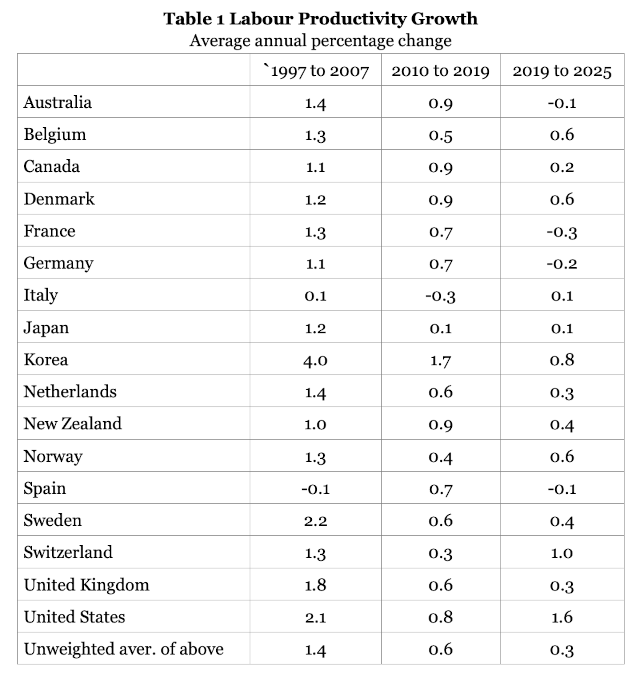
Looking ahead, it is therefore somewhat surprising that the IGR has assumed that over the next 40 years the annual rate of productivity growth in Australia will average 1.2 per cent. That is much faster than over the last 15 years, and especially faster than since 2019.
While the IGR acknowledges that the long-term outlook for productivity is subject to considerable uncertainty, the IGR seeks to justify its productivity assumption by stating that it “is within the range of those used by other advanced economies” – hardly convincing.
The best reason for expecting some pick-up in the rate of productivity growth is the take-up of AI, which certainly has the potential to lift productivity. Indeed, it is interesting that the only country that has lifted its productivity growth rate in recent years is the US, which is very much the leader in introducing AI.
In addition, as the IGR notes, Australia’s comparative advantage in the production and use of green energy could also help lift Australia’s productivity performance.
Nevertheless, it is risky to assume that Australia’s productivity growth rate will average as much as 1.2 per cent over the next 40 years. The IGR says that the Productivity Commission has estimated that AI could increase multi-factor productivity in Australia by at least 2.3 per cent over a decade, but that is well short of an average annual rate of 1.2 per cent increase over 40 years.
It will take around 10 years for AI to reach its peak, and unless there is another major innovation AI will have a diminishing impact on productivity in the last 15 years or so before 2065-66. Also, as the IGR notes, productivity gains are harder to identify in service industries which are labour intensive, but the IGR is projecting that the share of these service industries will increase which will lower the annual overall rate of productivity increase.
To its credit, the IGR does provide some productivity sensitivity analysis, which identifies the impact of lower productivity growth. That sensitivity analysis shows that if productivity only grew at an average annual rate of 0.4 per cent less than the baseline projection, then the budget deficit in 2065-66 would be more than 4 per cent of GDP, compared to only 1.8 per cent under the baseline scenario. In addition, for the same reasons the gross government debt would be around 57 per cent of GDP compared to only around 28 per cent under the baseline scenario. These are very substantial differences, and their implications merit more consideration than they receive in the IGR.
Policy assumptions
As noted above, the budget projections in the IGR reflect Treasury’s assessment of the financial implications if the government’s present policies are maintained, although an arbitrary ceiling is imposed on the amount of tax revenue. However, that begs the question of how realistic it is to assume that these policies can or will be maintained.
Instead, a more realistic assessment would be based on an in-depth assessment of how much is needed to adequately fund the cost of meeting the government’s future service and assistance obligations.
For example, it is not difficult to identify areas that are presently under-funded, such as higher education, schools, combatting climate change, defence and foreign aid and diplomacy.
In addition, experience shows that a few major economic shocks to the economy should be expected over the next 40 years. The IGR projections ignore this likelihood and do not allow the government enough room to properly respond to these shocks. Instead, to be able to properly respond to the inevitable future shocks the government needs to plan to return to a balanced budget or even a small surplus sooner rather than later.
Finally, one other policy assumption that gets insufficient attention in this latest IGR is the importance of migration. At present the policy debate nationally in Australia is all about how to reduce migration, but as the IGR makes clear we are looking at a future where the population will be ageing significantly and will actually fall without migration. In short, we would have major difficulties in maintaining our living standards in the years ahead without substantial numbers of migrants.
The IGR is a paean of praise for the government that is too complacent, or even too optimistic. Australia will require a proper consideration of how much additional revenue will be needed for the government to adequately meet its responsibilities, rather than the assumption of an arbitrary tax ceiling.
Furthermore, it should be understood that raising the necessary additional revenue need not damage economic growth, as Australia would still have a lower rate of taxation than almost all other OECD countries. What matters is how the additional revenue is raised.

Michael Keating is a former Secretary of the Departments of Prime Minister and Cabinet, Finance and Employment, and Industrial Relations. He is presently a visiting fellow at the Australian National University.