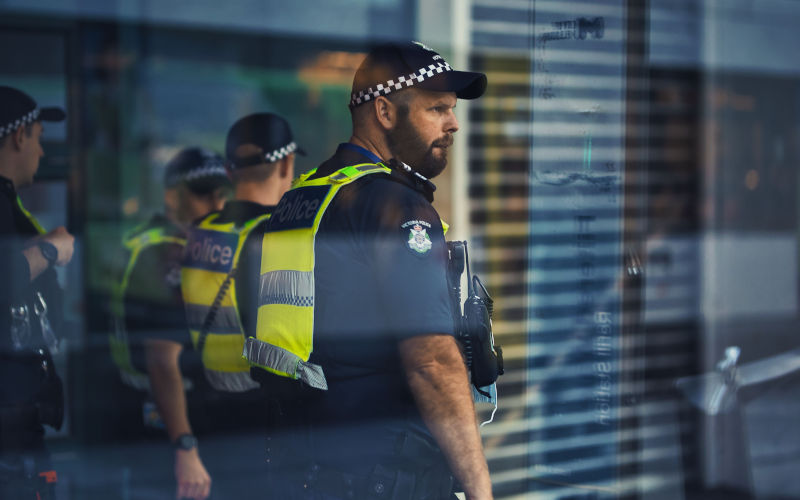
The Victorian Government relies too heavily on policing as the default solution to every social issue and is granting the police unchecked powers.
The Allan Government has again invested in cops instead of care. The police are big winners in the recent Victorian state budget, with an eye-watering $137.7 million allocated to resource them. This is instead of grappling with what causes people to come into contact with police in the first place.
Victoria has become the most heavily policed state in Australia after a two-decade ‘tough on crime’ rivalry between Labor and Liberal governments. The Allan Government continues to hand ever-expanding powers to police and give the greenlight to discriminatory policing. Police are permitted to exercise increasing powers unchecked, with the political will to create long overdue independent oversight of police still lacking.
In recent weeks, concerns have been raised about inappropriate use of tasers by police. This follows shocking revelations of racial profiling by police. Research released late last year by the Centre Against Racial Profiling confirmed what communities have said for decades about being subjected to over-policing and racist interactions with the police.
The racial profiling data showed that Aboriginal or Torres Strait Islander people were 15 times more likely to be searched by police than white people but were less likely to be found with prohibited items. Indigenous people were 10 times more likely to have force, or the threat of force, and 13 times more likely to have tasers, or the threat of tasers, used against them. The Centre Against Racial Profiling data also revealed disproportionate searches of, and use of force against, African, Middle Eastern and Pacific Islander communities.
Alarmingly, this racial profiling data showed that Victoria Police can pose a direct threat and danger. It demonstrates a pattern of Victoria Police exercising a range of their powers in a deeply discriminatory way and calls into question compliance with Victoria’s own Charter of Human Rights, which provides for the right to equality before the law and the right to liberty and security of the person.
In the same few days that this racial profiling data was released, it was revealed that Victoria Police did not comply with the law when it used wide-ranging powers to search people on 23 separate occasions dating back eight years, and that potentially hundreds of people were searched without authorisation. It was also exposed that Victoria Police installed at least 115 listening devices in prisons between 2000 and 2018 without the proper legal authority.
Also, just last year, the Harm in the Name of Safety report presented damning testimony about the nature of harmful and ineffective police responses to family violence, and the limited pathways for people impacted by this policing to seek satisfactory recourse. The report documented evidence from 225 Victorian family violence workers and found that harmful family violence policing practices are extremely frequent and widespread across the state.
Police should never be given a free pass for misconduct. While the Independent Broadbased Anti-Corruption Commission (IBAC) has the power to investigate police complaints, in practice, the overwhelming majority of complaints made by the public are sent back to the police for investigation. While inroads have been made in recent years, the status quo of impunity, whereby police investigate the actions of other police must end – Victoria needs an independent Police Ombudsman now. It needs a mechanism that can hold police to account. This has been a key call of the Yoorrook Justice Commission, the families of loved ones who have been killed in custody and Aboriginal and Torres Strait Islander, as well as human rights and legal experts. So long as police have the power to investigate the actions of their colleagues, police will continue to dodge accountability for misconduct and misuse of power. Such accountability and transparency are integral, particularly at a time when Victoria Police is processing Freedom of Information requests slower than at any point in its history.
Earlier this year, the Federal Court ruled that Victoria Police’s declaration of the entire Melbourne CBD as a ‘designated area’ in which they had extraordinary powers to stop and search people for no reason was unlawful, and that Victoria Police did not give proper consideration to Victoria’s own human rights laws. This followed landmark litigation where the Supreme Court of Victoria found that Victoria Police officers’ use of force against protesters was not justifiable or proportionate, and that their actions breached the state’s human rights laws. Together, these cases highlight how legal action is one of the only real tools available to hold police to account for trampling on people’s human rights.
Respect for human rights does not, however, appear high on the list of priorities for the Allan Government. It has previously pushed through laws to give police increased powers to lay their hands on children in order to search them, while admitting these were incompatible with Victoria’s own human rights protections. This is at a time when so-called ‘Protective’ Services Officers (PSOs) have also been handed more money. Essentially a quasi-police force, PSOs have alarming powers to carry weapons, arrest people and be deployed beyond train stations into shopping centres after a mere 12 weeks of training.
All this is set against the backdrop of a state experiencing a government-manufactured mass imprisonment crisis, with people being pipelined into police cells at escalating rates. Regressive reform of the state’s bail laws is resulting in skyrocketing numbers of people being warehoused in cruel and degrading conditions in police cells across the state.
The Victorian Aboriginal Legal Service characterised the recent Victorian state budget as prioritising ‘fiscal injustice and bad policy’. As has been previously said by their Chief Executive Officer and Yorta Yorta and Narrandjeri lawyer Nerita Waight: “Melbourne is becoming a police state, with excessive layers of control and surveillance – based on a culture of fear and in the absence of implementing effective supports and services.”
The Allan Government must end the bottomless spending on police and the status quo of police dodging accountability for their actions. Beyond this, governments across the country must stop relying on policing as the default solution to every social issue. Instead of pouring money into policing, governments must support alternatives that build up communities and help people avoid contact with, and criminalisation by, police altogether.

Monique Hurley
Monique Hurley is an Associate Legal Director at the Human Rights Law Centre, a community legal centre focused on driving systemic change.