Civil society groups are increasingly pressing governments to turn Australia’s international legal commitments into domestic law, policy and accountability.
With international laws and norms being shredded before our eyes, there’s an unprecedented upsurge of Australian concern about how to enforce, preserve, or replace them.
One question commonly heard in groups concerned about social issues is ‘how can we attract young people?’ Another is ‘how can we join up and get our message across?’ The answer to those questions is we can, and progressive Australians of all ages are now doing that in growing numbers.
People are making clear their opposition to warmongering, AUKUS, nuclear proliferation, inequality, government secrecy, the erosion of sovereignty and continued damage to the climate. Their unanswered question is: how can we get government to listen and put an end to these policies?
Several recent initiatives show how Australians who resist being insulted (by One Nation), ignored (between elections by governments), and deplatformed (by the legacy media all the time) are coming together to say so.
In June, Australians for Humanity gathered at NSW Parliament House to hear from Bob Carr, Chris Sidoti, and Rawan Arraf about how far Australia has recently fallen behind our former aspirations for universal equality, and how urgently we need a federal human rights act. A packed house of people concerned about the horrors being inflicted on others far away was unusual and positive. Often present in recent crowds like this are Shaoquett Moselmane, Ed Husic, and Senator Fatima Payman, who have all been sidelined by their parties in two parliaments for their advocacy on behalf of marginalised Muslim Australians.
In September, hundreds of Australians supported a Red Lines Package Omnibus Bill of measures for government to insert into Australian legislation on our undertakings in international law and conventions so that Australia doesn’t fund, arm, or invest in illegal settlements, war crimes, or genocide, anywhere in the world. Greens Senator David Shoebridge warned that government would not consider it, and he was right, but he told the gathering at Parliament House that this was only the first skirmish in a long fight and urged them not to drop the Red Lines campaign. He was joined by other co-sponsors: independent MPs Dr Sophie Scamps and Andrew Wilkie, independent Senators David Pocock, Fatima Payman, and Lidia Thorpe, and Greens Senator Mehreen Faruqi.
In October, supporters of the Sydney Peace Prize celebrated a couple of wins. First, former UN High Commissioner for Human Rights Judge Navi Pillay, who was the committee’s 2025 choice, and who is recognised (though not by President Trump, who doesn’t know ‘who this woman is’) for her lifelong advocacy of human rights and her fidelity to international law, was awarded the Nobel Peace Prize in 2026. Second, Australian human rights lawyer Jennifer Robinson will accept the Sydney Peace Prize for 2026.
The Australia Palestine Advocacy Network has an active program urging that Australia should no longer fund, arm, or invest in illegal settlements, war crimes, or genocide anywhere in the world. As well, the Jewish Council of Australia has announced plans to bring Molly Crabapple, prominent American author, artist, and journalist, to Australia in November to enlighten audiences in Sydney and Melbourne about a revolutionary Jewish movement of the past. Other civil society groups, including the International Campaign Against Nuclear Weapons (ICAN), the International Peaceful Australia Network (IPAN), and the Medical Association for the Prevention of War (MAPW) bring many of the same people together with lots more Australians who share their concerns.
Australians for War Powers Reform continues its perennial campaign for transparency and accountability in government on how Australia goes to war, criticising successive governments’ commitment to AUKUS and the continuing erosion of Australian sovereignty by an expanding US military presence. AWPR has prepared a draft act of parliament that aims to ensure that all executive government decisions permitting deployment of the Australian Defence Force in armed conflict overseas, and all decisions to aid foreign powers in armed conflict outside Australia, are made in conformity with international law. The group is seeking a parliamentarian to sponsor it next year.
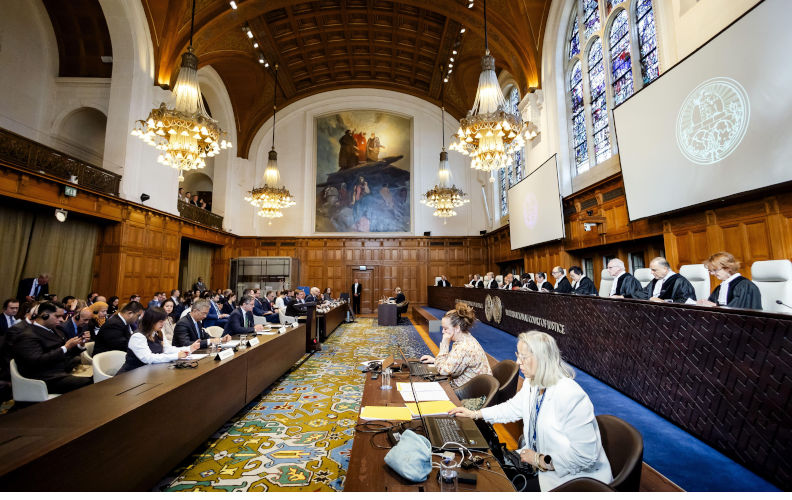
Also in October, the increasingly influential Association for the Promotion of International Law presented Justice Hilary Charlesworth online from The Hague to discuss her work at the International Court of Justice (ICJ), where she holds a seat for nine years from 2021. (None of the 15 judges represents their home country.) Among many cases on its docket, the ICJ is considering the application of the Genocide Convention – called the worst of crimes – in current circumstances. Justice Charlesworth wrote in 2002, at the time of NATO’s bombing of Kosovo, about international law as a ‘discipline of crisis’, and when that was revised a decade later as a ‘discipline in crisis’, she didn’t disagree. She told her Australian audience that she deplored the sanctions recurrently imposed by the US on the International Criminal Court (ICC) but argued that the system is resilient and that the work of the international courts has support and will continue.
ANU Professor Desmond Manderson asked her why international law is undervalued in Australia and, while it should apply universally and equally to the weak and the strong, how it has been supplanted by illegal wars and contestation between big powers and middle powers. Justice Charlesworth pointed out that international law works in ways that may be little noticed. She cited Australia’s racial discrimination law, its case against ‘scientific’ whaling that resulted in Japan giving it up, and the Mabo case for Indigenous land rights, which drew on a judgment of the ICJ in Western Sahara. But Australia had not yet accepted the court’s unanimous decision in support of the advisory opinion on climate change, nor had Australia legislated to apply the Universal Declaration of Human Rights and subsequent international human rights conventions in its domestic law.
The work of the ICJ has evolved over its history, and international law can now apply domestically to states parties. It includes obligations of states to their own citizens at home or abroad and to those of other states as well. Judge Charlesworth said political leaders should be reminded of their obligation to have domestic law reflect their international legal undertakings. While Australian governments continue to avoid that, Australian groups are finding various ways to press for it. Many are concerned that otherwise it will be too late for us all. Australia’s performance will be measured by both domestic and international opinion in its campaign for a seat on the UN Security Council in 2028.

Dr Alison Broinowski AM is a former Australian diplomat and a member of Australians fr War Powers Reform