Antisemitism and homophobia have different histories, but both can cast minorities as threatening, subversive or powerful – and both belong in a broader response to prejudice.
One of the complaints of Jews who are concerned about growing signs of antisemitism across the world is that antisemitism is often excluded from discussions of racism. There are particular reasons for this, which a comparison with homophobia helps clarify.
Most racism assumes inferiority on the part of the other. Indeed, racism as it developed in the western world was necessary to justify slavery, as Black Africans could be deemed less human than their white slave owners. In the shameful case of Australia, the original British settlers not only believed Aborigines were inferior, but talked openly of their dying out in favour of more superior Europeans.
These assumptions linger today in lingering assumptions about people seen as non-white, although rarely expressed in the crudities of a century ago. But Jews, rather like the Chinese in Southeast Asia, are disliked and persecuted precisely because of the fear that they are superior, that they are rich, cosmopolitan and powerful and therefore a threat in a very different way to that posed by Indigenous Australians.
In the minds of antisemites, Jews can simultaneously be exploitative capitalists and subversive communists. One of the bizarre features of some Christian Zionists, who are a powerful pro-Israeli lobby, especially in the United States, is that they are both ardent defenders of an expanded Jewish state while clinging to antisemitic tropes about Jews.
This is where the parallel with homosexuals becomes useful, for we, too, are perceived as subversive, cosmopolitan and powerful. The parallel is hardly new: back in 1951 Hannah Arendt wrote of “the complicated game of exposure and concealment … only one’s Jewishness (or homosexuality) had opened the doors of the exclusive salons, while at the same time they made one’s position extremely insecure”.
Of course, the roots of antisemitism and homophobia are rather different. The history of antisemitism is deeply embedded in both Christian and Islamic teachings, some of which remain current today. And the reality that the Israeli state insists on regarding all Jews as potential citizens, a position constantly reaffirmed by most of the peak Jewish organisations, means opposition to Israel too often segues into antisemitism.
Sadly, Israel’s defenders play into this script, by insisting that support for Palestinians is somehow antisemitic. The determination of the antisemitism envoy, Jillian Segal, to impose a particular definition of antisemitism, despite the range of well-founded objections to the wording from the International Holocaust Remembrance Alliance, stems from her desire to blur the distinction.
Homophobia, on the other hand, stems from deep insecurities about sexual desire and gender roles, a sharp contrast to the stress on conventional heterosexual families in orthodox Judaism. Nonetheless, the prominence of Jewish scholars of sexuality, most notably Freud, means that Jews are easily perceived as contributing to sexual decadence. This was a central trope in Nazi Germany and has echoes in some contemporary antisemitic rhetoric. The former ruler of Hungary, Viktor Orban, is a classic example of someone who is both antisemitic and homophobic.
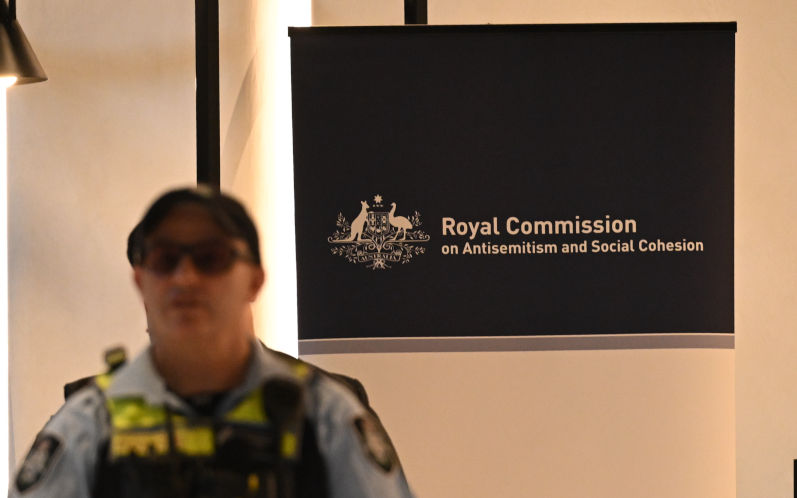
In my testimony to the royal commission on antisemitism and social cohesion I wrote that I am not immediately recognisable as either Jewish or gay, unlike someone who is Black who immediately attracts the attention of racists. To my surprise, the counsel who questioned me, when I appeared in person before the commission, ignored the parallel.
But the reality is that I am far more scared of young men clad in black and carrying Nazi-like symbols than I am of Palestinian protesters on campus. That I might be attacked for being either Jewish or homosexual underlines the reality that hatred or fear of one group too easily segues into a generalised attack on anyone perceived as part of a minority.
As the race commissioner has stressed at various points, if we are serious about social cohesion we need to move beyond singling out the hatred directed at specific groups and instead focus on expanding understanding and support of genuine racial, ethnic and sexual diversity.
The most effective way to do this would be to require all children to spend at least part of their schooling at a state school, where they would come in contact with the full diversity of contemporary Australia. [This would also help remedy the growing gap between the rich private schools and the rest, as every parent would have an incentive to support the state system]. I realise that no mainstream politician would be brave enough to argue for such a policy.

Dennis Altman AM is a Vice Chancellor’s Fellow at La Trobe University and the author of 15 books on politics and sexuality. A collection of his essays, Righting My World, will be published later this year by Monash University Publishing.