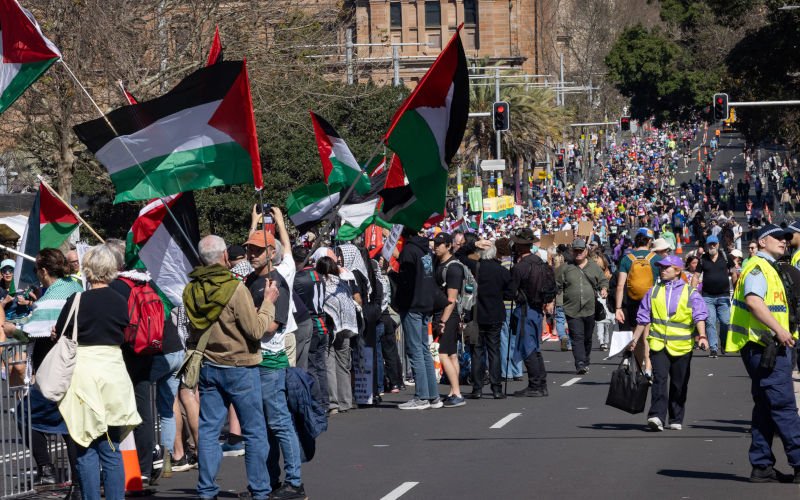
Hundreds of protesters lined the Sydney Marathon route over the presence of Israeli military-linked participants, calling for scrutiny under Australia’s character laws.
Hundreds protested the presence of Israeli military personnel while Egyptian-American comedian Bassem Youssef’s Australia tour was postponed by onerous character checks.
Hundreds of Australians carrying Palestinian flags lined sections of the Sydney Marathon route on Sunday 30 August, protesting against the entry into Australia of a delegation reportedly including current and former Israeli military personnel.
The demonstration followed reports that as many as 40 Israeli soldiers, veterans and military-linked participants had travelled to Sydney as part of a team raising funds for Israeli disability charity Shalva.
Activists gathered along College Street beside Hyde Park, while other groups assembled near Anzac Parade. They called for the Australian government to investigate members of the delegation rather than allowing military service connected to Gaza, the occupied West Bank or Lebanon to pass without public scrutiny.
Protesters chanted “No IDF on our streets” and “IDF to the ICC” as runners passed. Many marathon participants responded with raised fists, peace signs, high-fives and cries of “Free Palestine”.
Judith Treanor of Jews Against the Occupation ’48 described the exchange between demonstrators and runners as unexpectedly uplifting.
“Many runners were draped in Palestinian flags. Others waved them or wore keffiyehs,” she wrote for Michael West Media.
“But it was the sheer number of ordinary runners who showed their solidarity that took us by surprise.”
Journalists and advocacy groups identified delegation members who had served in units facing serious allegations, including the Golani Brigade and Israel’s Unit 8200 signals intelligence division.
One named participant, Roy Oryon, was publicly profiled as a former deputy company commander in the Golani Brigade’s 13th Battalion, which fought in Gaza.
The Australian Centre for International Justice said at least 39 Israeli nationals had entered Australia for the marathon, including people reportedly deployed in Gaza, the West Bank or Lebanon.
It called for enhanced screening and referral to the Australian Federal Police wherever credible information indicated possible involvement in torture, war crimes, crimes against humanity or genocide.
APAN demands investigation
Australian Palestine Advocacy Network president Nasser Mashni said Australia could not claim to support international law while potentially admitting people suspected of involvement in serious international crimes without investigation.
“Australia has clear legal obligations under international law,” Mashni said.
“These individuals must be questioned, investigated and, if the evidence warrants it, prosecuted.”
Mashni criticised Australian organisations involved in supporting the visit, describing the marathon appearance as an exercise in ‘sportswashing the genocide in Gaza’.
“Australians know what they have seen on their screens for the best part of three years, and we deserve better,” he said.
The delegation’s supporters rejected that characterisation and promoted the visit as a charitable and community-building initiative.
Home Affairs refuses to explain screening
The controversy has placed the Department of Home Affairs under pressure to disclose what security and character screening was applied to members of the delegation.
Under section 501 of the Migration Act, a person may fail the character test if the minister reasonably suspects that person has been involved in genocide, a war crime, a crime against humanity, torture or another crime of serious international concern, even without a conviction.
Home Affairs would not comment on individual applications, citing privacy.
“All non-citizens who wish to travel to, enter, or remain in Australia must satisfy the requirements of the Migration Act 1958 and the Migration Regulations 1994, including identity, health, character and security requirements,” a department spokesperson said.
“The department assesses all applications on a case-by-case basis.”
That formula did not answer whether delegation members were required to provide detailed information about their military units, ranks, deployments or activities.
The department’s own guidance confirms it may request police certificates and additional character documents and that suspected involvement in genocide, war crimes or crimes against humanity can prevent a person from passing the character test.
A comedian faces a different standard
The lack of transparency stood in sharp contrast to the treatment of Egyptian-American comedian and political satirist Bassem Youssef.
Youssef’s sold-out Australian tour was postponed after he said authorities required an FBI background check from the United States and a criminal record from Egypt.
The former heart surgeon has lived in the United States since leaving Egypt in 2014 after his satirical television program was taken off air.
Because his Egyptian passport and identification had expired, he could not obtain the requested record in time for his scheduled Australian performances.
Youssef had previously visited Australia without incident in 2015 and 2023 and said those documents had not been required on the earlier visits.
He has not been formally banned or publicly refused a visa. His promoter describes the tour as rescheduled, with replacement dates still to be announced.
Nevertheless, the additional requirements prevented the scheduled performances from proceeding.
The Executive Council of Australian Jewry had earlier made representations to Home Affairs seeking the refusal of Youssef’s visa because of his statements about Israel and Israelis.
Home Affairs has not disclosed whether those representations influenced its handling of the application.
The contrast raises a question the department has so far avoided: why was an entertainer previously admitted to Australia required to obtain extensive records from two countries, while people publicly identified with military units implicated in grave international-law allegations were apparently able to enter and participate in a high-profile public event?
The issue is not whether every Israeli veteran should automatically be considered guilty. Military service alone does not establish individual criminal responsibility.
The issue is whether Australia applied its character laws consistently, investigated credible information equally and subjected soldiers to scrutiny comparable with that imposed on a comedian.
For the protesters lining Sydney’s streets, the answer was visible in the empty stages awaiting Youssef and the military-linked delegation running freely across the Harbour Bridge.
Republished from AMUST

Mohamed Ainullah
Mohamed Ainullah is an AMUST subeditor responsible for the Mediascan section of AMUST