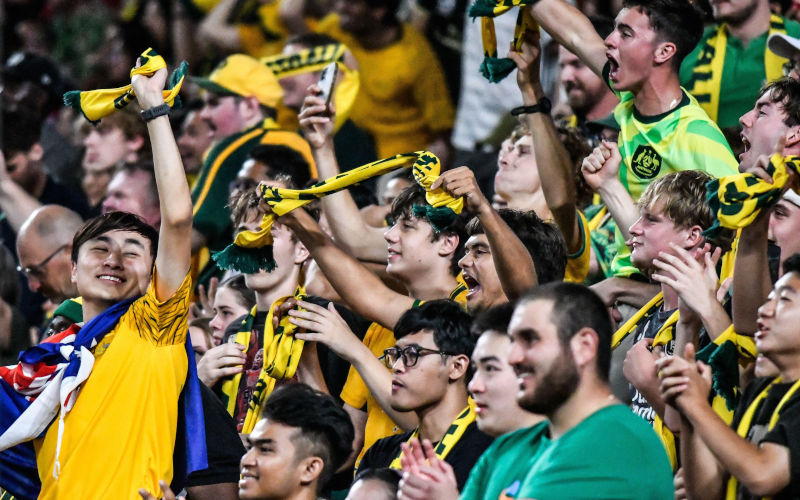
The World Cup offers a simple answer to a complicated political debate: a nation is strongest when people with different pasts choose the same future.
When the referee blew the final whistle, my wife jumped from the couch and screamed with joy, “We won!” For a few moments, our living room in Melbourne became part of a global ritual, in which millions of people across ethnicities, religions, languages and histories were reacting to the same moment.
My wife was not born in Australia. She arrived here as a skilled software engineer and now works in information technology and data science. Her life is rooted in another country. Yet in that moment there was no distance between her and what was unfolding on the screen. The Socceroos’ victory felt like her own and I realised that belonging begins not in a birthplace but in participation and the decision to say ‘we’.
The FIFA World Cup makes this visible in a way few other global events can. For 90 minutes, nations become emotional communities in which strangers wear the same colours, share the same tension and experience the same collective release. It is a reminder that nations are not only legal or territorial formations; they are also shared acts of imagination.
Benedict Anderson famously described nations as ‘imagined communities’, sustained through shared symbols, stories and rituals among people who will never meet. Football is one of the clearest expressions of this idea. A national team gathers millions into a single emotional field in which identity is performed rather than inherited.
Watching my wife celebrate the Socceroos, I understood something simple: national identity is not inherited passively, it is entered into. I found myself thinking about a question that has surfaced repeatedly in Australian public life: what makes someone truly belong? Is it birthplace, ancestry, language or something less tangible but ultimately more enduring? Her spontaneous cry of ‘We won!’ answered that question before I could.
It also made me reflect on Pauline Hanson’s speech at the National Press Club, where she argued that multiculturalism has weakened national cohesion and called for a return to a monocultural Australia. The contrast between that political vision and the simple joy unfolding in our living room could not have been sharper.
The appeal of Hanson’s position lies in its simplicity. Cohesion appears easier when culture is uniform, language is singular and identity is fixed. But democratic societies are not held together by sameness. They are held together by institutions that allow difference to coexist within a shared civic framework. The question is not whether Australia should be monocultural, but what kind of cohesion a modern democracy can realistically sustain.
Australia’s history suggests that cohesion and diversity are not opposites. Long before European settlement, hundreds of First Nations peoples lived across the continent, each with distinct languages and cultural systems. Diversity is one of the foundations of Australia’s story.
Migration after the Second World War reshaped the country again. Italians, Greeks, Vietnamese, Lebanese, Chinese, Indians, Sudanese, Iranians and many others rebuilt their lives here, contributing to the country’s economic, cultural and institutional development. They did not erase Australia; they helped form it.
Charles Taylor argues that recognition is a basic human need. People flourish when their identities are acknowledged rather than denied. When recognition is absent, citizenship becomes fragile. Recognition is therefore not symbolic generosity but democratic infrastructure, because it enables participation in shared public life.
Will Kymlicka extends this argument by showing that multiculturalism is not a deviation from liberal democracy but one of its achievements. Equal citizenship does not require cultural uniformity, but institutions that allow people from different backgrounds to participate fully while maintaining meaningful continuity with their identities.
Bhikhu Parekh adds that no culture possesses a monopoly on wisdom. Societies develop through dialogue between traditions rather than through the dominance of one over others. Innovation emerges where perspectives meet rather than remain isolated.
This is not abstract theory. It is visible in everyday Australia: in hospitals shaped by international medical training; universities embedded in global research networks; technology firms built on transnational expertise; and neighbourhoods where languages, cuisines and histories intersect.
Australia competes globally not only for capital, but for talent. Migration is therefore not only a moral question but a structural one.
My own experience reflects this reality. My professional background is in communications and journalism, where I have spent much of my career helping organisations tell their stories and connect with diverse communities. My wife is an information technology and data science specialist. Our friends are academics, engineers, doctors, teachers, software developers and entrepreneurs. Many left established careers to begin again in Australia. They did not come to replace Australia with something else. They came because they believed in what it already was: stable, democratic and open to participation. They contribute, work, volunteer, raise children and invest in the country’s future. In practice belonging is built through these ordinary acts.
Ghassan Hage has argued that debates about immigration often carry an implicit logic of ownership, where some assume the authority to decide who belongs. But democratic societies are not possessions; they are shared inheritances, continuously reshaped by those who participate in them.
What Australian society reveals is a challenge to the idea that equality requires sameness. Justice is not achieved by eliminating difference but by enabling full participation across difference. A football crowd demonstrates this more clearly than any theory: people with different languages, beliefs and histories stand together in anticipation. When the Socceroos score, difference does not disappear but it no longer defines belonging.
Jürgen Habermas describes this as constitutional patriotism, in which loyalty is grounded in democratic institutions and shared civic principles, not in ethnicity. This describes how Australia already functions. Citizenship here is enacted through participation, responsibility, contribution and care.
Critics of multiculturalism often treat identity as finite, as though diversity subtracts from what already exists. But identity is not a fixed substance. It is a process of renewal that expands every time someone chooses to invest in a shared future and deepens every time that investment becomes action.
When my wife celebrated the Socceroos’ victory, she was not performing belonging. She was expressing it. Her joy was earned through lived participation in this country’s present and future. Her feeling emerged naturally from life here; no policy or ideology instructed it.
Perhaps this is the truth the World Cup reveals: a nation is held together by shared hope, by strangers who become neighbours, by neighbours who become citizens, and by citizens who, for 90 minutes, become one crowd, not by bloodlines or uniformity.
If multiculturalism truly prevented national unity, my wife would not have leapt from the couch when the Socceroos scored. She would have remained merely a spectator. Instead, she celebrated as millions of Australians did. It was not because she had forgotten where she came from but because she had embraced where she now belongs.
Sirwan Barzanji
Sirwan Barzanji is a Melbourne-based Kurdish writer, journalist and communications professional. His work explores migration, multiculturalism, identity, belonging and the role of democratic institutions in diverse societies.