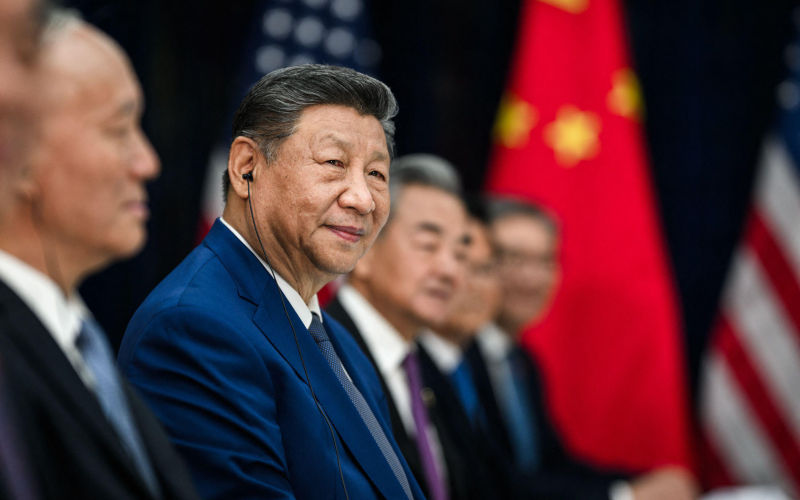
As Xi Jinping travels from Central Asia to Egypt and India ahead of a planned US visit, China is promoting its vision of multilateralism, security and South-South cooperation more broadly.
Xi’s month of travel signals that China is playing a key role in South-South cooperation amid a tariff war and geopolitical instability.
President Xi Jinping has begun a month of travel expected to lead to the United States and a summit with President Donald Trump. That contrasts with the earlier part of the year, which saw Xi hardly going anywhere but staying in Beijing. Instead, he hosted foreign leaders who flocked to meet him, including those of middle powers such as Britain, Germany, Canada and Spain, as they looked beyond an unpredictable American president and mixed signals from Washington.
This reflects the growing importance of China’s economic power, the potential of its vast market and latest technological advances. Now, ahead of his proposed visit to the US on 24 September, Xi has launched a diplomatic offensive.
First he visited Kyrgyzstan for the summit of the Shanghai Cooperation Organisation, then – for the first time in 10 years – Egypt. This weekend he goes to India for the summit of BRICS (Brazil, Russia, India, China and South Africa), an organisation now of 11 members designed to counterbalance Western-led global governance. China is sending a strong message that it is playing a key role in South-South cooperation amid a US-China tariff war and mounting geopolitical instability, as wars disrupt shipping routes, drive up energy prices and – together with extreme weather – deepen threats to global food security.
At the SCO summit, Xi said that the 10 member countries should “prioritise security” and prevent external interference in the affairs of other nations. He also announced initiatives including a new centre for international artificial intelligence (AI) cooperation. Xi said the Eurasian bloc should take on a bigger global role in technology and security. A key lesson from the bloc’s 25 years of cooperation was “finding the right way to coexist without alliance, confrontation or targeting any third party”.
“Its most significant achievement has been its steady growth into a new type of regional cooperation organisation that now spans the widest territory, encompasses the largest population and holds the greatest development potential in the world,” Xi said.
However, the world was at a crossroads, with rivalries between dialogue and confrontation, win-win cooperation and zero-sum competition, and multilateralism versus unilateralism. Xi said countries had to “prioritise security and create a universally secure environment”, and prevent external forces from interfering in the internal affairs of other countries to safeguard regional stability.
In Cairo, where Xi held talks with his Egyptian counterpart Abdel-Fattah el-Sisi, he presented a four-point proposal for peace and a new security architecture in the Middle East, which reflects Egypt’s influence in the region. It encourages regional countries to take charge of their own security by resolving differences through dialogue, promoting a vision of security combining development and peace, focusing on economic growth and regional cooperation as a bedrock for stability, and supporting the United Nations and respecting national sovereignty.
Analysts said Xi’s journey from Central Asia to Egypt highlighted Beijing’s efforts to strengthen alternative trade, energy and manufacturing networks across Eurasia and Africa, as wars and tariffs expose a reliance on vulnerable supply routes and overseas markets. Xi’s latest visits will also consolidate the Belt and Road Initiative, and promote a world order of multilateralism in contrast to US-led unilateralism.
While Trump has said Xi will visit on 24 September and that a formal state banquet will be hosted in his honour, the conflict and rivalry between the two major powers remain real. It remains to be seen how much common ground the two can find, ultimately, on AI governance, as well as trade, Taiwan and many other thorny issues.
Xi’s diplomatic charm offensive promotes China’s vision for world peace and global collaboration. It reflects a consistent foreign policy of multilateralism and mutual respect for sovereignty and core interests.
Meanwhile, it is to be hoped a Xi-Trump summit will have concrete outcomes. It is reported that Xi will also lead a big Chinese business delegation to the US, paving the way for agreements on enhanced trade and economic ties that should be positive for bilateral relations, though differences will remain.
Republished from SCMP Editorial
