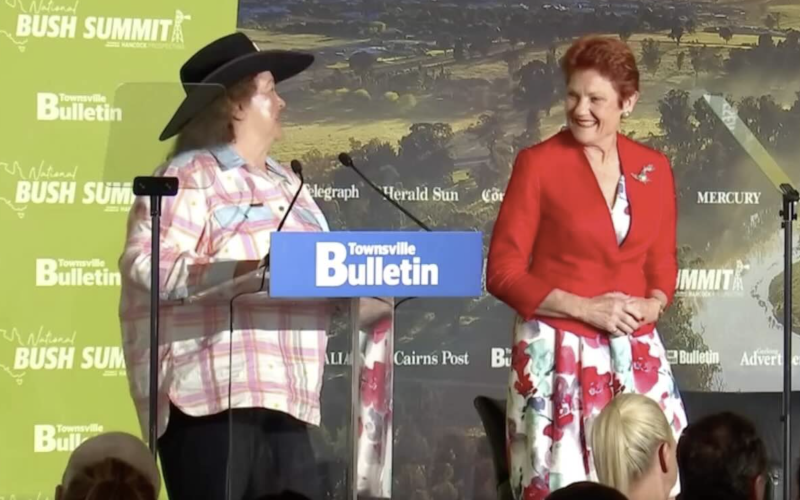
The Nationals claim to represent farmers and One Nation claims to speak for battlers. Their mining connections tell a different story. Rural independents offer an alternative.
The Nationals and One Nation are fronts for the mining industry.
Helen Haines tells us that health is the main issue that people in Indi raise with her.
The Nationals have sold out farmers to the miners. One Nation pretends that it speaks for battlers but has also sold out to miners, like Gina Rinehart.
The National Party was founded to represent farmers and country people. That claim is no longer sustainable. Over the past three decades the party has abandoned its traditional constituency in favour of the mining industry.
The evidence is clear. When National Party leaders leave Parliament, they go to mining companies. Former leader Mark Vaile became chairman of Whitehaven Coal. Former deputy prime minister John Anderson moved into the gas industry. Former deputy premier Ian Armstrong became chair of the Shenhua Community Consultation Committee in 2009 – Shenhua being the Chinese state-owned company that sought to build a $1.7 billion open-cut coal mine on the Liverpool Plains. When Larry Anthony was elected federal president of the National Party in 2015, he was simultaneously a lobbyist for Shenhua Watermark Coal. He denied having a conflict, saying he had stopped working for Shenhua just months earlier, but was still listed with the SAS Group on the federal and Queensland lobbyists registers, and listed as an executive director on the firm’s website. As Liverpool Plains farmer Tim Duddy of the Caroona Coal Action Group said at the time: “They want to be the mining party.” He was right.
The National Party has received declared donations from Woodside, Santos, Hancock Prospecting, Carmichael Rail (via parent company Adani Mining), and Clive Palmer’s Mineralogy. Barnaby Joyce accepted a $40,000 gift from Gina Rinehart, returning it only when it failed the pub test.
Resources Minister Keith Pitt championed a $250 billion government underwriting scheme for the coal industry. Barnaby Joyce and Larry Anthony urged the Nationals’ federal conference to freeze renewable energy subsidies while keeping fuel subsidies for miners.
Meanwhile, the farmers the party claims to represent face droughts worsened by climate change, groundwater threatened by coal seam gas, and health services that receive $9.2 billion less per year than city residents.
As Jack Waterford wrote on P&I, the National Party has ceased to be a political party in the ordinary sense. It has become a wholly owned subsidiary of big mining and energy lobbies, most of whom are not even Australian.
The National Party is not the voice of the bush. It is the voice of the mine.
One Nation presents itself as something different: a party of the battler, the outsider, the forgotten Australian. The funding tells us otherwise.
Gina Rinehart, Australia’s richest person and the driving force behind one of the world’s largest private mining empires, has become One Nation’s principal financial backer. She bought the party a plane worth $1.5 million. Two of her senior company executives each gave $500,000. A further $1 million came from a stockbroker who moves in her circle. These donations, declared in the weeks before One Nation’s Farrer by-election win, dwarfed anything the party had previously received from a single donor network.
Gina Rinehart has poured millions into the Institute of Public Affairs to generate climate denial. She made significant financial contributions to the Liberal-National Coalition for decades. Her personal relationships with Barnaby Joyce, Matt Canavan, and other senior Nationals helped shape the Coalition’s obstruction of meaningful climate action for years.
Rinehart is now investing in its replacement, One Nation, whose policies reflect her investments. The party declares net zero is “destroying Australia”, pledges to exit the Paris Agreement, opposes renewable energy subsidies, and promises to keep coal burning. Standing in front of Loy Yang A power station in August 2026, Hanson pledged that under One Nation the plant would not close in 2035 as scheduled. Coal seam gas, open-cut mining, and fossil fuel expansion are One Nation orthodoxy – precisely as they have been National Party orthodoxy, funded by the same corporate interests.
One Nation is not the voice of battlers. It is the voice of the mine.
It is no surprise that country people are now looking to independents who will better represent their interests and concerns. Indi was one of the most entrenched conservative seats in the country.
Indi is now a safe independent seat held by the exceptionally able Helen Haines, who remains in a serious but stable condition after the shocking attack on her last week. She is an exceptionally able local member, who is deeply concerned with a key issue, health.
Haines said recently that healthcare was the leading issue that people speak to her about right across Indi. In her electorate many of the residents live in rural or remote locations. Healthcare, especially specialist care, is difficult to access and as a result health resources and health outcomes tend to be poorer. She added there was a double suicide rate in rural areas, multipurpose health funding left unguaranteed in Corryong, patients in Benalla urgent care having to pay, unlike those at city hospital emergency departments, and the problem of inadequate internet undermining telehealth.
Only weeks ago, the ABC reported that Haines had personally handed Anthony Albanese an annotated copy of the National Rural Health Alliance’s Forgotten Health Spend 2026 report, documenting an annual rural healthcare expenditure shortfall of $9.23 billion.
The former member for Indi, Cathy McGowan, described in the Saturday Paper last weekend how the community-led electoral approach gained broad support.
“We developed the Indi way, now referred to as the Indi model. Centred on participatory democracy, community power and a collaborative relationship between constituents and their elected representatives we built extensive kitchen table conversations. People willingly signed up to a strong framework of integrity to empower our community and make democracy work for us. The Indi model operates as a grassroots movement rather than a political party, guiding local communities to determine their own issues and select independent representatives.”
The National Party has sold out to the miners and failed to represent rural voters on a whole range of issues of concern, poor health and poor education. And One Nation has shown also how eager it is to front for the mining sector.
Independents across the country like Helen Haines are stepping up because the Nationals and One Nation have effectively sold out to the fossil fuel industry. They have forgotten country people.

John Menadue is the Founder of Pearls and Irritations and a board member. He was formerly the Editor-in-Chief. John was the Secretary of the Department of Prime Minister and Cabinet under Gough Whitlam and Malcolm Fraser, Ambassador to Japan, Secretary of the Department of Immigration and CEO of Qantas.