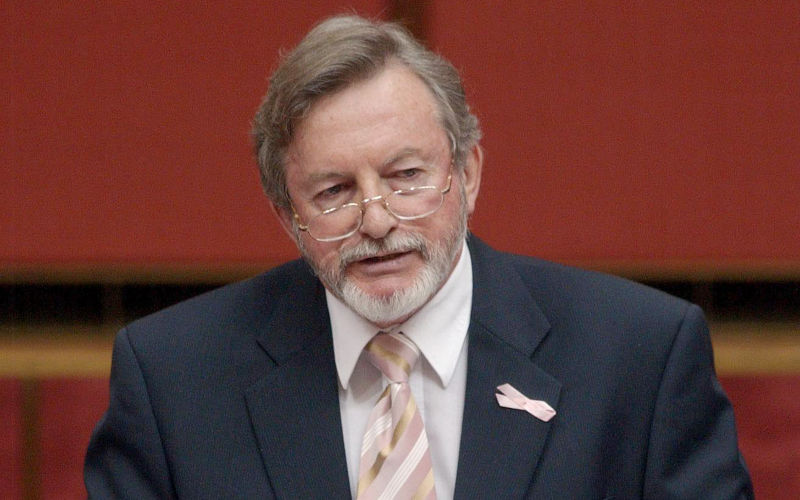
The 2002 Senate inquiry found Peter Reith deceived Australians over children overboard. Cabinet then blocked key staff from giving evidence, leaving crucial questions unanswered.
In October 2002, the Australian Senate Select Committee on a Certain Maritime Incident handed down their report. The unlikely nomenclature for this committee hid its true purpose, which was to examine the false claims made by the government that asylum seekers had thrown their children into the sea. This came to be known as the “children overboard incident”. It was an inquiry into the events surrounding the sinking of the refugee boat, referred to as the SIEV 4 during the 2001 federal election campaign, and the rescue of 200 asylum seekers who were on that boat and would have otherwise drowned. While the event has been well documented, little has been written about the inquiry.
For us, a senator who was a member of the committee and a political adviser, the inquiry hearings and submissions took over the next few months of our lives, as each layer of political deceit surrounding these events was exposed and the true human toll on all involved revealed.
The inquiry was both unusual and extensive. The first chapters of the report outlined the new border protection regime, which came into force following an earlier incident involving the rescue of 433 Afghan asylum seekers by the Norwegian container ship, the MV Tampa. The last few chapters discuss the sinking of another asylum ship, the SIEV X, and the death of more than 300 asylum seekers aboard that ship.
The committee report raised the question that had hung over the inquiry: “Did the overboard story and the emotional reaction it provoked influence the outcome of the federal election?”, held in November 2001, which had seen an increase in the vote for the incumbent Coalition government.
In answer to that question, the committee found that, because the SIEV 4 was the first boat intercepted after the election had been called, the handling of the boat was a public demonstration of the government’s strength on border protection. The findings of the report state “the behaviour of unauthorised arrivals was to be a public justification for the policy of the Pacific Solution”.
The report itself outlines how unusual this inquiry was. It looked into claims made during a federal election in which “border protection and concerns about asylum seekers were central issues”. The foreword to the report by the chair of the committee, Senator Peter Cook, calls the inquiry an “investigation” – a term which clearly differentiated the nature of the work the committee was required to do in order to meet its terms of reference.
While the terms of reference did not include the Tampa incident, the report refers to it and the new policy regime as background to the inquiry – the incident was the catalyst for significant legislative change and the new policy response to asylum seekers known as the Pacific Solution.
The committee began by investigating evidence about the “children overboard” incident and, when the falsity of this incident was established, endeavoured to focus on what was done by the government to correct the record.
On 7 October 2001, the Minister for Immigration, Philip Ruddock, announced that asylum seekers had thrown their children overboard in an attempt to force a rescue. On 10 October, two photographs were released to the public as ‘proof’ that this had happened.
The committee heard that the media adviser for the Minister for Defence purportedly told ministerial staff that “no personalising or humanising images were to be taken of the SUNCs” (suspected unlawful non-citizens).
It was determined that the Minister for Defence, Peter Reith, and/or his staff were told on at least eight occasions between 11 October and 7 November that the photos did not depict what they claimed to show. The Prime Minister, John Howard, was informed by Reith about the doubts surrounding the photos on 7 November. The government did not issue a correction or retraction.
On 10 November 2001, the election was held. Prior to August, the government was predicted to lose that election. The Tampa crisis is considered to have been a game changer, reinforced by the Howard government’s framing of asylum seekers as “lesser humans” through the release of these images. This cemented both the policy towards asylum seekers and the public’s opinion.
The committee found that the government had deliberately misled the Australian public with these images of children and adults in the water. They had been taken on a different day and, importantly, did not depict children thrown into the water by parents. What they did show was two of the seven navy personnel who had leapt from a great height of the ship to rescue the people in the water after the boat had sunk on 8 October.
At one point Commander Banks, the navy officer in charge of the rescue vessel, was asked why he had not removed the women and children from the boat before it sank. His answer shocked us. He told the committee that removal of the children before the boat sank would mean that he had failed his mission, which was to deter and deny access to Australia’s migration zone. Here was a clear example of how far the government had strayed from basic principles of law and morality.
As a result, 200 asylum seekers, including young children, were forced to enter the water before they could be rescued: an event so life threatening that the nature of the impact on the navy personnel and asylum seekers was acknowledged by Commander Banks to the committee.
The government’s deliberate misdirection hid the bravery of the navy personnel.
It is telling that the government was openly hostile to the inquiry. Cabinet actively blocked access to ministerial and prime ministerial staff and public servants in ministerial offices, thereby preventing any assessment of ministerial conduct. Yet a range of people did provide evidence, including senior members of the Australian Defence Organisation and senior public servants. Nevertheless, the blocking of ministers and key staff meant that the committee was “unable to pursue the ‘overboard story’ to its conclusion”.
Despite this, the committee’s report remains a detailed account of political interference that has impacted the lives of those involved for decades and provides a unique insight into the continued obfuscation by the then prime minister that the events were just a “miscommunication“.

Marianne van Galen Dickie
Dr Marianne van Galen Dickie is a lecturer in Law at Thomas More Law School ACU. She also works as an advocate for Sisters Inside Qld assisting women who have had their visas cancelled under s 501 of the Migration Act. Marianne was the migration advisor for the Australian Democrats from 1998-2004 . Between 2008 and 2017 she was the Director of the Migration Law Program at ANU College of Law.

Andrew Bartlett
Andrew Bartlett is an advocacy and policy advisor for Volunteering Queensland. He is a former Senator for Queensland, from 1997 – 2008, representing the Australian Democrats, with responsibility for several portfolios including migration. He was a member of several Senate committees during this time. Andrew returned to the Senate in 2017 for a short period of time representing the Greens .