Across Europe and the US, some of the loudest anti-immigration politicians have migrant roots, migrant spouses or family histories shaped by migration. The contradiction has done little to slow their rise.
Earlier this month, Germany’s far-right Alternative für Deutschland (AfD) won 43.8 per cent of the vote in Saxony-Anhalt, a state where foreign nationals make up 7.9 per cent of the population – roughly half the national average. Yet because it fell three seats short of a majority, it needs to secure the support of another anti-immigrant party, the Sahra Wagenknecht Alliance, which is led by a woman whose father came from Iran.
Two weeks later, the AfD finished first in Mecklenburg-Vorpommern, whose economy relies on some 50,000 people with an immigrant background. Chancellor Friedrich Merz’s Christian Democrats failed to secure a single seat in the state parliament – a first in the party’s history. Smelling blood, the AfD’s Alice Weidel then called for federal elections “before Christmas”. Presumably, she has since returned home to Switzerland and her Sri Lankan-born wife and their two sons.
Watching all this from Poland, where Weidel would not have been permitted to marry a woman (though European Union courts have ruled that Poland must register same-sex marriages conducted elsewhere), has brought the far right’s approach to politics into focus. It boils down to being so outrageous, mendacious or immoral that your flabbergasted opponents cannot formulate a timely response.
And so, in Germany, a party that promises “remigration” (pressuring immigrants and their offspring to leave) wins the largest share of the vote in states that have a disproportionately small share of immigrants or rely on immigrants to sustain the local economy. And in Poland, a government that spent eight years scaremongering about migrants issued more residence permits to non-EU citizens in 2023 than any other EU member state. According to the state auditor, the former ruling party, Law and Justice (PiS), handed out more than 366,000 visas to arrivals from Asia and Africa, allegedly often in exchange for cash.
The Polish nationalists who rail the loudest against Germany tend to have German-origin surnames (be it Sławomir Mentzen of the Confederation party or Grzegorz Braun of the Confederation of the Polish Crown). Similarly, many of the leaders of Europe’s anti-immigrant parties are themselves immigrants or the children of immigrants. The Czech nationalist Tomio Okamura was born in Tokyo to a half-Japanese, half-Korean father. The Dutch nationalist Geert Wilders, who has a Germanic name, traces his lineage on his mother’s side to Indonesia, and is married to a Hungarian woman.
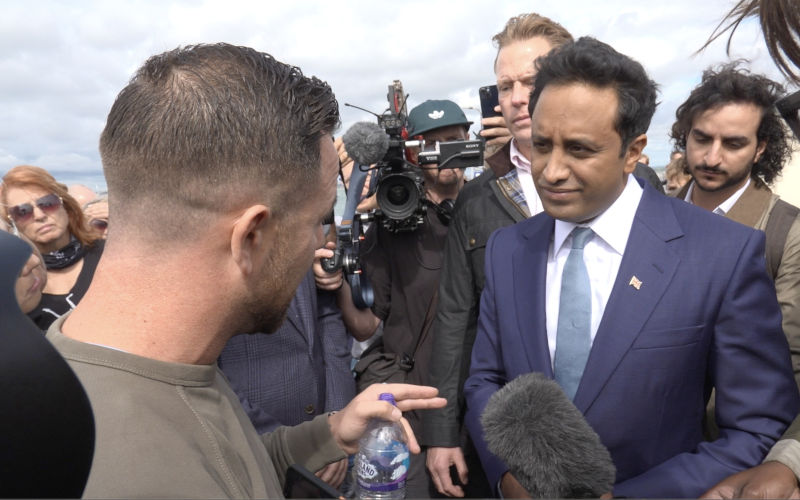
In Britain, Reform UK’s immigration policy is in the hands of Zia Yusuf, the son of Sri Lankan Muslim immigrants. In February, he promised a “Deportation Command” that would run five charter flights per day to reverse what he calls an “invasion”. If Reform were to win the next election, Yusuf could well become home secretary.
Then there is France, where the far right has built its entire platform on the promise of opposing Muslim immigration from the Maghreb. Once again, one need not look far to find hypocrisy. Éric Zemmour, who rails against the “Great Replacement” of native-born French, is the son of Algerian Jews. Similarly, National Rally leader Jordan Bardella’s great-grandfather was an Algerian immigrant, and his grandfather migrated to France from Italy in 1960. If Bardella’s proposed immigration policy had been in force at the time, he probably would never have been born.
The situation is no different in the United States, where the only people with an unimpeachable claim to Indigenous status, following decades of mass murder and displacement from their native lands, make up 1–2 per cent of the population. All other Americans are relative newcomers or the descendants of newcomers. President Donald Trump’s grandfather left Bavaria at 16 to avoid conscription and was expelled when he tried to return after making a fortune running taverns and a brothel in the US. Trump’s mother was born on an island in the Hebrides off Scotland; his first wife was Czech; and his current in-laws are Slovenes who received their US citizenship in 2018 – a textbook case of what Trump calls “chain migration”.
Then there is Vice President JD Vance, who inveighs against immigration while on the job, before going home to his second-generation immigrant wife and their four children, Ewan, Vivek, Mirabel and Alec Neel.
The list goes on: Secretary of State Marco Rubio’s grandfather was once detained as an illegal immigrant to the US and a judge ordered his deportation. Elon Musk, a citizen of South Africa, where his maternal grandparents fled after leading a small Canadian party that was banned for its pro-Hitler sympathies, originally arrived in the US on a student visa. He was granted entry on the condition that he would be attending a graduate program at Stanford, yet, according to the Washington Post, he never enrolled. Despite his apparently unlawful overstay, he is now one of the most vocal figures railing against illegal immigrants like himself.
One would be remiss to neglect Stephen Miller, the architect of Trump’s deportation roundups. An uncle of Miller’s once published a commentary noting that his nephew’s policies would probably have denied his own grandfather’s entry into the country.
And Supreme Court Justice Amy Coney Barrett has signed on to judicial decisions permitting the deportation of thousands of Haitians, despite having adopted two children from that island.
The hypocrisy of today’s right-wing populists has not dented their popularity. On the contrary, outrageousness has become a successful electoral strategy. But those voting for nativism should be careful what they wish for. They may end up expelling their own family members, if not their own leaders.
Copyright Project Syndicate 2026


Sławomir Sierakowski
Sławomir Sierakowski, Founder of Krytyka Polityczna, is Head of the Program Board of Impact CEE and a senior fellow at the German Council on Foreign Relations (DGAP).