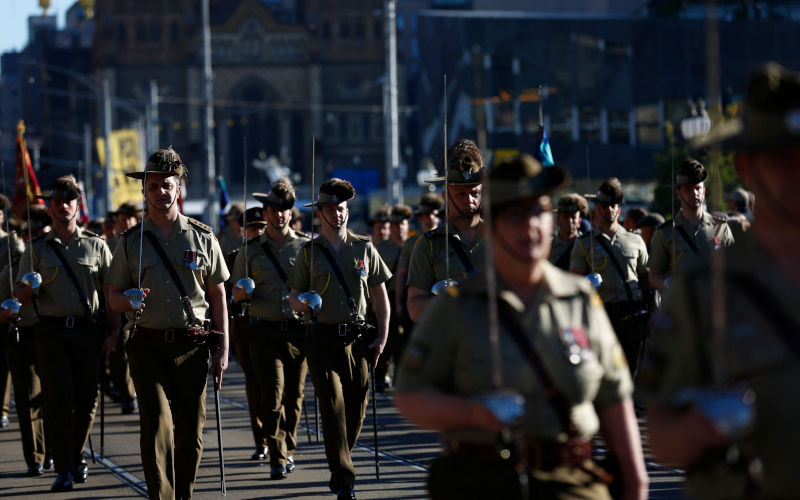
The military’s standing in Australian public life has become more complicated, but recent controversies involving One Nation and veterans’ healthcare show that military service continues to command considerable political respect.
Australia’s military forms an integral part of Australia’s national identity. The esteem accorded military service in the wider community is enormously deep and broad. This high status extends beyond the military itself, narrowly defined, to veterans and the wider military community, including Anzac Day and the Australian War Memorial (AWM) in Canberra. Retired senior military figures also have a respected place in social and public life.
Anzac Day has risen almost to the status of Australia’s most revered national day and become both a secular and quasi-religious festival. The War Memorial has received favoured treatment among national institutions, exemplified by generous spending on its refurbishment. It was famously described by former Liberal leader Brendan Nelson, a recent AWM director, as ‘the soul of the nation’. Recent governors-general have included former military figures such as Michael Jeffery and Sir Peter Cosgrove, the latter an especially esteemed figure. State governors have often been former military figures too.
That status afforded representatives of the military community, primarily the Returned & Services League (RSL), special political influence, often manifested in direct access to the prime minister and cabinet of the day and a privileged place in major public debates. Like a sacred cow, it was once untouchable.
Modern Australia has a more complicated relationship with its military, however. Many different elements exemplify this complexity and challenge the military’s elevated public status. Rather than a sacred cow, the military community may now be seen as a more complicated beast.
For instance, Australian veterans have fiercely expressed their displeasure with their treatment by the Department of Veterans’ Affairs. They have, in their own eyes at least, become the ‘forgotten people’. The recent Royal Commission into Defence and Veteran Suicide also revealed the disproportionate mental and physical suffering of service and ex-service personnel. The behaviour of the military at home and abroad has also been put under the microscope. The record of the military in its treatment of women in its ranks has increasingly been revealed as sexist and entirely inadequate. Additionally, the documented misbehaviour of some elite forces in Afghanistan, typified by the notorious case of SAS soldier Ben Roberts-Smith VC, has damaged the reputation of the military and caused internal division within its ranks.
Yet does the military remain a sacred cow, to be tampered with at your peril? It would appear so on the evidence of two quite different recent examples.
One is the response to One Nation’s intemperate attack on senior Liberal Andrew Hastie. Pauline Hanson’s party has risen dramatically in public opinion polls. Hastie, like most of his Liberal colleagues, is struggling to counter it.
Hastie gave evidence in a civil case against Roberts-Smith, angering his supporters, such as Hanson’s billionaire backer, mining magnate Gina Rinehart. One Nation tried to undermine Hastie by repeatedly calling him a traitor in one of its widely distributed animated cartoons. Hastie fought back, describing Hanson as a ‘lying coward’. She refused to apologise or take down the offending cartoon. Parliament, across party lines, largely took Hastie’s side. So did the RSL. Tasmanian independent Senator Jacqui Lambie, herself with a military background, was most vociferous in attacking Hanson on behalf of the veterans’ community, on the grounds that Hastie’s military service, including two tours of Afghanistan, earned him universal and unchallenged respect, whatever his politics.
The longer-term electoral consequences of this controversy remain to be seen, but Hanson and One Nation have probably suffered reputational damage for stepping over an acceptable cultural line.
The second example is the negative response to the federal government’s attempt to curb some of the entitlements of veterans. This involved applying a general cap of $5,000 per year to allied health benefits, such as physiotherapy and mental health therapies. Calls followed for the resignation of the minister for veterans’ affairs, Matt Keogh, for having disrespected veterans by not taking their concerns seriously during consultations over the bill. After sustained pressure, including some dramatic gestures from the military community involving the laying down of medals outside Parliament House, the proposal was emphatically rejected by the Senate, sent back to the House of Representatives and then abandoned by the government. The opposition and the whole crossbench were united. Lambie was again outspoken. The government has been rebuffed, although Keogh has survived so far.
Where does the military now sit? The broader context is that, despite increasingly toxic parliamentary and political language becoming commonplace in Australia, not least from One Nation, the party was seen to have crossed the line by fiercely attacking a distinguished veteran. Despite many Australians being forced to tighten their belts, including NDIS clients having services cut and older Australians having their medical insurance rebates cut, a cap on allied health services for veterans was also judged to have crossed the line.
No one should take the special place of the military in Australia’s heart for granted. This applies both to the military itself and to governments and potential critics. In the case of the former, veterans fear that they are taken for granted by governments when it comes to receiving financial support. The wider community may also be increasingly uneasy about those negative aspects of military culture revealed in recent court cases and inquiries.
The warning to governments and potential critics, however, is that, despite all this negative publicity, the military still commands special respect. Its high public standing gives military lobbyists continued leverage, if exercised carefully. Governments can’t treat veterans just like anyone else, even in tough times. Critics must be careful to pick their targets too.
Republished from Eureka Street

John Warhurst AO is an Emeritus Professor of Political Science at the Australian National University, and was the Moderator for Massimo Faggioli’s talk. He is chair of Concerned Catholics Canberra Goulburn and a member of the Plenary Council, and a regular columnist with the Canberra Times and Eureka Street.