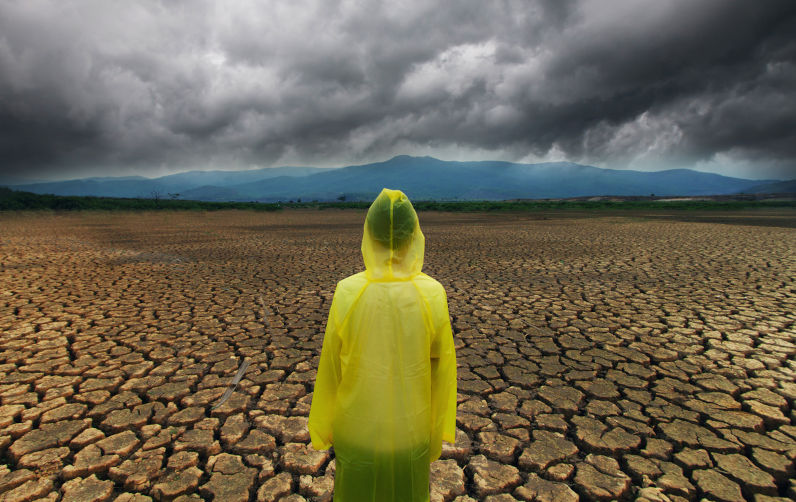
In a new book out today, Thom Woodroofe argues that climate and energy policy must connect with everyday economic pressures if it is to build lasting public support.
Many Australians believe two things to be true: that climate change is real, getting worse and of major concern; and that the week-to-week grind of paying for groceries, rent, fuel, school costs and electricity leaves little bandwidth for anything that seems like a big, nation-changing endeavour, unless it helps to alleviate those pressures.
This dynamic also ties into our political polarisation: most Australians want to see action on climate change, but where that can be perceived or mischaracterised as ‘going too far’ or decoupled from these immediate pressures, it can also be weaponised in the other direction. Take, for example, the successful campaign that Tony Abbott waged against Australia putting a price on pollution by presenting it as a ‘tax’ on Australian households. Or the exploitative reverse narrative by the new National Party leader, Matt Canavan, in the face of this year’s fuel crisis when he says that a ‘strategic wind reserve’ doesn’t do a thing for Australia.
This is not just anecdotal; the statistics back it up. In 2024, a large CSIRO survey found that most Australians backed a shift to renewables, with an overwhelming majority supportive of a significant transition. While many favoured a steady pace for that transition rather than a rushed one, the direction of travel was clear.
The other striking finding was that people wanted more transparent, local information about large-scale projects such as solar farms, wind farms and transmission. In other words, to be a success, this needs to be an open, shared journey.
Similarly, the 2024 Lowy Institute Poll revealed that ‘the vast majority of Australians’ (87 per cent) said they support the government subsidising renewable technologies, but ‘reducing household energy bills’ had overtaken ‘reducing carbon emissions’ as the main energy priority for Australians, even though both were considered important.
Likewise, the 2025 poll showed that more than half of the Australian public felt that ‘global warming is a serious and pressing problem’ and that ‘we should begin taking steps now, even if this involves significant costs’, with 75 per cent in support of renewables playing a major role in the energy mix. But, strikingly, Australians were divided on whether achieving a net zero target would leave the economy better off (38 per cent), worse off (36 per cent) or the same (23 per cent).
This trend was also pronounced among younger people, with Mission Australia’s 2024 Youth Survey Report revealing cost of living as the top concern, overtaking climate change. Mission Australia CEO Sharon Callister noted, “While climate change remains an important issue for young people, ranking second … it currently takes a back seat to the urgent financial challenges many are facing.”
This is also not a challenge that is unique to Australia’s climate and energy movement. In the United States, lifelong environmental campaigner Bill McKibben has been candid about the movement’s limits: it has often succeeded in winning the argument on the science, but struggled to build the kind of durable political coalition needed to overcome vested interests and the daily pressures that shape how people vote.
As Naomi Klein, journalist and Professor of Climate Justice, has said, the calculus cannot simply be about ‘end of the planet’ struggles versus ‘end of the month’ struggles, or humanity will lose. Just as Australia’s former Chief Scientist Alan Finkel has conceded, while humanity has undertaken enormous transformations before, they were always driven by self-interest.
The transition from people power to animal power meant that farmers could plough large fields and couriers could get from A to B much faster. The transition from horse power to steam power opened up previously unimagined industrial opportunities and led to mass transport. The transition from coal-fired steam engines to diesel engines for trains cut the expense and plumes of black smoke. The transition from town gas to natural gas allowed us to heat our buildings and run our factories at lower cost and with greater safety.
If we were in America, where I have spent a considerable amount of time working with and around both sides of politics, we would say we need a climate and energy policy for the ‘middle class’ or ‘the heartland’. To put this in the equivalent Australian political vernacular, some might say we need a climate and energy policy for ‘working families’, ‘the battlers’ or ‘quiet Australians’. But to put it more simply, our next wave of climate and energy policymaking needs to increasingly be fixed on middle Australia.
The fact is that Australia needs a climate and energy policy that works for everyone, from the Cabinet Room to the boardroom, to every lounge room across the mortgage belts, in the regions and beyond. Because the moral imperative to address climate is not enough to galvanise everyone. Good climate and energy policy should cost people less each month, not more.
It should help the increasing proportion of the country that rents to also embrace renewables and reduce their energy bills, as opposed to simply those who own housing, the increasingly out-of-reach ‘Australian dream’.
It should make the replacement for the family car a debate about what is cheaper, not a culture war.
It should show that there can be upwards, or at the very least sidewards, economic mobility during the transition, not downward mobility, as many workers fear.
It should breathe new life and confidence into our regional towns and industrial centres, rather than just being there for the bailout.
It should shorten commutes for those who live in the mortgage belts, not lengthen them.
It should make homes cheaper, to incentivise people to do more than insure their home to protect it.
I have come to believe that it is only through demonstrating these things we can finally convince all of the Australian population of the benefits of being an international leader on climate change, and that ambitious emissions targets, renewable energy and green exports will help to create a more stable and prosperous nation for us and our children. While we have made good progress in recent years, we have a long way yet to go.
This is an extract from Power, Prosperity & Planet: Climate & Energy Policy for All by Thom Woodroofe, published by Monash University Publishing as part of the In The National Interest series, available from 27 April.

Thom Woodroofe
Thom Woodroofe is a Senior International Fellow with the Smart Energy Council. He played a key role in securing the Paris Agreement on climate change in 2015, including helping establish the High Ambition Coalition of progressive nations. He has since worked as chief of staff to former Prime Minister Kevin Rudd; for the Department of Foreign Affairs & Trade in Washington, DC; and at the Asia Society in New York, where he forged a backchannel for US–China climate talks. Thom studied diplomacy as a Rhodes Scholar at Oxford University and grew up off-the-grid on a solar-powered property in regional Victoria.