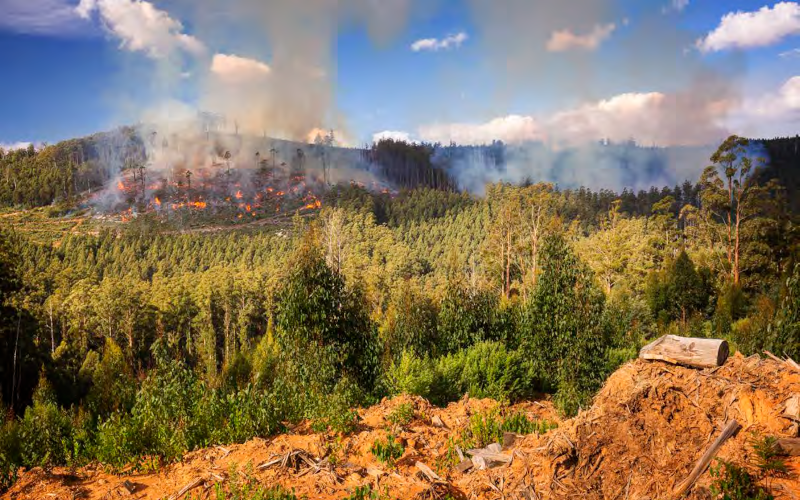
Research shows that logging, thinning and prescribed burning can increase forest flammability, challenging long-held assumptions about bushfire risk reduction.
The fire season in southern Australia is coming to a close. After yet another devastating year, a growing body of research points to an uncomfortable but critical conclusion: the way we manage vegetation and fire is not working – and in some cases, is making the problem worse.
Recent studies, including new work from Tasmania, show that logging can make forests far more flammable. Industrial logging creates dense regrowth that is highly fire-prone. This is not a new finding. Research following the 2009 Black Saturday fires and the 2019–2020 Black Summer fires has consistently shown links between logging and increased fire severity. Similar patterns are now being observed internationally.
This link between logging and fire risk reflects a broader problem. Many forms of disturbance – not just logging – trigger dense, highly flammable regrowth. It can be generated by mechanical thinning, where removing large numbers of trees creates more open, drier, and more flammable forests. This pulse of elevated flammability can persist for decades.
Prescribed burning can have similar effects, despite being widely promoted as a way to reduce fire risk. When interventions like logging, thinning and burning increase flammability rather than reduce it, they represent what has been termed “bioperversity”.
We have called the pulse of flammability created by logging, thinning, and prescribed burning disturbance-stimulated flammability. While the term is new, the phenomenon is not. It has been recognised for more than a century, including in Royal Commissions following major bushfires like that in 1939. Testimony after the 2019-2020 Black Summer fires acknowledged that prescribed burning can increase flammability in some forests. Some firefighters have gone further, describing hazard reduction burns as “hazard production burns”.
Disturbance-stimulated flammability increases risks to rural communities, firefighters, and to native plants and animals. It also challenges the assumption in fire management that more active intervention reduces fire risk.
What can be done?
Widespread mechanical thinning is not the answer. Evidence shows it often has limited effects on fire severity and can, in some cases, make fires worse. It also removes critical wildlife habitat, generates substantial carbon emissions, and is costly.
The effectiveness of prescribed burning also needs to be rethought. In particular, policies that target burning in remote areas far from people and property do little to reduce risk where it matters most (where people live) and may, in some cases, increase flammability.
A more effective approach is to focus management closer to houses and infrastructure, including the use of strategic slashing as a partial barrier to wildfire. Even then, it is important to recognise that interventions have limited effect under extreme fire weather. Slashing has another important advantage – it does not generate dangerous smoke pollution. Smoke from fire can have major health impacts, including increased risks of dementia, Parkinson’s disease, as well as impairing IQ in children.
Another key step is to stop creating large areas of fire-prone regrowth. This means strongly questioning the continuation of native forest logging in Tasmania, Victoria and New South Wales. These practices, in part, reflect a legacy of past forestry policies that deliberately removed less flammable old-growth forests and replaced them with more fire-prone regrowth.
Given the risks associated with logging native forests, timber production should instead be sourced from plantations. When well designed and managed, plantations can have reduced fire risk relative to logged native forests.
There is also a strong case for expanding the use of new technologies – such as drones – to improve early fire detection and support rapid suppression. These tools are not a substitute for well-resourced firefighting, but they can play an important supporting role.
Without a fundamental rethink of how vegetation and fire are managed, Australia will continue to face escalating bushfire risks. The evidence is clear: we can do much better – but only if we change course.
David Lindenmayer
Professor David Lindenmayer is a distinguished Australian scientist and academic, specialising in landscape ecology, conservation, and biodiversity. His research focuses on integrating nature conservation with agricultural production, improving biodiversity conservation in forestry and plantations, and enhancing fire management practices. With over 1000 peer-reviewed papers and 50 books, David is one of the most published ecologists globally. He leads large-scale, long-term research programs in south-eastern Australia. A Fellow of the Australian Academy of Science, he has received numerous prestigious awards, including the ESA Whittaker Award, multiple Eureka Prizes, and the Australian Natural History Medal.
Phil Zylstra
Dr Phil Zylstra is an Adjunct Professor at Curtin University who researches fire behaviour and the implications that this has for the ways we interact with forests.