If Iran succeeds in extracting reparations for the US–Israeli war, it would mark an historic shift in how power and accountability operate in the international system.
If Iran succeeds in extracting reparations for the damage done to it in the US-Israeli war, it will be a world historic moment.
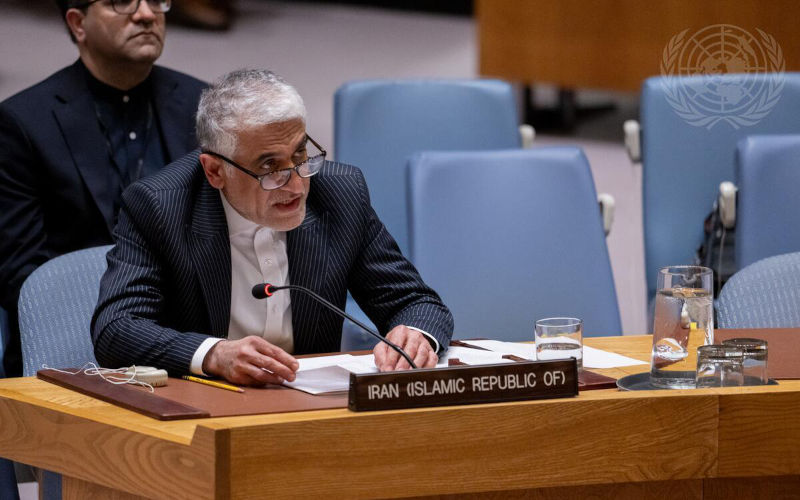
Iran may be bloodied but it remains unbowed and is seeking compensation from Arab states over ‘direct involvement’ in the US-Israeli war of aggression. Iran sent a letter to UN Secretary-General Antonio Guterres this month outlining its claim against Bahrain, UAE, Saudi Arabia, Qatar and Jordan. They also intend to apply a transit toll on the Strait of Hormuz as an instrument of restorative justice.
Under international law – if anyone still pays attention such things – the Iranians have a strong case. What will determine if justice is done, however, is victory over the aggressors.
Over 100 US-based international law experts, professors, and practitioners have released a letter stating that the United States and Israel violated the UN Charter by launching strikes on Iran on 28 February. The signatories include leaders of prominent international law associations and former Judge Advocates General – the top legal advisors to the US armed forces. They cite the complete lack of evidence of an imminent Iranian threat that could support a self-defence claim.
Under international law the aggressor is responsible for all the destruction that follows. The white-dominated western countries like the US, Australia and New Zealand should stop banging on about the illegality of Iran taking control of the Strait and address the root causes of why it did so.
So what is the case against the Arab states? In the early days of the war, radar systems operating from these countries were fully engaged in the war. Thousands of US troops were operating from 14 US bases in their territories. Attack planes, refuelling planes and aerial surveillance planes all operated from bases like Saudi Arabia’s King Fahd Air Base, as reported by Middle East Eye. Major western outlets such as the Wall Street Journal and the New York Times documented missile launches and multiple other ways Jordan and the Gulf States were directly involved in the war despite the mainstream media portraying them as innocent bystanders and victims of Iranian aggression. Trump and Secretary of War Pete Hegseth have both described the Gulf States as fighting “shoulder to shoulder” with the US and Israel. In filing their letter with the UN the Iranians have also provided satellite and other data to support their claim.
Iran argues that the Arab states, under international law, are co-belligerents. The UN’s International Law Commission Articles on State Responsibility (2001) defines the concept of “Aid or Assistance” in the commission of an internationally wrongful act. It is not hard for Iran to prove that these states did not maintain neutrality.
In reality, for Iran to get justice, deterrence and reparations, there is no international body or court to turn to; it must win by making a continuation too painful for the aggressors. There are signs it might just succeed. Iran has achieved something few on the western side anticipated: the destruction of most of the US bases.
Mark Lynch, director of the Project on Middle East Political Science at George Washington University told Middle East Eye: “The bases around the region are suffering real damage, and I think it’s very unlikely that we’re ever going to go back and put our Fifth Fleet back in Bahrain. It’s too vulnerable. This is the physical architecture of American primacy, and Iran has essentially rendered it useless in the span of a month.”
The war on Iran is a long way from finished. Even if the ceasefire holds, the Israelis and Americans will see this only as a stage in their multi-decade project to wreck Iran as a major regional competitor.
At the end of imperial wars, the victims are traditionally made to pay. In the 19th Century, the British fought the Chinese over the latter’s resistance to the British government’s lucrative opium trade into China. The imperialists won and imposed the infamous Unequal Treaties on China, including awarding to Britain the island of Hong Kong. Queen Victoria even shamelessly named a stolen Pekingese dog “Lootie” after the British sacking of Beijing’s Summer Palace, one of the great cultural crimes of history.
When the US war on Vietnam ended, decades of harsh US sanctions on their victims began. As the US moved towards accepting it had lost the war, Nixon promised $3.3 billion in reconstruction aid under the Paris Peace Accords (1973). The Americans never paid a cent. The US also pressured the IMF, World Bank, and UN agencies to block Hanoi’s applications for loans, seriously retarding reconstruction.
When the slave revolt in Hispaniola (present day-Haiti) drove out the French, the western powers returned in force a few years later and imposed harsh “reparations” for being dispossessed of their stolen land and humans. From 1825, Haiti was forced to pay 150 million francs to France to compensate former slaveholders for their “lost property.” This debt was only fully paid off in 1947, permanently crippling the nation.
The US-Israeli war on Iran is something different. Iran, like the Vietnamese, the Algerians and the Indians may have what it takes to prevail over imperial aggression. Iran may have something different: the power to impose reparations on the aggressor.
Across the west we are subjected to the astonishing chutzpah of leaders decrying the “illegality” of Iran’s declaration of sovereignty over the Hormuz Strait in response to the war launched against them.
These same leaders stood silent and complicit and lifted no more than an eyebrow as hundreds of Iranian schoolchildren were killed, hundreds of billions of dollars in infrastructure destroyed, and leader after leader were assassinated.
Cowards, all of them, they at best offered whispered rebukes when Trump threatened the destruction of Iranian civilisation in a single night. But tax a barrel of oil and “Oh my god, this is intolerable!”
Iran has every right to insist on reparations but they will only come about if Iran succeeds in imposing its position on the belligerents. The Israelis and Americans are unlikely to face justice at the ICC or ICJ, so reparations must be extracted from the other enabling states like the UK, Australia, New Zealand, Germany and France. It is an elegant solution.
One thing the Iranians will hopefully recover soon is their stolen money. Experts estimate more than $100 billion remains blocked in foreign banks (including in the US, Qatar, South Korea, and Iraq).
We should remember that since 1979 the western world has grievously damaged Iran’s economy via sanctions and the weaponisation of international trading systems, as well as blocking its integration within the community of nations.
If Iran succeeds in extracting reparations, it will be a world historic moment. It will be an achievement that will benefit countries around the globe which are assailed by major powers. Nuclear powers like the US and Israel should respect the territorial integrity of non-nuclear states. They have done the opposite – and should face consequences.
For these reasons and more, I hope the Iranian government succeeds in its historic mission to preserve the territorial integrity of the sovereign state of Iran and that they can receive just compensation for the terrible crimes committed against them.
I will give the last word to Mohaddeseh Fallahat, a mother who spoke to the UN Human Rights Council this month about losing her daughter to a US airstrike at Minab at the very start of the US-Israeli war on Iran:
“As they walked out the door, they simply said, Mum, come pick us up after school. That simple sentence now repeats in my mind a thousand times. Each time my heart burns with pain. No mother ever thinks she will send her child off to school with a smile, only to be met with silence.”

Eugene Doyle is a writer based in Wellington. He has written extensively on the Middle East, as well as peace and security issues in the Asia Pacific region. He hosts the public policy platform solidarity.co.nz.