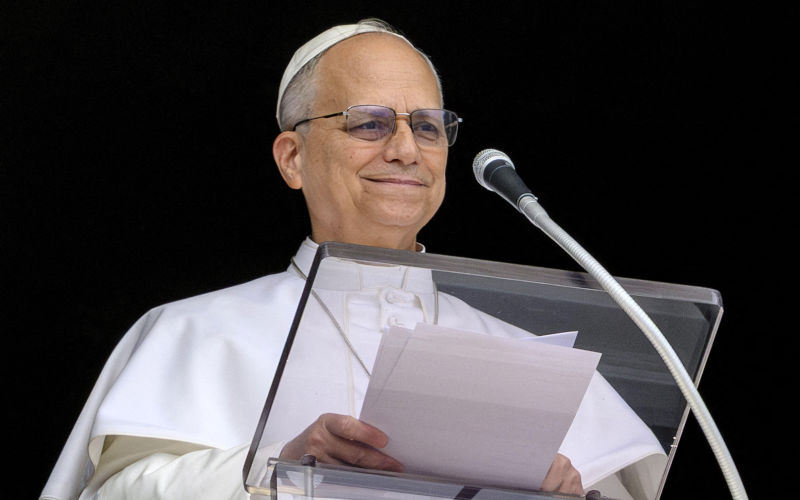
Pope Leo XIV has spoken on several occasions about the urgent need to seek peace and not war. President Trump and other American politicians have essentially told him to mind his own business and to stick to issues of religious teaching and belief. But Pope Leo is sticking to his essential business of providing ethical and moral leadership.
The Catholic Church has very explicit teachings about war, which can provide a moral compass for our times. These have two elements. When is it right or morally justified to go to war (the jus ad bellum); and how should war be conducted (the jus in bello).
Saint Augustine of Hippo, in the 5th century developed the view that war could be justified in certain circumstances to restrict evil forces. Centuries later in the 13th century, his teaching was clarified in much greater detail by the famous theologian Thomas Aquinas.
The Catholic Church’s just war teaching developed over centuries, as the shape and manner of wars became more dramatic, for example, as the power and destructive capacity of the weapons used increased, and it became more difficult to separate combatants from civilians.
This ‘just war theory’ is still held today as part of official Catholic Church teaching. It is outlined in the Catechism of the Catholic Church (reference sections 2307–2317). The jus ad bellum requires the following conditions to be fulfilled.
- There must be a just cause. Force can be used as a form of self-defence by nations against serious aggression. But it cannot be justified by revenge against aggression or as an attempt to gain economic advantage.
- War can only be waged by a proper and legal authority, such as a national state or government.
- There must be a good intention, such as to seek justice and peace, or an end to violence. The goal of gaining power, of destroying another nation state or dominating another culture would not justify military aggression.
- All other peaceful efforts must have been tried first, such as negotiation or economic sanctions.
- There also must be some reasonable prospects of obtaining a positive outcome. Otherwise, a war is only likely to cause more suffering, and would be judged immoral. This principle of proportionality is common in Catholic social and moral teaching. The positives likely to be gained must significantly outweigh the damage that might be caused by any action.
The second part of the Catholic Church’s teaching on just war relates to how the war itself should be conducted. This part of the teaching is called jus in bello.
- A key element of this teaching is that civilians should never be deliberately targeted.
- There should be a degree of proportionality in the use of force, a common feature of much Catholic moral teaching. The degree of harm likely to result should always be proportionate to the likely outcome.
- There should be no actions that could in themselves be classified as evil, such as torture, rape, targeting civilians or genocide.
Much of the content of the United Nations Declarations following the Second World War was founded on traditional Catholic Church teaching of this nature.
The two world wars also had an important impact that urged a clarification of the Church’s teaching: the Church never admits to changing its teaching, just explains the changes as ‘a development of doctrine’! Following these major conflicts, there was a significant movement (or clarification) from allowing war according to the above conditions, towards a deepening questioning of the morality of war itself.
The big change came during the Second Vatican Council in the 1960s. Vatican II declared that actions targeting whole populations were ‘a crime against God and humanity’. Indiscriminate destruction, such as nuclear war, was explicitly condemned. The teaching also incorporated a recognition of the proper place for conscientious objection, in other words refusing to fight on moral grounds. This became more common in Australia during the Vietnam War.
There was also a stronger emphasis on legitimate defence, peace making and prevention of harm. This marked a significant change in emphasis, where the teaching was placing a moral limit on action, rather than giving moral approval to actions in certain circumstances.
The introduction of nuclear weapons led to a significant change. Pope John XXIII, in his encyclical Pacem in Terris (1963), placed a new emphasis on the importance of global governance and human rights. The document argued that war is no longer a proper method of resolving disputes in this nuclear age.
Later, Pope John Paul II expressed strong opposition to preventive wars such as in Iraq in 2003. And he considered nuclear deterrence as only a temporary, but morally uncertain, stop gap measure. It was never endorsed as morally good, but only as a deterrent of last resort.
The 1992 edition of the Catechism of the Catholic Church made the conditions of justifying warfare extremely demanding. The existing teaching was not abandoned, but the development of doctrine refined it in this way:
- There must be an expectation of lasting, grave and certain damage.
- All alternatives must have been tried.
- There must be a serious prospect of a positive outcome.
- There must be no greater harm resulting.
This development of teaching made it much harder to morally justify the use of war in the modern age. Most conflicts today would not qualify. In his encyclical letter called Fratelli Tutti (2020), Pope Francis wrote: ‘It is very difficult nowadays to invoke the rational criteria elaborated in earlier centuries to speak of the possibility of a “just war”‘.
In recent years, the emphasis of the Catholic Church has moved from asking when war is justified to how do we prevent war altogether? The focus should be on mediation, the promotion of human rights and the role of international institutions, such as the United Nations. While not an outright rejection of all wars, the Catholic Church now sees the conditions for war as so strict that modern warfare could rarely meet them.
So, finally, why has Pope Leo been so committed to speaking publicly about efforts to promote peace at the present time? A few clues exist in his choice of Leo as his formal title and his membership of the Order of Saint Augustine.
The Augustinian Order was founded in the 13th century by Pope Innocent IV and Pope Alexander IV and influenced by the teachings of Saint Augustine from the 4th century. Augustine had a strong religious conviction that the seeking of peace was the deepest human goal. He defined peace as the tranquility of order, in other words, a type of harmony where everything is rightly ordered towards God. For Augustinians, promoting peace means restoring the right relationships, both within the self, between people and in the wider society.
The current Pope’s choice of Leo as his papal title is his endeavour to continue the work of Pope Leo XIII (1878–1903). Leo XIII’s encyclical letter Rerum Novarum dealt with the underlying causes of social unrest, workers’ rights, and economic justice, and was very much related to the promotion of peace in society and in the wider world.
Pope Leo XIV’s emphasis on the critical importance of promoting peace in the contemporary world is consistent with Augustinian teaching and is apolitical. If Leo wanted to be political in this matter, he could be, but he has far too much intelligence and integrity to do that.
Republished from Australian Fabians 28 April 2026

Peter Norden
Peter is a Fabian and a former Jesuit priest. His forty years in The Jesuits, and the close associations he had during that time with key leaders in the Catholic Church, both nationally and internationally, gave him a more than ordinary insight into this area of contemporary community interest and concern. In 2007, he was made an Officer in the Order of Australia ‘for services to community development through social research and programs aimed at assisting marginalized young people and offenders, to the mental health sector, and to the Catholic Church in Australia.