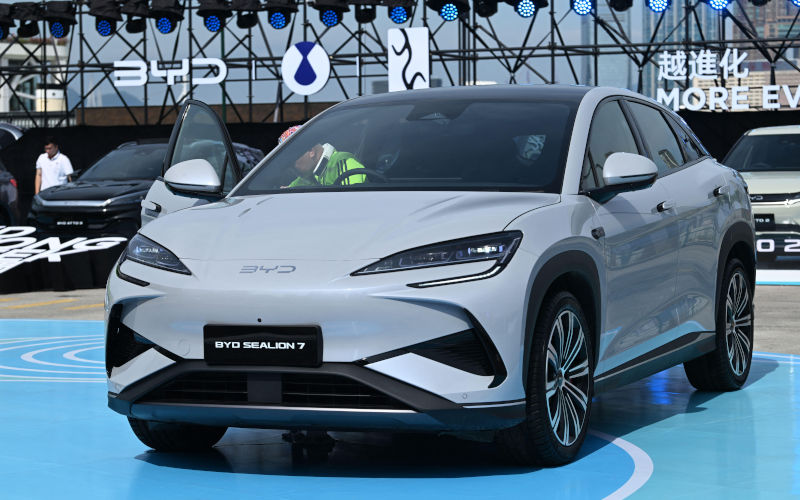
Australian politicians, in the reasonable pursuit of fleet efficiency, have approved Chinese-made EVs for ministerial use. According to a Sky News commentator, however, these cars are not merely transport, they are “rolling microphones”. In fact, they are the vehicles that will keep moving when the next fuel shock arrives.
Sky News has declared the six BYD (Build Your Dreams) electric vehicle models for use by Australian politicians as “the rolling microphone in the parliamentary garage”. This latest ‘China suspect’ concerns something far less dramatic than a grey-hulled destroyer thousands of kilometres off our shore. It’s a taxpayer-funded electric vehicle with excellent lumbar support and a very quiet motor. But, according to the Sky News commentator, “if you’re in a Chinese-made vehicle, they are listening to every word you say”.
It is a remarkable claim, and a revealing one. The Australian Signals Directorate – the professionals paid to worry about precisely these threats – did not object to Chinese EVs entering the ministerial fleet. That detail did not make it into the Sky News segment. Although no evidence has been given by our world-class intelligence officers, News Corp has pulled off a familiar trick: manufacturing a national security crisis out of a fleet procurement decision.
The irony of the ‘they’re listening’ panic sharpens when you hold it against the facts. Australia is not short of allies with documented mass surveillance programs – programs with legislated reach into the data of hundreds of millions of people. Those programs operate with bipartisan support and detailed enabling legislation. Yet Sky News has not commissioned many segments questioning whether the phones in our pockets, running software subject to foreign government data-access laws, represent a Trojan Horse. Apparently, data only becomes ‘surveillance’ when it travels in a particular direction. When it travels the other way, it is simply the cost of the alliance.
When the commentator delivered his warning, he did so surrounded by cameras, mixing boards and smartphones with components probably built in the same Chinese factories that assembled the BYD Shark. To accept the News Corp premise, you must believe that a microchip in a car dashboard is a security breach, while thousands of identical microchips in a television studio are merely tools of the trade.
It turns out the concern is not with Chinese microchips. It is with Chinese market share. A recent Wired investigation documented how dark-money groups in the United States are funding social media campaigns to frame Chinese technology as a threat to ‘family data’ and ‘national well-being’, a strategy designed less around genuine security than around protecting domestic corporate interests from stronger foreign competition. Whether a similar logic is at work here is a question worth asking: one inconsistency is on the record: in 2024 News Corp Australia named the BYD Shark its Car of the Year. Is this a conspiracy or an editorial culture that has not yet decided what it thinks, defaulting to alarm when geopolitics is in the air?
While the spy-car story was circulating, we were watching an actual transport-related national security disruption. The recent Middle East fuel crisis did not require a foreign intelligence agency to compromise a ministerial sedan. It simply required oil shipping routes to become unreliable and, within days, Australians were confronting the fragility of a transport network built entirely around imported liquid fuel. Petrol station queues, freight delays, logistics paralysis – a genuine, structural vulnerability exposed without a single microphone being planted anywhere.
An EV fleet drawing on a diversified and increasingly domestic electricity grid is not a security risk. It is a partial hedge against exactly that kind of disruption. The vehicles that News Corp warns might be ‘listening’ are, in practical terms, the vehicles that keep moving when the next fuel shock arrives.
This is what an evidence-based security conversation about EVs looks like. It is not the conversation being had on Sky News. For a media company that has reliably opposed the energy transition, the rise of the EV presents a structural problem. The spy-car story is a solution of sorts: it does not need to be true to be useful. It just needs to circulate long enough to slow a purchase decision or seed doubt about a policy direction. We have seen this pattern before. Whenever a new technology threatens legacy industries, a security concern is reliably found nearby.
Strip away the drama and the choice is not complicated. Australia can make transport and energy decisions guided by expert advice, economic evidence and genuine strategic thinking, including the hard-won lesson that a nation dependent on imported fuel is a nation perpetually one crisis away from paralysis. Or we can let a manufactured panic steer policy, ensuring that while we debate whether our ministers’ conversations are safe, we remain exposed to the vulnerabilities that actually keep people awake during fuel disruptions: a fleet that cannot move, a grid that cannot be domesticated and a transition that never quite begins. Next time the fuel runs dry, the origin of the rescue vehicle may feel less urgent.

Fred Zhang
Fred Zhang has worked across major, community, and industry media outlets in Australia for a decade. He has a keen interest in multicultural communications and strategic public engagement.