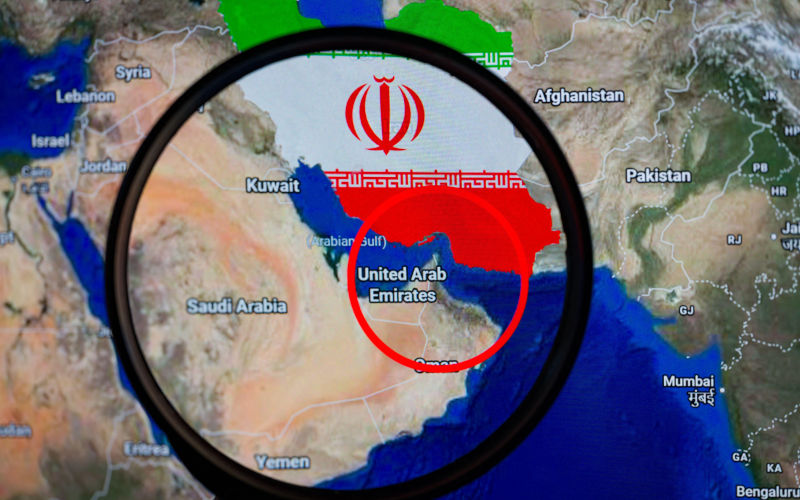
In the current Iran war, both sides are seeking to shape the narrative surrounding whatever agreement eventually emerges. This entails public rhetoric that may not align with quieter negotiations taking place between the US and Iran. The world is watching not necessarily the collapse of diplomacy but its transformation into a more public form of political performance.
On Sunday afternoon, 3 May 2026, Donald Trump used Truth Social to announce what he called ‘Project Freedom’: an American naval operation in the Strait of Hormuz involving 15,000 personnel, guided-missile destroyers, and more than 100 aircraft. According to statements from Trump, the operation’s purpose was humanitarian: to escort commercial tankers through one of the world’s most strategically sensitive waterways. He warned that any interference would be met forcefully.
If implemented at the scale described, the operation would amount to one of the largest American military deployments in the Gulf in recent years. The Strait of Hormuz carries roughly a fifth of the world’s traded oil and gas, meaning that even limited disruption quickly becomes a global economic concern.
At the same time, reports continue to circulate of indirect exchanges between Washington and Tehran through regional intermediaries, including Pakistan. Various proposals and counterproposals are reportedly moving quietly between the two capitals even as public rhetoric escalates. If those reports are accurate, then the central question is not why diplomacy appears unstable. It is why both sides seem determined to combine negotiation with public confrontation.
Part of the answer may lie in domestic politics rather than military strategy. Neither Washington nor Tehran appears to want a prolonged regional war. Both governments seem to be searching for something more politically sustainable: an outcome they can present at home as a victory rather than a concession. In that sense, the naval deployments, public threats, denials and social-media exchanges are not separate from diplomacy. They are increasingly becoming part of it.
Consider the pattern. On 7 April, Trump posted on Truth Social that “a whole civilization will die tonight” if Tehran did not yield, a threat retracted within hours by the announcement of a two-week ceasefire. When the first round of talks in Islamabad ended without agreement on 12 April, the United States imposed a naval blockade on Iranian ports the following day. Each escalation has been followed, within hours or days, by indications that diplomatic channels remain open. These are not necessarily the actions of governments preparing to abandon negotiations altogether. They may instead reflect attempts to strengthen bargaining positions before returning to the table.
Iran’s response has followed a similar pattern. Iranian officials have publicly rejected claims that Tehran would surrender its enriched uranium stockpiles or accept broad American conditions without guarantees. Foreign Ministry spokesperson Esmaeil Baghaei stated that enriched uranium was “as sacred to us as Iranian soil” and would not be transferred. Yet reports also suggest Iranian negotiators have continued indirect engagement through intermediaries and have submitted revised demands rather than withdrawing from discussions entirely.
Taken together, these developments look less like disengagement than strategic positioning. Beneath the rhetoric, both sides have strong incentives to avoid a wider confrontation.
Iran enters this phase under severe economic and political strain. Years of sanctions, declining revenues, domestic frustration and regional pressure have significantly narrowed Tehran’s room for manoeuvre. Even when Iranian officials project confidence publicly, the economic reality places limits on how long confrontation can continue without some form of negotiated relief.
The United States faces different pressures but similar constraints. American military commitments are already spread across multiple regions, while domestic appetite for another long Middle Eastern conflict appears limited. Trump, in particular, has political incentives to project strength without becoming trapped in a prolonged war that could damage economic stability ahead of future electoral contests.
For both governments, the challenge is not simply reaching an agreement. It is reaching one without appearing weak in the process. That pressure helps explain the importance of public messaging.
Trump needs to show that pressure produces results. Iranian leaders need to show that resistance prevents surrender. Both governments are therefore speaking to two audiences at once: each other across the negotiating table, and their own domestic audiences watching from home.
Social media has intensified this dynamic. Diplomacy that once unfolded mostly behind closed doors now develops in parallel with public messaging campaigns conducted in real time. Statements on Truth Social, speeches in Tehran, interviews, denials, leaks and counterclaims all feed into the same political environment. In effect, the public messaging is no longer separate from the diplomacy; it has become part of the bargaining process itself.
None of this is entirely new. Great powers have always negotiated through signalling, public pressure and political theatre. What feels different today is the speed and visibility of the process. Audiences no longer wait for diplomacy to conclude before interpreting it. They watch events unfold moment by moment through phones, feeds and rolling updates.
Pakistan’s role in this environment is also worth noting. Islamabad has historically maintained working relationships with both Tehran and Washington, while occasionally positioning itself as a regional intermediary during periods of tension. If current reports are accurate, Pakistan’s importance lies less in dramatic public mediation and more in providing a quieter diplomatic channel through which both sides can continue communicating while publicly sustaining harder positions. That quieter channel may ultimately prove more important than the public confrontations dominating headlines.
What the world may be witnessing, therefore, is not necessarily the collapse of diplomacy but the transformation of diplomacy into a more public form of political performance. The naval operations, public threats, denials and strategic leaks are not clear evidence that negotiations are dead. They may instead represent efforts by both governments to shape the narrative surrounding whatever agreement eventually emerges.
If a settlement does come, both sides will almost certainly claim victory. In reality, the outcome is more likely to reflect mutual exhaustion, strategic compromise and the political need for both governments to preserve credibility before domestic audiences.
Whether such an agreement produces lasting stability is another question entirely. Peace depends not only on what governments sign but also on how those agreements are defended, interpreted and sustained after the headlines fade.

Muhammad Amir
Muhammad Amir is a PhD researcher in International Relations at Deakin University, focusing on conflict resolution and regional politics.