BJP’s historic state dominance, Takaichi’s ‘proactive’ Indo-Pacific role, AI’s emerging role in diplomacy, Pyongyang’s ‘normal nation’ push, Myanmar’s change without change, Taiwan’s national happiness win.
Narendra Modi’s Bharatiya Janata Party (BJP) dominated India’s recent state and territory elections, winning in West Bengal and holding Assam and, with coalition partners, the federal territory of Puducherry.
BJP won West Bengal for the first time in the party’s 46-year history. It, and its alliance partners, now control 21 of 28 states, governing some 72 per cent of India’s 1.4 billion people.
Al Jazeera said the West Bengal victory was arguably the Hindu nationalist party’s most consequential victory since Modi came to power in 2014.
“The lotus has bloomed in West Bengal,” Modi said on social media, referring to BJP’s election symbol.
Five state and territory elections were held last month but the results were not declared until this week. The other two states contested were Kerala and Tamil Nadu. In Kerala, a communist government lost to an alliance led by Congress. Tamil Nadu was won by a new party led by actor-politician Chandrasekaran Joseph Vijay, known simply as Vijay.
But West Bengal was the grand prize. The state was home to almost 100 million people, 27 per cent of whom were Muslim. Al Jazeera reported that BJP campaigned on anti-incumbency themes against the seemingly entrenched, but now outgoing, chief minister Mamata Banerjee, and made use of its well-practised anti-Muslim rhetoric. It won 207 out of 294 seats.
The Electoral Commission of India had recently revised the voting rolls, eliminating 2.7 million voters in West Bengal. Muslims were disproportionately affected, according to Al Jazeera. An OpEd in The Statesman newspaper said no party had so dominated state and territory ground since the late 1970s, in Indira Gandhi’s time as Congress leader.
The footprint of the National Democratic Alliance, the coalition BJP leads, covered some 72 per cent of India’s land area, the article said. The Ganga (Ganges) ran entirely through NDA-governed states. “That is not a coincidence of geography,” it said. “It is the result of sustained political work across a decade.”
The results, said an analysis in The Indian Express, highlighted the national electoral prowess of the BJP and the ideological supremacy of Hindutva, a right-wing ideology that aims to make India a Hindu nation-state. The article, by contributing editor P B Mehta, said BJP’s victories were a tribute to furious energy and political imagination but they also carried a shadow for Indian democracy.
“For now, Hindutva is producing a culturally hierarchical order where the claims of identity imperil India as a zone of freedom,” Mehta said. “For now, India is in the grip of Hindutva supremacy; it has been sold as a utopian dream. There is no rival.”
Takaichi adds to Abe’s blueprint
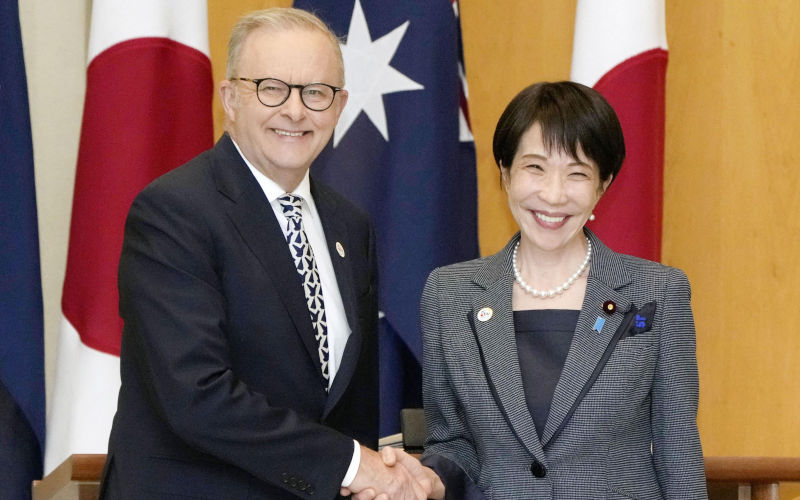
Japanese Prime Minister Sanae Takaichi visited Vietnam and Australia in the past week, stressing her commitment to the idea of a free and open Indo-Pacific, as spelled out by her predecessor and mentor, the late Shinzo Abe.
Two weeks before, in an online meeting with regional leaders, she pledged US$10 billion (A$13.78 billion) to help Southeast Asian nations cope with the effects of the US war on Iran on oil prices and supply. She later scrapped restrictions on the export of Japanese weaponry.
Takaichi has begun positioning Japan as a force for stability and strength in a region wary of China’s aggressive posturing and unsettled by Donald Trump’s volatile foreign policy, says a commentary in Singapore’s The Straits Times. The article, republished from the New York Times, said Takaichi was trying to raise Japan’s profile as China was strengthening its economic and military clout.
In Vietnam last weekend, Takaichi said she wanted to build on Abe’s notion of a free and open Indo-Pacific (FOIP) – a concept considered to be a way of countering China, the analysis said. The concept has three pillars – the rule of law, free trade and freedom of navigation; the pursuit of economic prosperity; and a commitment to peace and stability.
The Japan Times reported Takaichi in Hanoi unveiled a vision to revamp the FOIP concept by adding economic security as a new cornerstone of regional co-operation. Takaichi repeatedly revised her address while en route to Vietnam, the story said.
In Australia, she again mentioned Abe. “I want to take concrete steps (related to the new FOIP) to help make the entire Indo-Pacific region stronger and more affluent,” she said.
But whether the new FOIP initiative could gain broad support at a time of deepening geopolitical competition remained to be seen, the paper said. China had become increasingly assertive and the US, which had supported Abe’s concept, appeared to be deviating from the rule of law.
In an earlier story, the paper quoted Takaichi as saying she wanted Japan to play an even more proactive role in the Indo-Pacific.
She said in her Hanoi speech: “In this region, which holds the key to the future peace and stability of the international community, I am reaffirming my resolve to fulfill Japan’s role… in building an international order based on freedom, openness, diversity, inclusivity and the rule of law.”
AI helps but diplomacy needs human judgment
Singapore Foreign Minister Vivian Balakrishnan has developed a personal AI assistant. It connects to his communications channel, processes voice notes and images, schedules tasks and, crucially, has memory. In a recent Facebook post, he called it a second brain.
“The diplomat who learns to work with AI will have a meaningful edge,” he said. “I think that edge is now.”
International relations expert C Raja Mohan said Balakrishnan had opened a window on the future of diplomacy. Mohan, a contributing editor with The Indian Express, said diplomacy rested on two pillars: institutional memory (who said what, when and why in an engagement between governments) and individual craft, honed through years of negotiation and persuasion.
A self-learning AI system would not replace either, he said in a recent column. But it would reorganise and amplify them.
“The old machinery of diplomatic craft – slow, paper-bound, and hierarchical – struggles to keep pace with the velocity of contemporary diplomacy and the growing weight of the cognitive load on its practitioners,” Mohan said.
“AI tools will inevitably emerge as a force multiplier in modern diplomacy. A well-tuned AI system can draft communiques in minutes and cross-check decades of treaties for consistency.”
AI systems could be a levelling factor empowering middle powers and small states. “In the past, diplomatic advantage often flowed from sheer manpower,” he said. “AI changes that equation. A five-person delegation equipped with a sovereign AI stack could possibly match the analytical and drafting capacity of a 50-person mission.”
By eliminating the procedural drudgery, AI would free diplomats to focus on the human dimensions of the craft – awareness of other societies, political judgment and relationship building, Mohan said.
But there was a danger. As AI systems began to simulate negotiation outcomes, generate policy options and model crisis responses, the temptation would grow to let them decide.
“While AI can scan vast archives and detect patterns, it can also make serious errors in interpreting history or assessing present circumstances…[T]hey remain far from replicating the human ability to read political nuance, weigh competing interests and judge the mood of a counterpart.”
Mohan quoted Singapore’s Balakrishnan as saying diplomacy had long assumed practitioners were negotiating with another human intelligence – one with a brain and a heart, with each shaped by unique cultural, political and economic backgrounds.
“If diplomatic decision-making is outsourced to machines, that assumption comes under stress,” Mohan said.
No re-unification in new North Korea constitution
North Korea has revised its constitution, removing references to reunification with the South and defining only the North Korean region as its territory.
Terms linked to reunification, such as ‘northern half’, ‘reunification of the fatherland’, ‘peaceful reunification’, and ‘great national university’ have been taken out of the document.
The changes were in line with North Korean leader Kim Jong-un’s ‘two hostile states’ policy, declared in 2023, The Korea Herald said. The constitution was amended at the 15th Supreme People’s Assembly, held in March. It was discussed at a news conference held in the Unification Ministry in Seoul this week.
The Korea Times said the document now defined North Korea’s territory as the land between China and Russia to the north, and South Korea to the south, along with adjacent territorial waters and airspace.
It said the constitution did not identify South Korea as ‘primary foe’, even though Kim had previously referred to Seoul as an enemy.
Experts at the news conference viewed the changes positively. The Herald reported Yang Moo-jin, from the University of North Korean Studies, as saying the message from Pyongyang was ‘we will not covet your territory, so you should not covet ours’.
And Lee Jung-chul, from Seoul National University, was quoted in The Times as saying it appeared Pyongyang was trying to project an image as a ‘normal’ state.
The amended constitution also consolidated the authority of North Korea’s leader, formally identifying the president of the State Affairs Commission (Kim Jong-un) as head of state and ranking the position above the Supreme People’s Assembly.
The changes included scrapping the assembly’s authority to remove the State Affairs Commission president, the Herald said – weakening its symbolic oversight role. A new provision gave the State Affairs Commission president authority over the country’s nuclear forces.
Leader’s new house, behind high walls
Myanmar’s deposed and imprisoned leader, Aung San Suu Kyi, has been transferred from prison to house arrest and her sentence has been reduced, for a second time. The ruling regime disclosed the changes in a 39-second announcement on 30 April.
Suu Kyi would serve the remainder of her sentence in house arrest, Ucanews.com, the Catholic Asian news site, reported. It said her sentence had been reduced by one-sixth, the second such reduction in two weeks in April. Her sentence now stood at 18 years and nine months, down from the 33-year term imposed after the military coup of 1 February 2021.
Suu Kyi, 80, was moved abruptly from Naypyitaw Prison to a secure house in the capital on 16 April, the final day of Thingyan, the Myanmar New Year water festival, The Irrawaddy, a Burmese exile news site, said.
The house was in a neighbourhood for military families and was surrounded by high fences. Citing informed sources, it said construction was rushed to be finished on time and Suu Kyi complained about the smell of fresh paint.
On 17 April, the day after Suu Kyi’s transfer, the regime pardoned U Win Myint, Myanmar’s last democratically elected president, and released him to his family home. But Frontier Myanmar, another exile news site, said he was under close surveillance and guests going to his home had to register with the authorities.
It said in an analytical article Myanmar leader Min Aung Hlaing on 3 April traded his role as commander-in-chief of the armed forces to become the regime’s president, after an election that had been tightly controlled by the military junta.
“These political manoeuvres appear designed to show that a political opening is afoot in Myanmar, after five years of civil war and economic collapse,” it said. “There are doubts, however, about whether these developments pave a way out of Myanmar’s political crisis.”
Asia leads ‘least miserable’ economies
American economist Steve Hanke each year produces a ranking of the world’s happiest and most miserable economies. Hong Kong’s South China Morning Post said Hanke’s recently released 2025 ratings showed Southeast Asia as one of the healthiest economic neighbourhoods in the world, with Singapore and Thailand ranking among the ‘least miserable’ economies.
The paper reported, by the way, that the world’s happiest economy was Taiwan. Global demand for semiconductors and artificial intelligence software sent its GDP growth soaring, while unemployment, inflation and bank lending rates remained low.
Taiwan ranked as the ‘least miserable’ economy for the second year in a row, Taipei Times said. It said Singapore came second, followed by Thailand and Ireland.
The ranking, known as Hanke’s Annual Misery Index (or HAMI) measures what Hanke, from Johns Hopkins University, calls a country’s economic temperature. The rating is compiled using four factors – unemployment, inflation, lending rates and growth in real CDP. As with golf, a low score is better than a high one.
A total of 178 countries were ranked this year, SCMP said, and Venezuela, hit by US sanctions, topped the list with 556.5 points. Taiwan’s score was 2.1. Singapore’s rating was 2.6 and Thailand’s was 3.1.
According to Hanke, a low score meant jobs were healthy, prices were stable, credit was affordable and incomes were rising. “A high HAMI score means the economy is feverish and its people are suffering,” he said.

David Armstrong is the Editor-in-Chief of Pearls and Irritations. David is one of Australia’s best respected reporters, editors and media executives, with more than five decades of experience in Australia and Asia. A contributor for more than 10 years, David writes a regular column on Asian media.