
Home battery installations shattered records in April. Householders were racing to secure the biggest possible discount for the biggest possible energy storage system before changes were introduced to the federal rebate that are designed to encourage much smaller systems.
Industry analyst SunWiz says the race to beat the 1 May changes to federal Labor’s Cheaper Home Batteries rebate “sent the market into a frenzy,” adding a record
2.4 gigawatt-hours (GWh) of new residential storage capacity for the month – a 57 per cent jump on March numbers.
“The graph [below] shows that linear growth cannot be used to describe this chart,” SunWiz says.
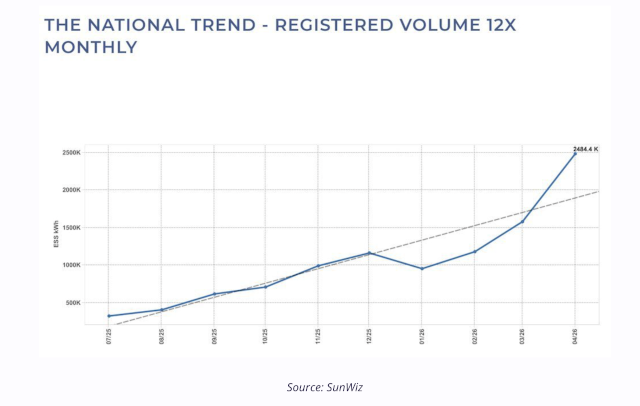
“In fact, we’re seeing something close to exponential growth”, it adds, “particularly given the tremendous increase from March to April, with 2.4 GWh now being registered for the first time in battery STC [Small-scale Technology Certificates] history.”
The data gels with the latest figures on Cheaper Home Batteries from federal energy minister Chris Bowen, who last week revealed that total system installations under the scheme had reached more than 360,000 in the 10 months since the program was first launched.
On Wednesday, at the Smart Energy Conference 2026 in Sydney, Bowen and the Clean Energy Regulator updated that number to more than 380,000. In a LinkedIn post, Bowen noted that the amount of storage installed by households since the launch of the battery project now exceeded 10 gigawatt-hours, or 70 times more than the original Tesla big battery at Hornsdale.
This follows the latest quarterly report from the Australian Energy Market Operator, which specifically credits home batteries – along with grid scale battery storage – for reducing demand in the evening peaks and lowering wholesale prices, which will eventually feed in to lower customer bills.
“Distributed-scale [batteries] are smashing it”, Johnston told Renew Economy on Tuesday. “And as a result, unleashing a huge workhorse towards this energy transition – at a pace that is hard to match.”
The huge surge in storage system installs was led by New South Wales, where 60 per cent month-on-month growth saw the state become the first in Australia to register more than
1 gigawatt-hour (GWh) of new home battery storage capacity in a single month.
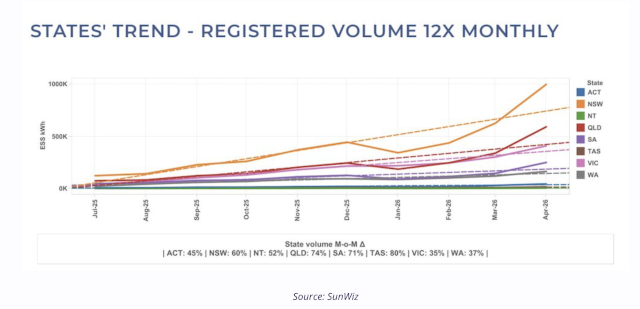
“It was only in November that we reported that national [home] battery capacity had crossed 1 GWh for the first time,” Johnston said. “Now, in NSW alone we’re seeing the same capacity registered in battery volumes in a single month.”
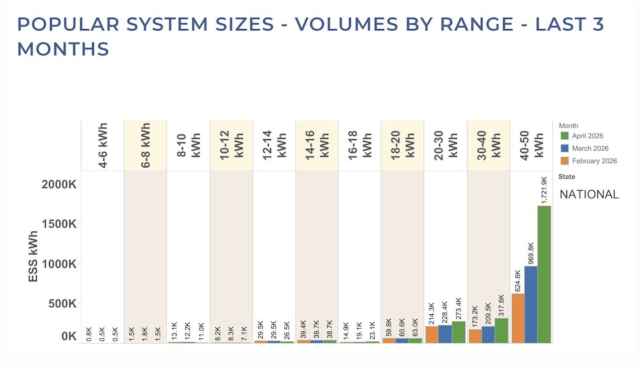
SunWiz says capacity gains were notched up in every state, ranging from 35 per cent in Victoria to 74 per cent in Queensland and 80 per cent in Tasmania. Among the various capacity size segments, its “like looking at a staircase”, says Johnston. “The larger the segment, the larger the increase.”
As the chart below shows, there was a huge 78 per cent increase in the installation of systems sized between 40-50 kWh – the segment for which the 1 May rebate changes will slash thousands of dollars from the available discount.
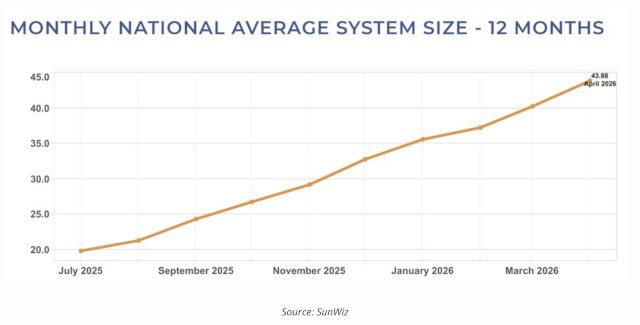
Meanwhile, the boom in battery uptake is fuelling more records in rooftop solar installations, with 442 megawatts (MW) of new small-scale PV capacity registered nationwide in April – a 31 per cent month-on-month jump and the strongest month in STC history, according to SunWiz.
“The May 1st battery rebate reduction drove a surge in large-format storage, which required proportionally larger solar arrays, lifting growth across every state and igniting a near-doubling in the 20-30 kW segment”, the report says.
According to SunWiz data presented in a webinar on home batteries hosted by Renew Economy last week, just 7 per cent of rooftop solar installations are currently for panels only – the rest are for solar and batteries, installed together.
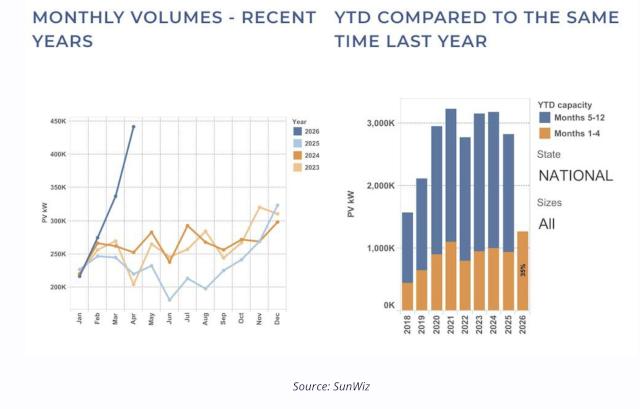
“We’ve got record volumes of PV – twice as much as the same time the previous year – and it’s all being driven by the battery rebate”.
As the chart above shows, the strongest first quarter of the past nine years was reported in 2021. But the first quarter of 2026 “smashed even that”, says Johnston, and compared to 2025, the market is 35 per cent ahead after the first four months of 2026.
The result, says Johnston, is a huge amount of extra energy generation and energy independence. “And with that – with those big solar systems and big battery systems – people will start to think, ‘well, what else can I do with that energy?’, which includes powering their EV and electrification [of their homes] too. “So there’ll be some really positive flow-on effects from all of this.”

Sophie Vorrath
Sophie is editor of One Step Off The Grid and deputy editor of its sister site, Renew Economy. She is the co-host of the Solar Insiders Podcast. Sophie has been writing about clean energy for more than a decade.