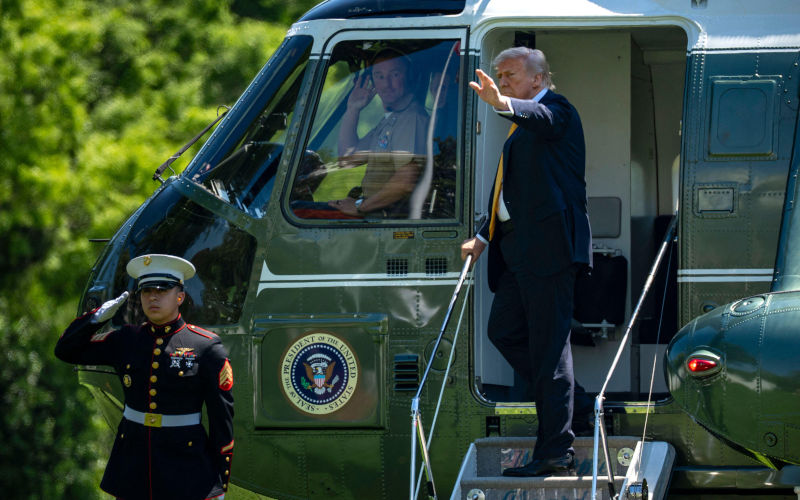
Donald Trump’s visit to China comes amid mounting tensions over trade, AI, security and the Middle East, but both Washington and Beijing appear determined to prevent the relationship sliding into deeper confrontation.
US President Donald Trump’s coming visit to China is being closely watched by business leaders, policymakers and Chinese-American groups hoping for signs that Washington and Beijing can stabilise one of the world’s most consequential relationships, even as expectations for major breakthroughs remain limited.
The trip comes against the backdrop of mounting geopolitical tensions, including the ongoing war involving Iran and disruptions linked to the Strait of Hormuz, as well as continued friction over trade, technology and national security.
Still, many in the United States see the visit as an acknowledgement by both governments that allowing ties to deteriorate further would carry significant economic and strategic costs.
“It’s the view of both Chinese-Americans, Asian-Americans and all Americans, quite frankly, that we need to improve the relationship between the United States and China,” Gary Locke, former US ambassador to China and chairman of the board of the Committee of 100.
“The world is looking for leadership from both the United States and China joining together to solve some of the most pressing issues facing the world,” Locke said, citing climate change, artificial intelligence, cyberattacks and nuclear proliferation.
US consumers and exporters watch summit for economic relief
For many Americans, however, the impact of the relationship is felt less through diplomacy than through household budgets and jobs.
Locke argued that tariffs imposed on Chinese imports had increased costs for US consumers already grappling with inflation, while retaliatory measures from Beijing had hurt American exporters.
“People want some certainty,” he said. “Prices are a lot higher, whether it’s for tools or shoes or clothes or toys or furniture.”
China’s retaliatory tariffs, he added, had reduced purchases of American soybeans, Boeing aircraft and medical equipment, affecting US workers and farmers.
The White House has signalled that economic issues will dominate the visit.
Randall Schriver, chair of the US-China Economic and Security Review Commission and a former assistant secretary of defence for Indo-Pacific security affairs, said the administration appeared primarily intent on making the current trade truce more durable.
“It appears to me that the Trump administration is mostly focused on the trade and economic agenda,” Schriver said.
“They want something that’s more durable and a little bit more permanent.”
Senior US officials have previewed discussions ranging from artificial intelligence to agriculture and energy cooperation, though they have played down expectations of sweeping agreements or large Chinese investment announcements during the trip.
The administration has repeatedly framed the relationship in terms of “stability” and “predictability”, language that some analysts see as reflecting concern over the economic and geopolitical risks of escalating tensions.
“They have said in their own strategic documents that they want a degree of stability, predictability and something that’s durable and sustainable in their relationship with China,” Schriver said.
The visit is also drawing attention from industries directly exposed to the bilateral relationship.
Farmers are closely watching whether Beijing could increase purchases of US agricultural goods, while aerospace executives are looking for signals on potential Boeing orders.
Technology companies, meanwhile, are seeking clarity on export controls and the future of advanced semiconductor sales to China.
AI and security tensions shadow Trump’s Beijing visit
Kyle Chan, a fellow at the John L Thornton China Centre at the Brookings Institution, said Trump’s visit was not a dominant focus in Silicon Valley, where companies remained “hyper-focused” on the AI race itself and building out computing power.
“But there are some parts of the tech community that are watching,” Chan said.
“Some in the AI safety community would like more dialogue between the US and China on AI safety risks. Nvidia and other US semiconductor companies are watching to see if Trump might relax export controls on chips and chipmaking equipment to China.”
Chan said concerns over AI safety and cyber risks had intensified in the US following the release of Anthropic’s powerful Mythos model earlier this year.
He said Xi was likely to push for greater international coordination on AI governance, potentially opening the door to official communication channels between Washington and Beijing on AI risks and standards.
“If the US and China can agree to start an official dialogue on AI, then this could one day lead to norms or even agreements that could shape AI development in both countries,” Chan said.
Samuel Bresnick, a research fellow at Georgetown University’s Centre for Security and Emerging Technology, said discussions around military AI systems had drawn particular attention in think-tank and academic circles amid the Iran conflict.
“We are seeing these systems become more powerful and more strategically consequential,” Bresnick said.
He said expectations for concrete policy breakthroughs should remain modest, but added that even establishing channels for dialogue on military AI risks and responsible use would be significant.
The trip is also unfolding as businesses continue adjusting supply chains after years of trade tensions, pandemic disruptions and geopolitical uncertainty.
While “decoupling” became a dominant term in Washington policy circles in recent years, Locke said what was happening now was better understood as diversification rather than a complete economic rupture.
“There is some natural decoupling occurring all around the world,” he said, arguing that companies had learned during the Covid-19 pandemic not to depend excessively on any single country for critical goods or materials.
But he added that the US and China remained deeply interconnected.
“We still need each other. We still absolutely need each other,” Locke said.
Scott Paul, president of the Alliance for American Manufacturing, said the summit was “very much top of mind” for businesses and manufacturing groups watching for agreements on trade, investments and critical inputs.
“For those who follow policy, the summit is very much top of mind,” Paul said.
“The outcomes could be very significant: potentially establishing a Board of Trade, making agreements on investments or purchases, or ensuring access for critical inputs.”
Paul said many manufacturers would welcome an “uneasy economic truce” that preserved some tariffs while reducing uncertainty, giving companies greater confidence that reshoring and supply-chain realignment would deliver long-term benefits.
He added that concerns over artificial intelligence were increasingly intersecting with manufacturing and trade debates, warning that heavy reliance on Chinese electronics imports for US data-centre expansion risked becoming “a one-in-a-generation missed opportunity to regrow a significant manufacturing sector in America.”
Iran conflict and Strait of Hormuz tensions hang over bilateral talks
Beyond trade and technology, the Middle East conflict is expected to loom over the talks.
China relies heavily on energy imports from the Gulf region and has criticised US military action against Iran, while Washington has pushed Beijing to take a more active role in encouraging regional stability.
Locke said Trump would likely press Xi to use China’s influence with Tehran to help reduce tensions and restore shipping flows through the Strait of Hormuz.
“That topic of Iran is going to be a very sensitive issue,” he said.
Despite the high stakes, Schriver said most ordinary Americans were probably not closely following the visit.
“I suspect most Americans are not paying much attention, because we’ve got an ongoing conflict in Iran,” he said.
“A lot of Americans are worried about kitchen-table issues like the price of gas and the price of energy and food.”
Still, among foreign policy, business and diplomatic circles, the summit is being viewed as an important indicator of whether Washington and Beijing can keep competition from spiralling into deeper confrontation.
Chinese-American groups watch summit for signs of stabilised ties
For Chinese-Americans, the visit also carries another layer of significance.
Locke said many in the community retained cultural ties and pride in China’s history while remaining firmly American.
“Most Chinese-Americans, most people of Chinese ancestry in the United States, were born in America,” he said.
“There’s a nostalgia for China, but there’s also a firm allegiance to America. We are American.”
He also pointed to concerns within the Chinese-American community over scrutiny of Chinese scientists and researchers in the US, as well as restrictions affecting Chinese students and academic exchanges.
“There’s been concern that the administration has really reduced the opportunities for Chinese students to come to the United States,” Locke said.
While the summit itself was unlikely to directly shape those policies, he said personal and cultural exchanges remained essential even during periods of strategic rivalry.
“Diplomacy first starts with people-to-people exchange,” Locke said.
“While the top leaders of the two countries work on very tough issues, organisations can help promote greater understanding between the two peoples.”
Additional reporting by Dewey Sim
Republished from South China Morning Post

Teresa Elena Frontado
Teresa Elena Frontado is an award-winning journalist and editor with over 20 years of experience. She has held senior leadership roles in several media organisations, including the Miami Herald, WAMU, WLRN and the Houston Landing. She is also a co-founder of The 51st, a hyper local news website in Washington D.C. She was a Knight-Wallace Fellows at the University of Michigan and has two master’s degrees, one in international law and another in Latin American history.

Lucy Quaggin
Lucy Quaggin is a New York City-based correspondent for the Post. She joined the Post as a digital production editor in 2021. Prior to this, she was a front page editor at Australia’s 7NEWS.com.au, and has worked across a number of newsrooms including HuffPost Australia, Sky News and ABC News 24 in Sydney, and Global Radio in London.