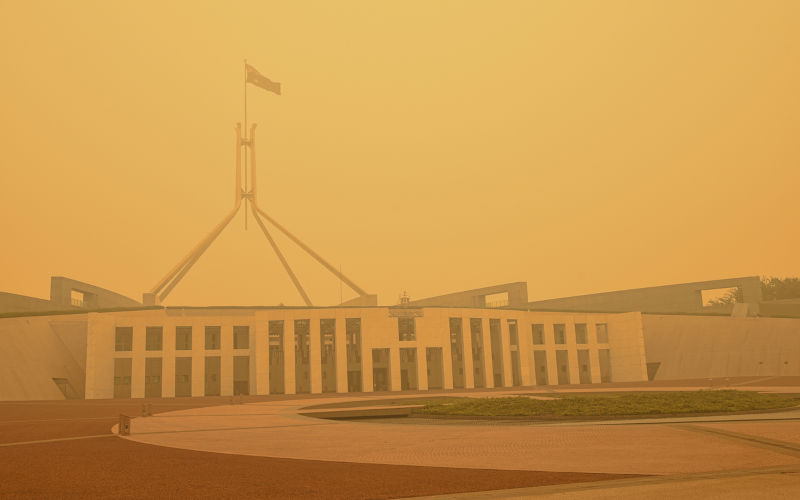
The 2026 budget is a continuation of the Labor Government’s denial of the urgent need to reduce carbon emissions before the climate reaches a tipping point.
The 2026 budget speech was titled ‘Resilience and reform’. ‘Resilience’ – a very fluid term favoured by political communicators these days – was deployed 13 times, but the word ‘climate’ failed to appear even once.
This glaring omission reaffirms the government’s reluctance – seemingly intentional – to discuss climate change risks, as I have previously discussed in P&I.
The budget continued the tax-friendly treatment of the fossil fuel industry and failed to reform tax loopholes and subsidies. The diesel Fuel Tax Credit scheme at a cost of $13 billion a year in 2026–27 was left untouched, and the broadly-supported proposal for a 25 per cent gas exports levy that would have delivered $17 billion annually was ignored. $2.2 billion over the next 14 years of the climate department funding was redirected.
How can we understand the government’s energy – and what’s left of its climate – policy? There are clear actions to support the transition from expensive gas and ageing coal plants to now cheaper and more reliable renewables and storage. But this has not so far significantly dented Australia’s greenhouse gas emissions because other sectors’ emissions continue to rise.
And the government is still giving licenses and tax advantages to new coal and gas exports, keeping Australia ranked in the top three in the world for gas and coal exports. Wherever possible, it promotes its ‘good-news’ domestic renewable energy policy, while avoiding discussion of future climate impacts.
Thus, Australia’s first climate and security risk assessment delivered in December 2022 by the Office of National Intelligence remains under lock and key. Even the Parliament, charged with making policy on the subject, is left in the dark. And the domestically focused National Climate Risk Assessment was proscribed from considering climate mitigation. It ended up low-balling on crucial issues.
This leaves Australians ill-prepared for what is to come. In his book, Upheaval, geographer and anthropologist Jarod Diamond concluded that the key predictors of success in responding to crisis and change are “acknowledgment rather than denial of a crisis’s reality; acceptance of responsibility to take action; and honest self-appraisal”, plus the “presence or absence of a shared national identity”, which can help a nation’s people recognise shared self-interest and unite in overcoming a crisis.
Four brief examples demonstrate that Australia is more at the denial than the acknowledgement end of the spectrum.
The first is the fate of the Office of National Intelligence report.
The second is the issue keeping climate scientists awake at night: the coming collapse of the Atlantic Meridional Overturning Circulation (AMOC), which transports tropical ocean heat to the northeast of North America and western Europe. AMOC is slowing down and now rapidly approaching a tipping point for its collapse over a hundred years.
This would be a going-out-of-business scenario for northwest European agriculture. Monsoons that typically deliver rain to West Africa and South Asia would become unreliable. Huge swathes of Europe and Russia would be devastated by drought. As much as half of the world’s viable area for growing corn and wheat could dry out. The southern hemisphere, including Australia, would become warmer and more prone to flooding. A regional food crisis could lead to large-scale people displacement and contribute to state breakdown and regional conflict.
Does that sound relevant to future food security for Australians – and regional security, too?
Yet there is barely a flicker of recognition about this from Australia’s political parties. A search of Hansard for the current parliamentary term (since May 2025) finds no reference to AMOC in either house.
The third example is the coming El Niño. Scientists are increasingly concerned that conditions now developing in the eastern Pacific will result in a ‘super’ El Niño later this year, perhaps the strongest ever recorded. In The New York Times, David Wallace-Wells writes it will:
… almost certainly [be] stronger than the ‘Super’ El Niño of 2015–16, and perhaps the most intense since the epochal El Niño of 1877… It’s almost certain that this El Niño will make 2027 the hottest year on record by some margin…A monster El Niño will give us at least a brief preview of a hotter and more chaotic world — a 2027 like we might’ve expected to see in 2035, and which not that long ago didn’t seem likely before 2050. ‘Prepare for bedlam’, the environmental writer Bill McKibben wrote earlier this year in anticipation.
For Australia, an El Niño means less rainfall and higher temperatures (drought) and less cooling cloud cover, including over the Great Barrier Reef. If this super El Niño eventuates, it will likely destroy swathes of the Great Barrier Reef, and produce record-breaking heat waves and severe fire risk, drought and lower crop yields and adverse health impacts on vulnerable Australians.
A check of Hansard for the current Parliament shows that no minister, or indeed Labor backbencher, in either house in the last year uttered a single sentence about the El Niño threat. Not a word! There are four mentions only by other parties: one by shadow minister Chester criticising the budget cuts to the Future Drought Fund; one by Greens Senator Whish-Wilson highlighting the issue in a short speech; and twice by Barnaby Joyce in what can only be described as wide-ranging rants.
The fourth example are the climate derailment and transition risks the government should have centre of mind. Transition risks are those associated with the move to a post-carbon economy. A recent study concluded the scale of the net-zero transformation means that reaching net zero will fundamentally overhaul vast parts of the global economy:
The transition is not simply a matter of swapping one energy source for another; it requires rebuilding infrastructure, retraining workers and redirecting trillions of dollars in investment…This uneven distribution of winners and losers will create difficult economic and political challenges, particularly during the transition period.
Even more pressing and most pertinent is derailment risk, where society becomes too distracted by escalating immediate crises to address the root causes of climate change by reducing emissions. A recent report by the UK Institute and Faculty of Actuaries, Parasol Lost, says an immediate step up in pace and preparedness can significantly reduce the impact of accelerated climate hazards, but warns that “global catastrophic risks, including economic shocks, are proximate”. And above 1.5°C:
We enter the danger zone where multiple climate tipping points may be triggered, such as the collapse of ice sheets in Greenland and Antarctica, permafrost melt, Amazon dieback and changes in ocean circulation. Some tipping points accelerate climate change…meaning there is a point of no return, after which it may be impossible to stabilise the climate close to conditions that we are able to adapt to.
The world reached 1.5°C in 2023, 2024 and 2025, and likely will again in 2026 and 2027.
Is our parliament capable of coming to grips with climate risks of these magnitudes? Or is it easier to abide by a new maxim, “Don’t mention the climate!”

David Spratt is Research Director at SafeClimate.org.au