The case for AUKUS rests on treating submarines as essential to Australian sovereignty, while ignoring the broader defence capabilities that already protect Australia’s maritime approaches and raise serious questions about whether new submarines are needed at all.
The debate on submarines currently consuming Australia’s headlines is corrupted by two compounding Ministerial lies by omission. That the truth behind the AUKUS submarine has been so avidly concealed demonstrates that the government knows the electorate will not tolerate it.
The first omission is not addressing what new nuclear submarines would do. We know now that former PM Morrison’s unexplained AUKUS confection with the United States (and UK) is meant to deliver nuclear submarines for high priority underwater operations defending the United States – not for Australia’s defence. And our Prime Minister Albanese has doggedly supported AUKUS, effectively gifting half a trillion dollars from Australian taxpayers to the US, to enhance its homeland protection. The evil of Scott Morrison’s AUKUS wedge is that all major political parties exploit it.
The Australian government’s public stance is so far from the truth that it can only talk of absurdities.
Defence Minister Marles, with withering insight, proclaimed that Australia is a three-ocean nation. Asserting that it’s obvious the vast distances mean the speed of a nuclear submarine is essential for our safety. Somehow a handful of nuclear submarines can just zip around three oceans and keep Australia secure. Germany had three thousand submarines and still failed to control the Atlantic in the second world war. This patronising garbage is the government’s way of hiding its subservience to America. Albanese has chosen a campaign of high-stakes deceit to secure his own political skin, and to hell with the consequence for Australia.
The second omission is that the value of our highly capable Defence Force in toto is systematically obliterated by the government. Australians are led to think Australia’s maritime security rises or falls on the submarine alone.
Yet Australia possesses a formidable array of overlapping maritime capabilities, built painstakingly since the first Defence White Paper of 1976. We have had to overcome the profound vulnerability of not knowing what is happening across our gigantic maritime and air surrounds. We did this by developing the unique Jindalee over-the-horizon radar, which detects and tracks aircraft and vessels well into the archipelago and our oceans. Out of new and upgraded airfields around the nation our potent combat aircraft reign supreme – even at great distance from our shore, refuelled by aerial tanker aircraft, controlled by Airborne Early Warning and Control (AEW&C) aircraft. Our long-range maritime patrol aircraft and surface combat ships can detect, track and kill submarines with acoustic technology and intelligent torpedoes. We have always had potent naval destroyers for both surface interdiction, antisubmarine and air warfare.
Why does the government evade mention of these deep defences, created determinedly over decades? Because it demonstrates that Australia’s security is sound without any submarines at all.
Indeed, that was the finding of the Defence Department when looking at replacing the Oberon submarines in the early 1980s. The Force Structure Committee (FSC) with six military Chiefs of Operations and of Material, the deputy chief of the Defence Force and science and analytical specialists assessed the marginal effectiveness of submarines in defending Australia. They found that submarines are of limited utility, as most of their functions are carried out more effectively by other elements of the Defence Force. A capacity for some specialist intelligence was recognised, but judged of incidental value.
This finding was driven largely by enduring factors – the relative immobility of submarines (even if nuclear), the vastness of potential areas of operations, and basing. Now that Jindalee bestows real-time surveillance of our surrounds, relative utility is even more diminished for the submarine.
Each member of the FSC, including from Navy, accepted that submarines offer little at the margin in Australia’s defence, at great cost. And no member, including Admirals, spoke against the submarine capability being disbanded. As it turned out, the Chair Alan Wrigley intervened suggesting it was worthwhile nevertheless to acquire a small number of small submarines to preserve the skills involved. It was further decided that no case existed to construct such submarines in Australia. Costly local production had to be limited, for critical capabilities. This became the Departmental position to be put to government.
Then along came Kim Beazley, a new Minister of Defence in 1984. He made it known that he had a view on submarines. Beazley did not want analysis or Departmental advice. Rather he required work to begin on large new submarines, to be built at Port Adelaide. The Department’s advice on submarine priority became irrelevant. Beazley then misled Cabinet, avoiding the submarine’s comparative effectiveness in defending Australia. Port Adelaide, a venerable Labor electorate, has since been the beneficiary of hundreds of billions of Defence money.
The submarine fix is scheduled to continue for Port Adelaide with the AUKUS submarines dwarfing this already egregious affront to taxpayers.
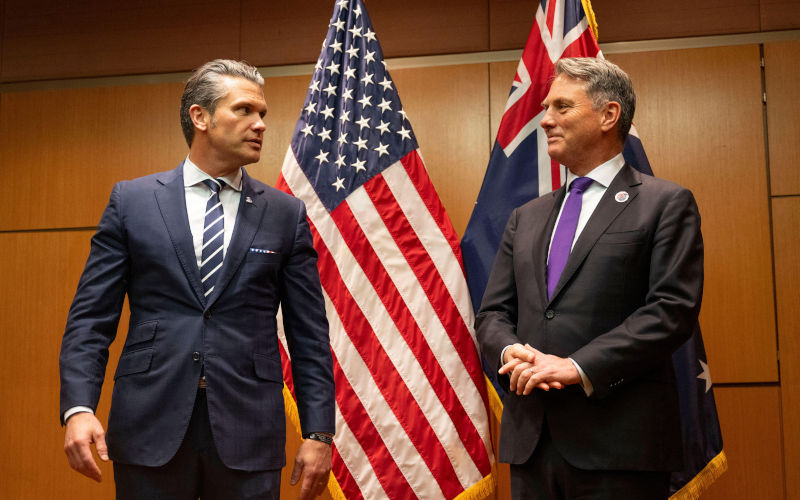
Last week, Richard Marles was asked about progress on the nuclear submarine plan while speaking at the Indian Ocean Defence and Security Conference and Exhibition in Perth. The defence minister brushed off calls for a “plan B” in case AUKUS fails, declaring it would be a step towards “giving up” on acquiring any new submarines at all.
Marles went further on the ABC’s 7.30 with David Speirs: “And were we to let go of this, were we to not have a submarine capability – that would represent a significant diminution in the nation’s sovereignty. I mean, in that moment we would become more reliant, not less on our alliance with the United States and that’s why we are so committed to being a submarine nation and to building our nation’s submarine capability.”
There we go again. Deliberate exclusion of anything else to defend Australia bar the submarine. A “submarine nation”? Patronising, brazen deception by Marles.
If Australia can’t have conventional submarines which best suit our northern waters, then we should not carry the cost of any.
What options would open up for a government not proceeding with new submarines? The scale of possibilities is mind boggling. Try 180 new major hospitals. Or the Melbourne-to-Brisbane Inland Rail freight line eight times over (scrapped half way because the government finds it too costly).
Every Australian is degraded by the Albanese government’s great submarine deception.

Dr Mike Gilligan worked for 20 years in defence policy and evaluating military proposals for development, including time in the Pentagon on military balances in Asia.