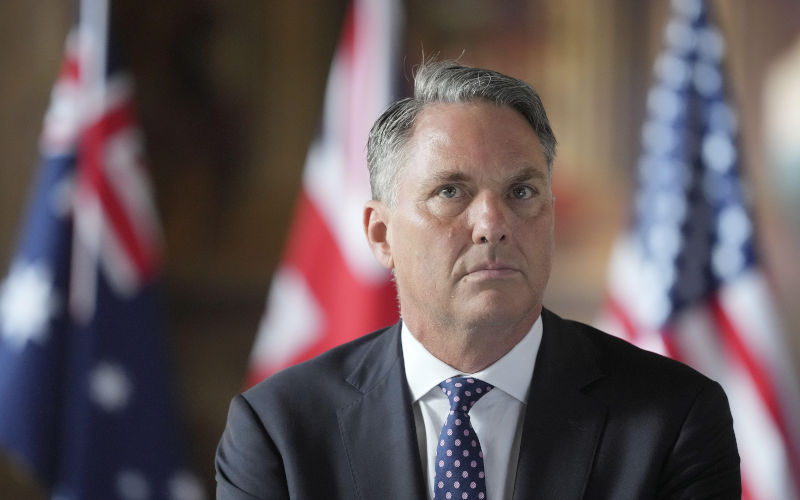
In the latest in our Foreign Policy Rethink series, Mike Gilligan argues that Australia’s renewed focus on defence self-reliance is incompatible with its deepening commitment to AUKUS and nuclear submarines.
Amid the attention demanded by the US-Israel war on Iran, Australia’s Defence Minister Richard Marles has released a little-noticed but promising new defence strategy – the 2026 National Defence Strategy.
It talks of self- reliance, as if that is a breakthrough for Australia. But self-reliance dates back 50 years, to the nation’s first Defence White Paper of 1976. Geopolitical realities at that time led us to pursue independence from America, though the path was unknown and sure to be tough and costly. Australia created a disciplined defence planning culture – ensuring defence dollars would not be diverted beyond our own priorities eg to US. Any treaty obligations to the US would be met from capabilities developed for our self-reliance. The United States agreed.
Politically, self-reliance was embraced bi-partisanly in 1976. Every Australian government thereafter, up to and including Malcolm Turnbull’s (Defence White Paper 2016) stuck with it.
In 2021, under Prime Minister Morrison, Australia’s independence evaporated into airy embrace of America and Britain as security partners via AUKUS. This triumvirate somehow decided that Australia should build nuclear submarines, to attack China alongside the US. In a twinkle Australia became an arm of American power. Australians had no say. Our disciplined, imaginative and regionally-respected independence of four decades was dumped. Without analysis or Labor whimper. The Albanese opposition unashamedly supported AUKUS on a skimpy briefing.
When the Albanese government gained power in 2022, America’s influence was accelerated. Minister Marles’ 2003 Defence Strategy was developed by hired academics of US security background. Self-reliance, specifically, was buried and so were decades of independent thought, policy and practical progress. Henceforth, fighting China with the US would be Australia’s defence objective:
“ Australia has a strong and deep Alliance with the United States, which is no longer the unipolar leader of the Indo-Pacific… for the first time in 80 years, we must go back to fundamentals, to take a first-principles approach as to how we manage and seek to avoid the highest level of strategic risk we now face as a nation: the prospect of major conflict in the region that directly threatens our national interest’ (2023 National Defence Strategy).
Now, after three years of US-centric fundamentalism, Minister Marles has discovered “self-reliance”. This is a big shift.
Fifty years ago, Australia experienced a capricious America up close, on foreign policy and the alliance. We had emerged from war on Vietnam exploited and bloodied, having acted foolishly, with no ANZUS treaty obligation. Hard thinking was afoot (within political and administrative circles) on distancing Australia. Then came President Nixon’s Guam doctrine in 1969, declaring that henceforth Australia must assume to be on its own:
“As far as the problems of military defence, except for the threat of a major power involving nuclear weapons. The United States is going to encourage and has a right to expect that this problem will be handled by, and responsibility for taken by, the Asian nations themselves.”
Gough Whitlam had visited China in 1971. On his becoming Prime Minister in 1972 work was already advanced on an independent Australia. The nation’s first ever Defence White Paper emerged in 1976, from the Fraser government, calling for self-reliance. Big change flowed. The military Services were rationalised into a single Defence Force. The Navy’s aircraft carrier was scrapped by the Hawke government at its first Cabinet. Decades of imaginative advances ensued, within strong policy and financial discipline.
Our transformation suited America, focused on Europe and West Asia. It was not until President Obama took exception to China’s economic rise that the US suddenly required fealty from Australia, to deal with China. And the US found it in Prime Minister Gillard, schooled by then-ambassador to US Beazley. Thereafter Australia was progressively embedded in US war planning against China, without explicitly forsaking self- reliance – until the Morrison government.
Scott Morrison was elected Prime Minister by political comrades aware of his capacity for turning viable endeavours into financial wreckage. That talent is on full display in the AUKUS device. Morrison committed Australia to a bit-part in America’s putative domination of China, to spend a possible $368 billion for attack submarines against our largest trading partner. The submarine cost was then, and remains, out of sight on any planning axis – over seven times Australia’s total annual defence budget to buy into a minor role in the US war machine in China’s approaches.
Morrison ignored the risk that this prolonged diversion of resources would leave Australia unable to defend itself. As did the Albanese government in 2023. Each of these last two Prime Minister has trivialised the judgement of every Australian government since 1976.
The question today is whether the Albanese government now appreciates that the depths it is plumbing in nuclear submarines are anathema to self-reliance. To date the government has been silent on the risk which the US itself has repeatedly warned – that US priorities will vary, but not always in accord with Australia’s. The ANZUS treaty has limited application which the US has made plain. Abrogation risk and financial overcommitment make the nuclear submarine a national folly. To claim that Australia can build self-reliant security while pursuing that folly would be an egregious national deceit.
Quite simply, Australia’s self-reliant defence is impossible while pursuing nuclear submarines. Defence Minister Marles’ adoption of a self-reliant defence policy is to be commended. But Australians must see signs of government unease about the submarine project. Easy enough, without fear of exaggeration.

Dr Mike Gilligan worked for 20 years in defence policy and evaluating military proposals for development, including time in the Pentagon on military balances in Asia.