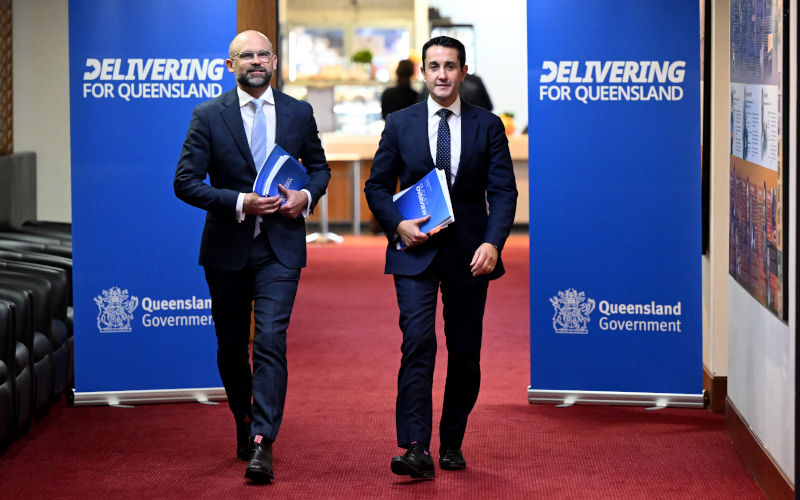
The release of the NSW and Queensland state budgets reveals a stark contrast in the recognition of the role of renewable energy in securing economic and social benefits.
NSW Treasurer Daniel Mookhey was unequivocal on the central role of the energy transition in economic growth and prosperity. Mookhey emphasised that the renewables transition is a top driver of investment into the state, with renewable energy infrastructure a significant contributor to the 20 per cent surge in investment over the year to the March quarter 2026.
He noted that clean energy transformation is ‘not merely an environmental cause, but an economic strategy’, and that to campaign against renewables, as his counterparts elsewhere and in previous governments have done, is to campaign against investment and jobs.
Home Energy Saver program
A centrepiece of the 2026–27 NSW budget was $557m (previously announced) under the Home Energy Saver program going to households, with interest-free loans of up to $15,000 over ten years to install energy-saving and cost-cutting upgrades.
The NSW Home Energy Saver program is expected to benefit more than 32,000 households across the state by making it easier to install rooftop solar, household batteries, insulation, reverse-cycle air conditioning, switchboard upgrades and draught-proofing.
This is a significant boost for NSW consumers that further turbocharges the massively successful Cheaper Home Batteries program of the federal government that provided a 30 per cent discount to the upfront cost of installing home battery systems. In less than a year, more than 400,000 homes have deployed batteries under the scheme, adding 11.2 gigawatt-hours (GWh) of distributed, dispatchable energy to the grid.
The NSW Home Energy Saver program provides the critical financing support for low- to middle-income earners and households to take advantage of the massive cost savings that are realised through renewable energies. It will also help to safeguard families from inflationary and volatile fossil fuel markets – one of the largest drivers of the cost-of-living crisis that has thrashed Australians.
Support for low-emissions manufacturing to accelerate the energy transition
The NSW government has launched the $480m Net Zero Manufacturing Initiative to fast-track emissions reduction and build enabling technologies for the energy transition.
Building on the $52m provided to four projects across agriculture, transport and electricity decarbonisation streams, yesterday’s budget confirmed $225m across three grant streams to support the development of low-emissions technologies and local manufacturing capacity of low-carbon products, and stimulate local manufacturing of renewable generation, storage and transmission components.
Climate Energy Finance applauds these measures, which are vital to realising a vision that places NSW at the centre of a prosperous domestic zero-emissions future.
Tomago aluminium smelter
Tomago is Australia’s biggest single energy user. It supports more than 3,000 direct and indirect high-value jobs and is a key export industry. Its majority owner Rio Tinto is threatening closure on the basis that after December 2028 it cannot procure electricity at a market price low enough to guarantee continued operations. NSW is continuing to work closely with the federal government, which is in direct negotiations with the smelter on a new power purchase arrangement.
Yesterday’s budget includes a provision for NSW to contribute to ensuring Tomago’s ongoing operation, pending its federal counterparts finalising negotiations with the smelter. Details remain sketchy.
The policy problem here is of national significance if Australia is to realise its Future Made in Australia vision. A number of structural solutions have been put forward to leverage the balance sheets of the NSW and federal governments. This could include a government-backed scheme finance vehicle (SFV) to finance a renewables buildout surge to ensure clean energy supply to Tomago and other major industrial facilities at stable, long-term, commercially viable prices.
What is clear is that the clock is ticking and the merry-go-round of taxpayer-slugging subsidies without a permanent solution – such as the forthcoming bailout – needs to stop. The NSW and federal government must act with urgency to secure the future of green manufacturing in this country. Tomago is key to that.
Coal royalties
One area of energy policy where NSW falls down is coal royalties. The 2026–27 budget revised royalties up by $84m in 2025–26 and $186m in 2026–27. This reflects higher thermal coal prices in response to major disruptions to the flow of oil and gas resulting from the conflict in the Middle East.
While the people of NSW see some short-term improvement to the budget, the latest energy crisis rams home the opportunity cost and lost prosperity from failure to implement a progressive royalty structure in which royalty rates increase as the market price of coal rises. Such a structure equitably delivers higher returns to the people in times of energy crisis, when fossil fuel prices are inflated and exporters are making superprofits.
Fossil fuel demand is inevitably in terminal decline. The rate of displacement of coal with renewables ratchets up with each global energy crisis and accelerates with the continued massive export of renewable energy technologies from China. There is a narrowing window of opportunity for NSW to replicate the leadership shown by the former Labor Government of QLD to introduce a progressive royalty regime.
Queensland fails on energy
In contrast to NSW, the Queensland budget misses the mark completely on energy, ignoring the enduring social and economic benefits of an accelerated transition to renewables. Instead, the Crisafulli government budget shows a clear emphasis on the importance of intergenerational investments into infrastructure such as transport. This is also key, but not at the expense of the former. The budget lays out just $490m for renewable energy generation and storage – a fraction of the spend into fossil fuels.
Royalty and land rent revenues are expected to be $2bn higher in 2026–27 than forecast in the 2025–26 MYFER, as a result of elevated commodity prices for LNG, coking and thermal coal, and increased coal production following weather-based disruptions in 2025–26.
Queensland’s LNG exports rose to a record volume of 24 metric ton in 2024–25 and are expected to be as strong in 2025–26. Treasurer David Janetzki has confirmed no changes will be made to the state’s coal royalty regime, choosing to continue to benefit from the political courage of the previous government, which introduced the progressive royalty regime against howls of protest from the fossil fuel lobby.
Billions into sustaining ageing coal capacity and new gas
The Queensland budget includes $5.1bn to upgrade and sustain the state’s ageing coal-fired power stations and build out new transmission infrastructure. This includes $1.8bn over the next five years (up from previous estimates of $1.6bn) allocated to maintain existing power generators.
The ‘electricity maintenance guarantee’ will include $520m in 2026–27 for upgrades to Stanwell, Tarong and Kogan Creek coal-fired clunkers and the Wivenhoe pumped hydro station. $501m will go to the Gladstone Project, a $2.5bn transmission project to support the local grid ahead of the closure of Queensland’s oldest and largest coal-fired power plant, the Gladstone Power Station.
Treasurer Janetzki spuriously claimed the state’s five-year energy plan – which scrapped renewable energy targets and extended the life of coal and gas-fired generators – was already delivering for Queenslanders through lower energy prices. This is despite the fact that the Australian Energy Regulator attributed the 2–14 per cent drop in wholesale energy prices in the 2026-27 Default Market Offer (DMO) across the national electricity market to increased output from wind and batteries and less dependence on gas and hydro in evening peaks. This dropped the DMO by 7.2 per cent for residential customers and 10.4 per cent for small businesses across Southeast Queensland. For rural and regional consumers, this determination from the regulator was passed through the Queensland Competition Authority to ensure proportional savings were delivered to regional Queensland.
A legitimate energy plan should deliver enduring downward pressure and stability on electricity prices. However, deploying $1.8bn into sustaining the state’s ageing and increasingly unreliable coal-fired clunker capacity only extends the exposure and vulnerability of consumers and industry to the volatility and insecurity of international fossil fuel markets.
The latest modelling from AEMO, AER and CSIRO all show firmed renewable energy is the cheapest form of power moving forward. Putting bandaids on ageing assets without building out and enabling low-cost replacement capacity poses a significant risk to the sustainability, both economically and environmentally, of the Queensland grid.
Funding to support the development of critical minerals value-add
On a more positive note, the Queensland government will allow state strategic project declarations and introduce new powers to support delivery of high-priority projects aimed at fast-tracking the next wave of critical minerals and other state-significant projects. This will help unlock extraction, processing and export opportunities that strengthen and diversify the state’s economy. The 2026–27 budget includes $146.1m in new measures to support extraction, processing and rehabilitation.
A tale of two budgets
What was made abundantly clear with the release of both state budgets was the stark contrast in the recognition of the role renewable energy plays in securing enduring economic and social benefits to households, small businesses and industrial consumers.
Treasurer Mookhey’s budget correctly emphasised the critical role renewable energy investment and low-emissions products and technology will play in diversifying and improving the resilience of the NSW economy.
On the other hand, Treasurer Janetzki has missed the mark on energy, leaving Queenslanders exposed for longer to the unsustainable downsides of fossil fuels. He has produced a massive infrastructure plan that fails to deliver firmed renewables as a central pillar of industrial resilience and cost-of-living pressure reduction.
Republished from Renew Economy
AM Jonson
Dr AM Jonson is editorial director of CEF.
Matt Pollard
Matt Pollard is an analyst at clean energy consultancy Climate Energy Finance (CEF),