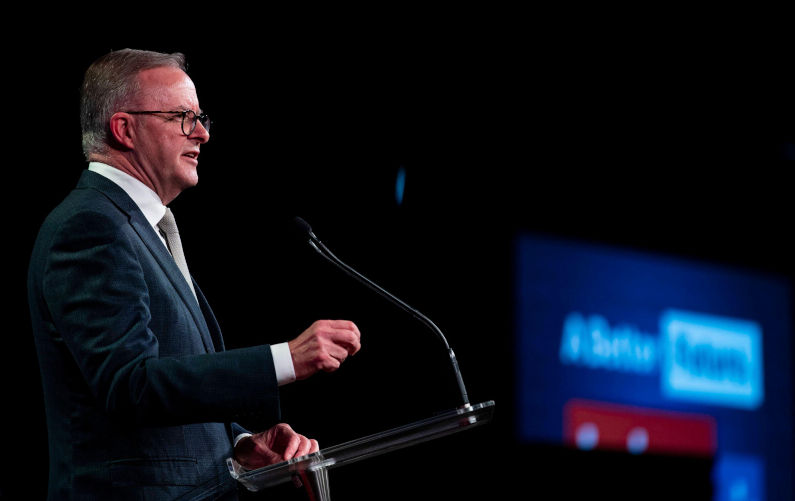
In the second of a two-part series ahead of the ALP National Conference, John Menadue argues Labor must apply its values to the great issues before Australia – sovereignty, human rights, democratic renewal, tax and the role of government.
If Labor is to recover its purpose, it must do more than recite familiar values. It must apply them to the great issues now before us.
The ALP National Conference in Adelaide this month provides an opportunity to do this. But it will require courage. Too many of Labor’s big-ticket items have run into the sand – climate change, major tax reform, relations with the United States and AUKUS, relations with China, foreign ownership and control of our mineral resources, reconciliation, relations with Asia and drug reform.
This is not simply a matter of better policy presentation. It is a matter of political purpose.
National sovereignty is a foundational political and legal value. It expresses the authority of a state over its territory and people, allowing nations to govern themselves without outside interference. In international law, it establishes equality among nations and requires mutual respect. It recognises that society’s laws and policies will reflect the values and aspirations of its own people.
In numerous ways, Australia has grievously surrendered its sovereignty to the United States, most recently in US military bases – Pine Gap, North West Cape, Tindal, Darwin and Perth – and in AUKUS.
Our rhetoric on international law and human rights is often not followed by implementation. We are in breach of the UN Human Rights Committee for breaches of the human rights of asylum seekers transferred to offshore detention in Nauru. We have legislated so that detainees cannot sue the government for any harm they endure while in detention.
We are in violation of many children’s rights. In Queensland, ‘adult crime, adult time’ legislation is a disgrace. The age of criminal responsibility in most of Australia is 10, well below the UN recommended minimum of at least 14.
Human Rights Watch has urged Australia to work with First Nations peoples to implement the UN Declaration on the Rights of Indigenous Peoples. The removal of First Nations children from parents is 10 times the rate of non-Indigenous children. Human Rights Watch has also documented chemical restraints being used in more than 150 aged care facilities.
By providing arms or material support that contribute to genocide in Gaza, Australia has not complied with its legal obligations. We delayed the recognition of Palestinian statehood. We have failed in our obligations under the Genocide Convention. Labor’s complicity in genocide is shameful.
A Labor Party serious about national sovereignty and human rights must confront these issues plainly. It cannot continue to invoke international law when convenient and ignore it when inconvenient.
At the same time as addressing Labor values, there are two immediate and critical issues. The first is democratic renewal in our public institutions, including the ALP.
Democratic systems, almost everywhere, are under great challenge, although we are in better shape than many countries, particularly the United States. Our judiciary too is in good shape, unlike when it became involved in the Dismissal of 1975. Our legislature is poorly regarded.
Loss of faith in parliament inevitably leads to denigration and loss of faith in government. Politics is a noble vocation. It is about how power should be exercised for the common good. Unfortunately, in the public mind, our politicians fall well short of that ideal. As a result, those whom Labor has traditionally represented, and the wider community, are the losers.
The Grattan Institute found 68 per cent of Australians believe that people in government look after themselves; that there is low democratic engagement beyond voting; that 42 per cent of Australians are pessimistic about the economy; that Australia’s sense of belonging and opportunity has declined from 75 per cent in 2005 to 61 per cent last year; that the wealth gap between young and old is growing; that we have little trust in the federal parliament and the media; and, that we have become more polarised.
Governments are overly influenced by powerful lobby groups and donors – miners, developers, licensed clubs and gamblers. The health ‘debate’ is not with the public but between insiders: the minister, the AMA, pharmacists and private health insurance companies.
Because Labor does not have a consistent principle-based set of policies – some would say a narrative – it has little capacity to defend or explain when its policies are misrepresented or misinterpreted in the media, as they have been on carbon and gas.
Democratic renewal is urgent: reform of the parliament, political parties, lobbyists, donors and the media.
But democratic renewal must include Labor itself. The ALP cannot credibly speak of renewing Australian democracy while its own membership has collapsed, its branches are weak, its factions control pre-selections and its internal politics is dominated by professionals, staffers and officials. Party members must matter again.
The second critical issue is the economic role of government.
We have been encouraged to forget that our prosperity is based on both public and private goods. To many people, government has become invisible. Australians have lost sight of the contribution of the mixed economy, not only in providing public goods, but also in ensuring that the forces of greed and short-sightedness are contained.
It is noteworthy that despite the continued denigration of government and the public sector, the three most trusted institutions in Australia are public institutions – the High Court, the ABC and the Reserve Bank.
There are economic functions where private funding or provision is possible, but only at high economic cost, with distorted incentives and serious consequences for equity. These include education, health insurance, energy and water utilities, and communication and transport infrastructure.
In these and other areas there are market failures for which prudent economic principles require a strong government role in funding or provision. Government aid should include an uptake of equity when given in support of essential industries in difficulty, such as airlines.
Unless Labor articulates and defends the proper economic role of government, equity and economic growth will be restrained by inadequate public spending and investment. Of these investments, the most important is in human capital, to ensure that people can develop their capabilities to contribute to their full potential through employment, business or unpaid work. In the competitive global economy of this century, human capital is a nation’s only secure asset.
Scandinavian countries demonstrate this. A population with skills and with incentives that match rewards is the best antidote to disadvantage and low self-esteem. It is not welfare, but well-paid and meaningful employment.
This is where Labor should be strongest. It should be the party that understands that government is not the enemy of prosperity, but one of its foundations. It should be the party that understands that a strong public sector, strong public institutions and strong public investment are not burdens on society but conditions of a decent and productive society.
But that requires a stronger taxation base and the courage to confront privilege. Australia cannot have Scandinavian-style human capital investment with a taxation system that protects speculation, inherited wealth, rent-seeking and foreign extraction of mineral wealth. Nor can it meet the challenges ahead while surrendering revenue to those most able to pay.
The National Conference should be the place where Labor says so. It should be the place where Labor acknowledges that its present timidity will not meet the challenges ahead. It should be the place where Labor begins to recover a principle-based politics, grounded in fairness, freedom, citizenship, stewardship, ethical responsibility and national sovereignty.
The alternative is more marginal seat management, more focus group language, more compromise with vested interests, more factional control, more policies that run into the sand.
Labor’s conference must be more than weasel words that won’t embarrass the government. It must be a test of whether Labor still has the courage to govern for the common good.
This piece is an update from an original article by John in 2014.
Read the first article in this two-part series:

John Menadue is the Founder of Pearls and Irritations and a board member. He was formerly the Editor-in-Chief. John was the Secretary of the Department of Prime Minister and Cabinet under Gough Whitlam and Malcolm Fraser, Ambassador to Japan, Secretary of the Department of Immigration and CEO of Qantas.