A new El Niño will likely bring heatwaves, droughts and health problems to southern Australia. In the UK, it’s already too hot for a warm beer. Wealthy nations are making very slow progress on emissions reductions.
El Niño is coming and health will suffer
I don’t think that I need to tell P&I readers that an El Niño event is developing in the Pacific Ocean, that the atmospheric and ocean measurements indicate it will be a strong one, or that El Niños tend to bring hotter, drier conditions in spring and early summer to eastern and southern Australia all the way across to WA.
It is, however, important to note that very high air and water measurements in the central Pacific now (summarised as a high ENSO Index) do not necessarily translate into very high temperatures and very severe droughts in Australia later in the year – there are many other factors that influence our weather. Nevertheless, Australia needs to be prepared for heat waves, droughts, bushfires, water shortages, unseasonal frosts (because of the reduced cloud cover), crop losses, food shortages, loss of wildlife and bleaching of the Great Barrier Reef.
While El Niño does not cause global warming and global warming does not cause El Niño, the addition of a strong El Niño to the global warming of around 1.4oC caused by anthropogenic greenhouse gases considerably increases the likelihood of a very warm second half of 2026 and first quarter of 2027 in Australia. And remember that, although the cooler La Niña phase of the cycle has prevailed over the last three years, these years have been the hottest on record.
Also, while El Niño refers to air and water conditions in the Pacific, its effects on weather are felt globally.
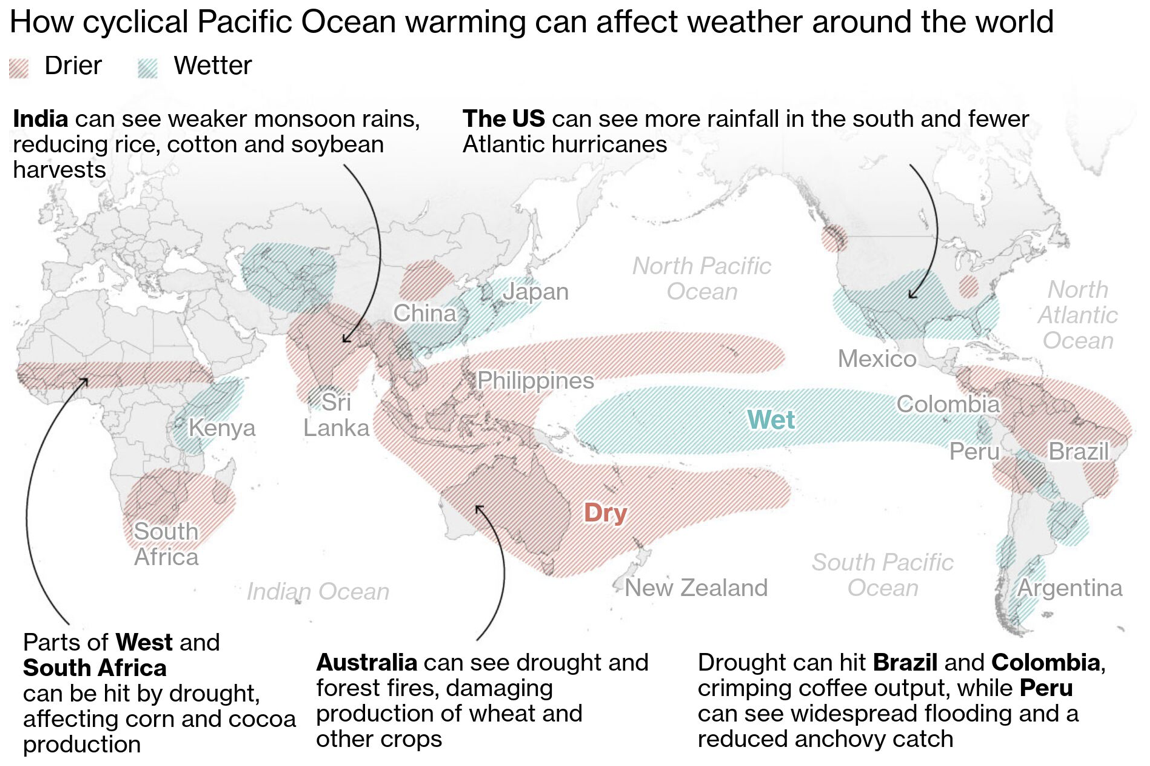
As well as signalling problems for Australia’s environment and economy, El Niño’s hot, dry conditions are also very harmful for human health:
- Extreme weather events: Australians are well aware that the heatwaves, bushfires, droughts and floods that can occur in hot summers often lead to injuries, pollution-induced respiratory problems, heat stroke, burns and drownings. Hot conditions can also disrupt people’s normal medication routines and some medications make people more sensitive to warm conditions. Extreme weather events can also lead to food shortages, higher food prices and food insecurity both locally and in the markets supplied, and, in some parts of the globe, malnutrition.
- Infectious diseases: Warmer weather makes more places suitable for disease-carrying vectors, such as mosquitoes, and facilitates disease transmission and the survival of infectious agents. Consequently, infections spread more quickly and outbreaks of diseases such as malaria, cholera and food poisoning can escalate.
- Mental health: During heatwaves, suicide rates, emergency psychiatric visits and hospitalisations for mental health problems increase.
- Life expectancy: Previous La Niño events have slowed improvements in mortality rates and led to decreases in life expectancy at birth of around 0.5 years.
It’s not possible to do anything to influence the weather we will experience in Australia over the next few months but it’s not too late for all levels of governments, emergency services, community organisations, neighbourhoods and households to make sure that they are as prepared as possible for the likely local events, not forgetting homeless people.
El Niño’s influence will be most noticeable later in the year but much of Australia is currently experiencing an extremely warm start to winter, with these conditions predicted to continue for a while.
Non-skiers may be enjoying a mild winter here but a very hot early summer is currently producing scorching temperatures in Europe, which is already experiencing global warming at about double the rate of the other continents. This 7-minute interview on Bloomberg news presents a very sensible discussion about the uncomfortable and at times dangerous effects of heat on individuals in their homes and outside, and on public services such as health, transport and power (many of which in Europe are dependent on very old infrastructure).
The main focus of the discussion, however, is on “climate inflation”, the general tendency for climate change in general and heatwaves in particular to increase prices (of, for instance, power, farm produce and real estate). Also highlighted are the different approaches of the Reserve Banks in the USA (not keen on government financial interventions to tackle climate change) and Europe where the central bankers are very keen to step in.
As the WHO recently advised governments: “climate change is not a future threat to be managed. It is an immediate and growing crisis affecting health, food, water, energy and national security simultaneously; and the current response is not matching its scale”.
Australia heading toward its 2030 emissions reduction target
It’s rare for me to report good news on tackling climate change by Australia but we are doing relatively well in one respect. In contrast with many other rich nations, we are at least making good progress towards meeting our emissions reduction targets (inadequate though Australia’s and other nation’s targets are to halt global warming).
Last year, 137 of the countries that are parties to the Paris Agreement submitted updated commitments (Nationally Determined Contributions or NDCs) aimed at limiting their greenhouse gas (GHG) emissions by 2035.
Collectively these commitments for 2035 will deliver less than 6 per cent of the emissions cuts needed to keep global warming under 1.5oC. While this is most unsatisfactory, it is not at all surprising based on past performance of the big polluting nations.
The wealthy G20 countries are responsible for over three-quarters of global annual GHG emissions (China, the US, India and the EU are responsible for over a half). However, they are collectively failing to meet their NDC emissions reduction targets for 2030, targets they submitted in the last round of submissions in 2021.
In 2023, of 14 of the G20 “countries” (actually 13 countries and the EU), only five were trending towards meeting their 2030 climate targets: Indonesia, Russia, South Africa, Turkey and, yes, Australia. This quintet of strange bedfellows is collectively responsible for 9 per cent of total annual global emissions. Australia is the only country which is cutting emissions above what is necessary to meet its target.
Of the remaining eight countries and the EU, Brazil and Canada face the biggest challenges. Brazil’s emissions increased by more than 50 per cent over the decade to 2022. To meet their target they need to have an annual rate of reduction of 5.4 per cent between 2022 and 2030 (see graph below). Canada’s emissions have been declining slowly but they need to increase the rate from 1.3 per cent per year to 5.5 per cent. It seems unlikely that either country will meet its challenge.
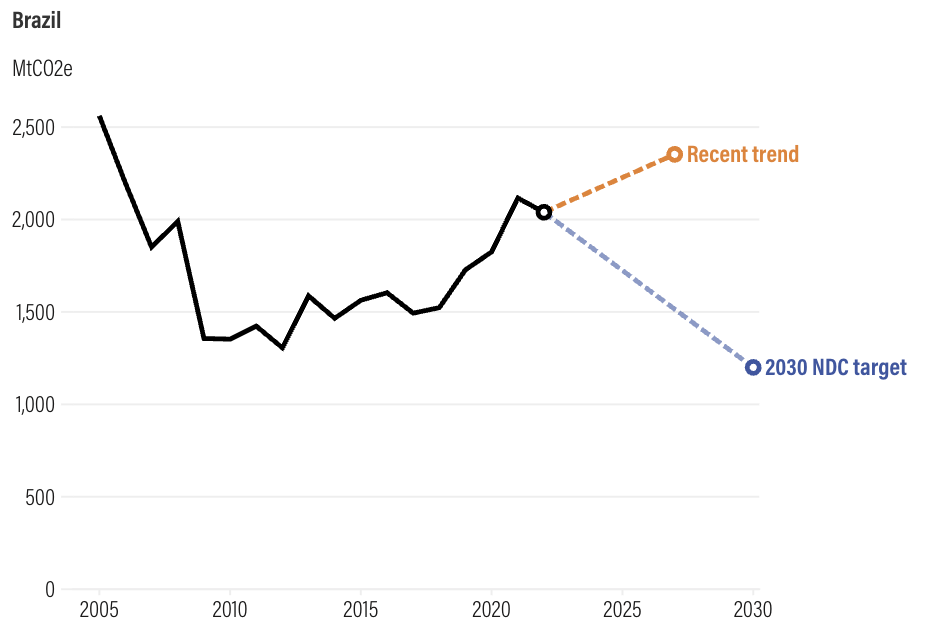
The climate action being taken by the world’s major economies is falling well short of what is required. According to the NDC report’s authors: “… for most G20 members, more work is needed to limit emissions, meet their targets and raise further ambition. 2030 is quickly approaching, and the longer action is delayed, the steeper and more costly the path toward achieving each country’s target becomes.”
Just to remind everyone, each country’s NDC emissions reduction target and their proposed climate actions are decided by each country for themselves, that is, they are not imposed by the UNFCCC or anyone else.
Most may still be off-track to meet their targets for 2030 but most of the very wealthy nations are at least now reducing their emissions. The graph below (from Bloomberg Green Daily on 23 June 2026) displays the domestic greenhouse gas emissions of the world’s largest capitalist economies between 1990 (roughly when the UNFCCC’s globally coordinated attempt to stem emissions began) and 2024. Several features stand out:
- There’s a lot of variation in the success rates over the 34 years. The UK and Germany halved their emissions but Canada, which likes to present itself as a good global citizen, didn’t just “experience”, it actively created, a 20 per cent increase in emissions.
- The UK and Germany stand out not only with their overall success but with their trajectory. Both got cracking early and have been consistently cutting their emissions since 1990. With the exception of Canada, which in 2024 was pretty much where it was in 1999, the reason all the others have not achieved greater reductions is that they allowed their emissions to increase for the first 15 to 25 years.
- Six of the G7 have been reducing their emissions over the last 20 years.
Come on Canada, you’re being beaten by the US.
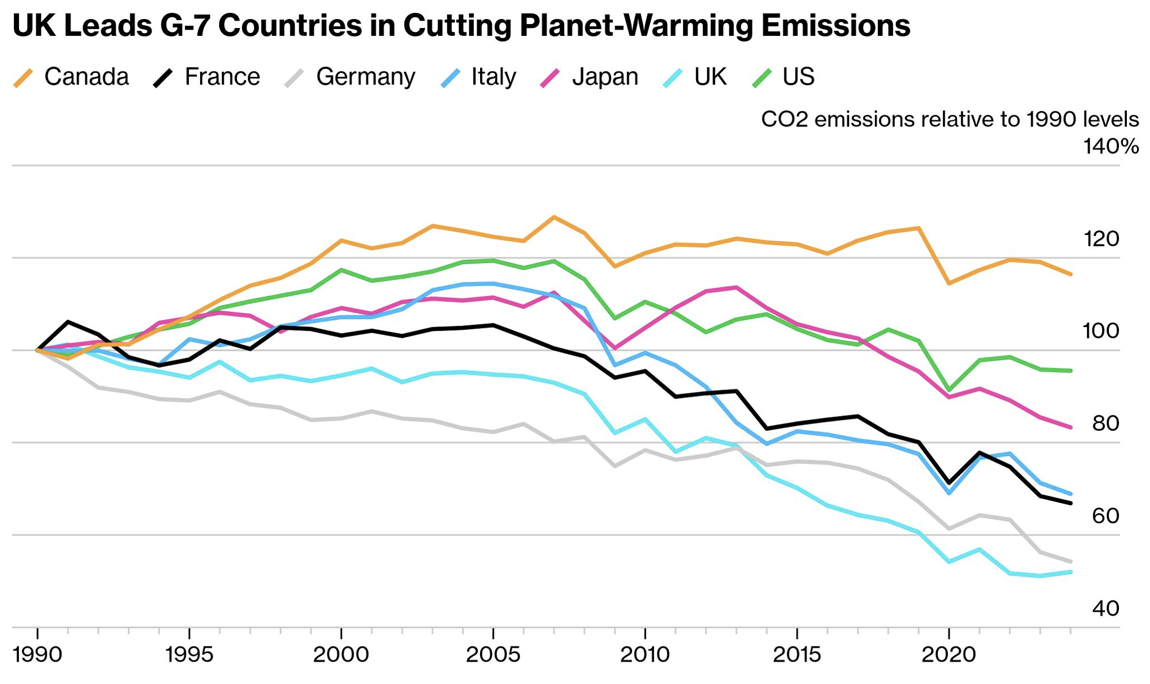
That said, it’s important to remember that the numbers here relate to emissions produced within each country’s borders. Some of the emissions reductions are attributable to dirty industries that have closed down and moved to countries where production costs are lower because labour is cheaper and regulations, particularly regarding environmental issues, are more lax. It would be interesting to see if the consumption-based emissions in the G7 countries demonstrate similar reductions.
Sleep, Australia, sleep: as we go we won’t feel a thing
Sleep, Australia, sleep
As off the cliff the kingdoms leap
Count them as they say goodbye
Count down the little things
The insects and birds
Count down the bigger things
The flocks and the herds
Count down our rivers
Our pastures and trees
But there’s no need to hurry
Oh, sleep now, don’t worry
‘Cause it’s only a matter of degrees
You can hear Paul Kelly sing the whole lament, accompanied by great images and terrible ones, in this video.

Peter Sainsbury is a retired public health worker with a long interest in social policy, particularly social justice, and now focusing on climate change and environmental sustainability. He is extremely pessimistic about the world avoiding catastrophic global warming.