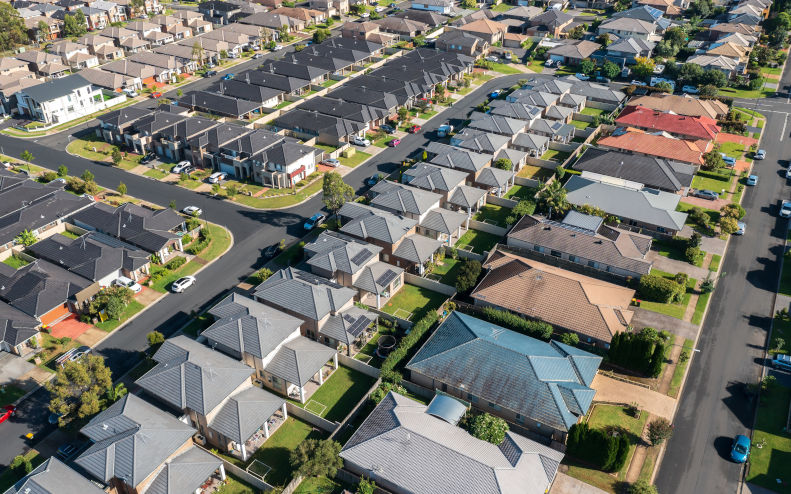
Housing policy should reflect the kind of society Australia wants to be: one that treats homes as a human right, builds neighbourhoods and social mixing, and stops privileging wealth accumulation over shelter.
Housing policies should reflect the sort of society we want to live in, not the quest for wealth accumulation. A home is not a commodity.
In the last budget we saw at last the importance of housing as a human right and not an investment opportunity for the wealthier. Not surprisingly the wealthy and their media supporters have mounted attacks on the budget in support of their own interests and not young Australians battling to find a home.
For the 25–34 age bracket, home ownership has collapsed from 61 per cent to about 43 per cent. Among Australians under 40, ownership rates have fallen by 10 to 15 percentage points over the last few decades.
The best response to the nonsense of Pauline Hanson is significant public investment in housing, health and education.
The property industry, with the help of the media, has been obsessed with the financial value of property as a commodity for wealth creation. We have had endless tables about how much the value of houses and units have increased in suburbs.
Housing policy should be about housing as a human right, where in homes we raise families, entertain friends and where we can close off from markets and business.
Too often property advocates and vested interests see the issue of housing as a technical problem concerning debt, prices and “bubbles”. Technical and management issues are important but there is much more at stake. What is really needed is policies should reflect the sort of society that we want to live in. “Housing” policy is not an end. It needs to serve certain values and principles.
What are the guiding principles that should apply to both house ownership and rental?
The first is that we should regard housing for its use-value. Too often we value housing for its exchange-value. We need to de-commodify housing. We must build houses to provide ourselves and others with shelter, comfort, a place where we can grow as individuals and a base from which we can develop as full members of society. We must avoid regarding houses as instruments of exchange as has so often been the case. Housing policy should not be influenced by the quest for wealth accumulation.
Older people like me have benefitted from increased property values through no virtue or work on our part. In the process we have frozen new home buyers out of the market. A fall in property values is socially desirable. And there are signs that may be happening. But the media keeps us focused on how we must protect our unearned property capital gains.
In the iconic film The Castle Darryl Kerrigan put it this way: ‘I’m really starting to understand what the Aborigines feel. Well, my house is like their land. Their land holds their memories, the land is their story, it’s everything, you can’t just pick it up and plonk it down somewhere else.” Kerrigan added: “It is not just a house, it’s a home. A man’s home is his castle … This is as clear as day. It is right and fair that a family be allowed to live in their own house. That is justice.”
Robert Menzies said in 1942: “One of the best instincts in us is that which induces us to have one little piece of earth with a house and a garden which is ours so that we can withdraw and in which we can be amongst our friends and into which no stranger may come against our will.”
It is an important principle that everyone should be able to live in a house or apartment appropriate to their needs. Housing is not a commodity or a market transaction. It is where we develop as members of a family and community.
The second principle is that housing must be part of a neighbourhood.
We are more than individuals linked by market transactions. Meaning in life comes from relationships both personal and communal. Our life in the public sphere is no less necessary than our private lives. As citizens we engage and contribute to the common good. It is in communities and neighbourhoods that we learn respect for others. It is where we abide by shared rules of civic contact. It is where we build social capital, networks of trust with our neighbours. We need to behave in ways that make us trusted members of our neighbourhood.
Unfortunately, many housing developments are sterile and hostile to the building of strong neighbourhoods. They promote exclusion rather than inclusion. Ugly shopping malls instead of local shops. More and more of our physical and metamorphic space is being enclosed by the market. This alienation from neighbours takes many forms in gated enclaves – high walls, roller doors, CCTV cameras, private entertainment, which all have the consequence of avoiding contact with neighbours and hinder the development of community. Good housing policy should be about building strong and vibrant neighbourhoods and not just isolated houses or units.
The third important housing principle should be the promotion of social mixing and sharing. It should be a basic requirement of good housing policy to avoid stratification or ghettos whether based on income, employment, religion or other grounds. During the Covid pandemic we saw the importance of public spaces and the social mixing of individuals, children, families and groups sharing our public parks and gardens.
Those public spaces must be protected and enhanced. Unfortunately, governments give access to these public spaces to developers, the new squatters on public land.
Public parks are deliberately underfunded, and we are told that access to iconic beauty spots can only be maintained with money from high parking fees.
Our health service increasingly discourages social mixing through the massive $12 billion-a-year subsidising of private health insurance which is separating out services for the wealthier. Our schools are becoming more stratified with wealthy parents aided by government subsidies, sending their children to separate private schools not because they are any better academically, but private schools give students social benefits in the jobs market.
Housing policy and programs must support social mixing through, for example, setting minimum and substantial levels of social inclusion in all major new developments.
In the post-war years, there was always a senior Commonwealth minister as minister for housing. For long periods housing was almost an afterthought. Fortunately, that has now changed with Claire O’Neil a senior Cabinet Minister for Housing.
But the Commonwealth government still fails to adequately fund social housing in cooperation with state governments.
Appropriate housing, education and health facilities are important human rights for everyone.
Housing policies and programs must be anchored in key principles; use value and not exchange value; building communities and neighbourhoods and social mixing and sharing.
An update from 15 November 2021

John Menadue is the Founder of Pearls and Irritations and a board member. He was formerly the Editor-in-Chief. John was the Secretary of the Department of Prime Minister and Cabinet under Gough Whitlam and Malcolm Fraser, Ambassador to Japan, Secretary of the Department of Immigration and CEO of Qantas.