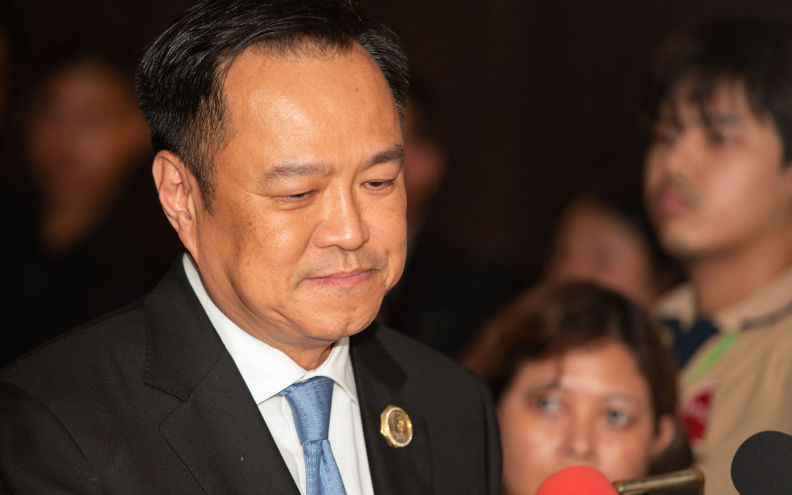
Thailand’s government commands a comfortable parliamentary majority, but corruption scandals, weak policy direction and a lack of tangible results are rapidly eroding its legitimacy.
When the Bhumjaithai Party-led coalition came to power after February’s election, it appeared to herald an unusually stable period after two decades of political volatility and turmoil. But less than four months into its four-year term, the government, backed it was believed by Thailand’s conservative establishment, appears shaky and unable to find its footing. The prime minister is embattled amid graft scandals and lacking clear policy direction.
As a crisis of government legitimacy is now percolating, Prime Minister Anutin Charnvirakul will come under growing pressure to revamp his cabinet and bring in more technocrats to deliver results or face the prospect of an early exit.
When he entered office, Mr Anutin was already hounded by two major existing scandals revolving around the allegedly rigged Senate election from June 2024 and the “Khao Kradong” encroachment of state-owned land – with the family of Bhumjaithai’s powerbroker, Newin Chidchob, among the encroachers. Being in power has encouraged the perception that the prime minister and his associates can exert influence over oversight agencies to delay and stymie the deliberations of these two cases.
Had Mr Anutin been able to govern with some policy thrust at the outset, it might have allowed his government to move forward and leave past scandals behind. Instead, more controversies have emerged without deliverables. The government mishandled petrol price hikes necessitated by the Middle East conflicts, allegedly handing a windfall to private petrol stations. To alleviate hardship from the energy crisis, a 400-billion-baht (US$2 billion) relief package was promulgated through a cabinet decree carrying a parliamentary majority. Half of the borrowing went to consumer subsidy, and the other half was earmarked for investments toward energy transition. While the opposition People’s Party challenged the package as misdirected and wasteful at the expense of fiscal discipline, the Constitutional Court ruled on 10 July that it falls within constitutional boundaries.
Other graft allegations will keep piling on government legitimacy. Another is a 1.6-billion-baht (US$48 million) AI scheme that was rammed through with questionable terms of reference, technical specifications and procurement processes. An initiative of the Ministry of Digital Economy and Society, headed by Chaichanok Chidchob, Mr Newin’s son and one of eight so-called “nepo babies” – scions of powerful political figures behind the coalition parties. Mr Chaichanok, who proudly declared the names of his parents upon entering parliament, is seen as a future Bhumjaithai leader. His political star has dimmed, partly as a result of this controversial project.
Yet the most egregious and damning may be the exam-rigging scandal involving bureaucratic posts for local administrations. Evidence has been found that thousands of exams were tampered with in connection with an alleged systematic bribery scheme involving officials under the Interior Ministry’s Department of Local Administration. The bribes are estimated to total some 4.5 billion baht (US$40 million).
Building on other graft cases, the exam-rigging has caused the most salient public outrage. While many bureaucratic posts at provincial level are paid just a few hundred dollars a month, they come with health and retirement benefits that provide family security. That the Interior Ministry’s kickbacks are so lucrative and systematic reminds the public why lower-level bureaucrats can be unqualified, inert and prone to graft.
The interior portfolio is traditionally the most powerful in cabinet because it supervises and administers departments overseeing rural governance, and a centralised and entrenched bureaucratic machinery. The post of interior minister is usually taken by the secretary-general of the largest coalition party, but in this case Mr Anutin has occupied both top posts. Accountability ultimately goes up to him.
On the policy side, the Anutin government has effectively put the “Land Bridge” idea and its associated Southern Economic Corridor on the back burner. The mega project to link up the three airports – Suvarnabhumi, Don Meuang and U-Tapao – around the greater Bangkok metropolitan area to make a logistics hub faces delay, as the contractor wants to renegotiate terms. Deputy Prime Minister and Finance Minister Ekniti Nitithanprapas has made promising noises, such as an investment-facilitating “fast pass” to cut through red tape. Commerce Minister Suphajee Suthumpun remains active on free-trade negotiations, especially with the European Union, although she seems to have lost lustre as the novelty of her communication skills wears off and she has no policy substance to fall back on.
To be sure, Thailand has been attracting considerable foreign direct investment in data centres and digital trade related to connectivity, while tourism receipts are steady. But policy directions remain largely uncharted because Mr Anutin is trying to survive on a day-to-day basis. He has been unable to come up with an outlook for Thailand’s economic future and diplomatic drive abroad. During recent parliamentary deliberations over the 3.78-trillion-baht (US$114 billion) budget bill with a projected deficit of 3.9 per cent of GDP, Mr Anutin delegated the government’s response to be led by Mr Ekniti while the prime minister made an official visit to France.
Despite his strong establishment credentials, the prime minister appears untenable unless he makes urgent changes to shore up public support and reassure his backers that he can weather the gathering storm. One major change could be a cabinet reshuffle, but it would test Mr Anutin’s mettle because the real powerbroker is Mr Newin. There is no sign that the prime minister has the heft to break away from Mr Newin.
Changing the cabinet line-up to entice technocrats and policy experts to enter the fray, let alone to empower them to get the economy moving, will therefore be Mr Anutin’s most daunting task in the near term. The alternative of accumulating corruption controversies in the absence of policy results will likely intensify public disenchantment. Without government responsiveness, public outcry may spill over into street demonstrations.
Thailand today does not face a crisis of parliamentary numbers because the government commands a comfortable majority. Instead, it faces a growing deficit of legitimacy. Unless Prime Minister Anutin demonstrates cleaner governance, clearer economic leadership and tangible policy results over the coming weeks, the stability that his coalition was intended to deliver may prove more fragile than it first appeared.
Republished from The Bangkok Post

Thitinan Pongsudhirak
Thitinan Pongsudhirak is a professor and senior fellow of the Institute of Security and International Studies at Chulalongkorn University’s Faculty of Political Science, he earned a PhD from the London School of Economics with a top dissertation prize in 2002. Recognised for excellence in opinion writing from Society of Publishers in Asia, his views and articles have been published widely by local and international media.