Despite all the talk, emissions will be almost 50 per cent higher in 2050, speeding up global warming and bringing tipping points closer. The US’s coercive neocolonialism trades medicines for minerals. And Australian mammals’ eyes, ears and noses help them enjoy the night.
UN projects emissions will keep increasing until 2050
The figure below (taken from the UN Environment Programme’s recently published Global Environment Outlook 7) contains what has to be the most depressing information I have presented in P&I.
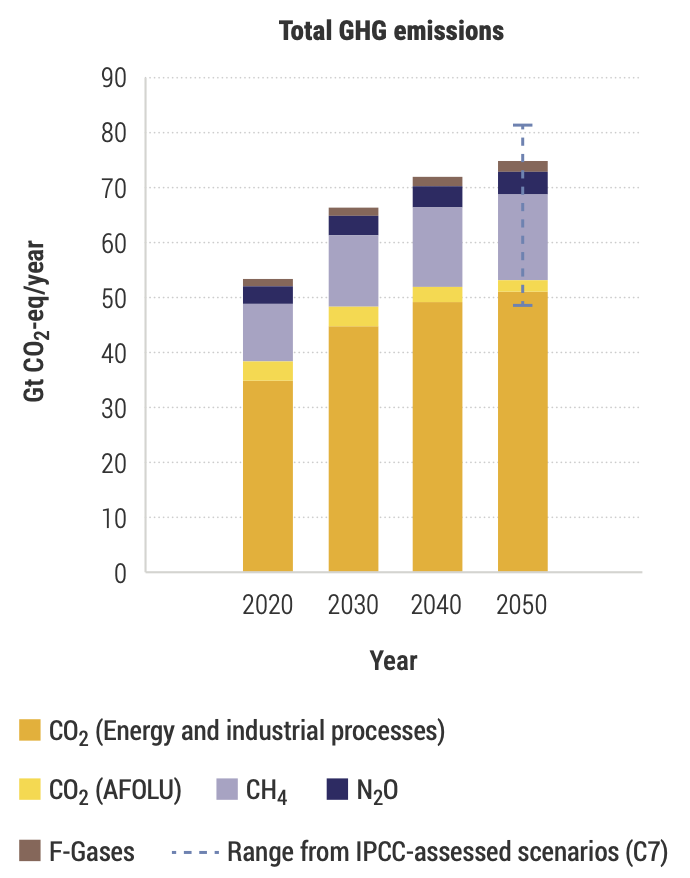
The graph demonstrates that the annual global emissions of all greenhouse gases (GHGs) in 2020 was around 53 gigatonnes of CO2 equivalent per year (Gt CO2-e/year). By 2050, under the Current Trends scenario, emissions are projected to be around 75 Gt CO2-e/year. And if you think that’s bad, the report says that after 2050 there will be a “slight decline towards the end of the century”. (I read about this increase in a commentary on the 1,200-page report and thought it might be a typo, so I checked for myself; it’s on page 509 if you don’t believe me.)
Most of the increase is attributable to the past and current principal culprits: emissions of CO2 from energy and industrial processes and methane.
So, business as usual for the next 75 years. All the international discussions and agreements about emissions reductions are just well-scripted hooey. As Greta Thunberg said, “Blah, blah, blah”.
The Key Messages section of the Executive Summary has been condensed to just six pages but even it contains a snake pit of distressing information. Here are some snippets:
- The rate of global warming in coming decades is likely to be higher than previously projected – no wonder, if we are going to keep pumping out more GHGs.
- Crossing environmental tipping points will be more likely and earlier than expected.
- One million of Earth’s (known) eight billion species are threatened with extinction, some within decades.
- Between 20 and 40 per cent of Earth’s land area was degraded by 2022. Between 2015 and 2019, at least 100 million hectares of productive land were degraded annually worldwide (over the period, that’s equivalent to WA, Queensland and NSW combined).
- Annual solid waste exceeds two billion tonnes and will double by 2050.
- These environmental crises are causing substantial damage to health, livelihoods, food, energy and water security, economies, infrastructure and basic services, increasing poverty and inequalities and decreasing life expectancy.
- Most of the internationally agreed environmental goals and targets are unlikely to be met with existing policies.
The report emphasises the need for “transformative” (the word appears countless times), whole-of-government, whole-of-society change, with transformation of the economic and financial systems “a prerequisite” for transformation of the materials and waste, energy, food and environmental systems. But the specific policy suggestions look more like tinkering (perpetuating the impossible dream of green capitalism with a human face) than real transformation of the global political economy.
According to the authors, “all countries care about sustainable economic growth”. Possibly, but what isn’t acknowledged is that regarding the wish for their economies to be sustainable, most countries channel Augustine praying for chastity, “yes please but not yet”. Nor is it recognised that capitalists and large corporations care only about the accumulation of personal wealth now. They don’t give a jot whether it’s environmentally sustainable.
When will environmental tipping points be crossed?
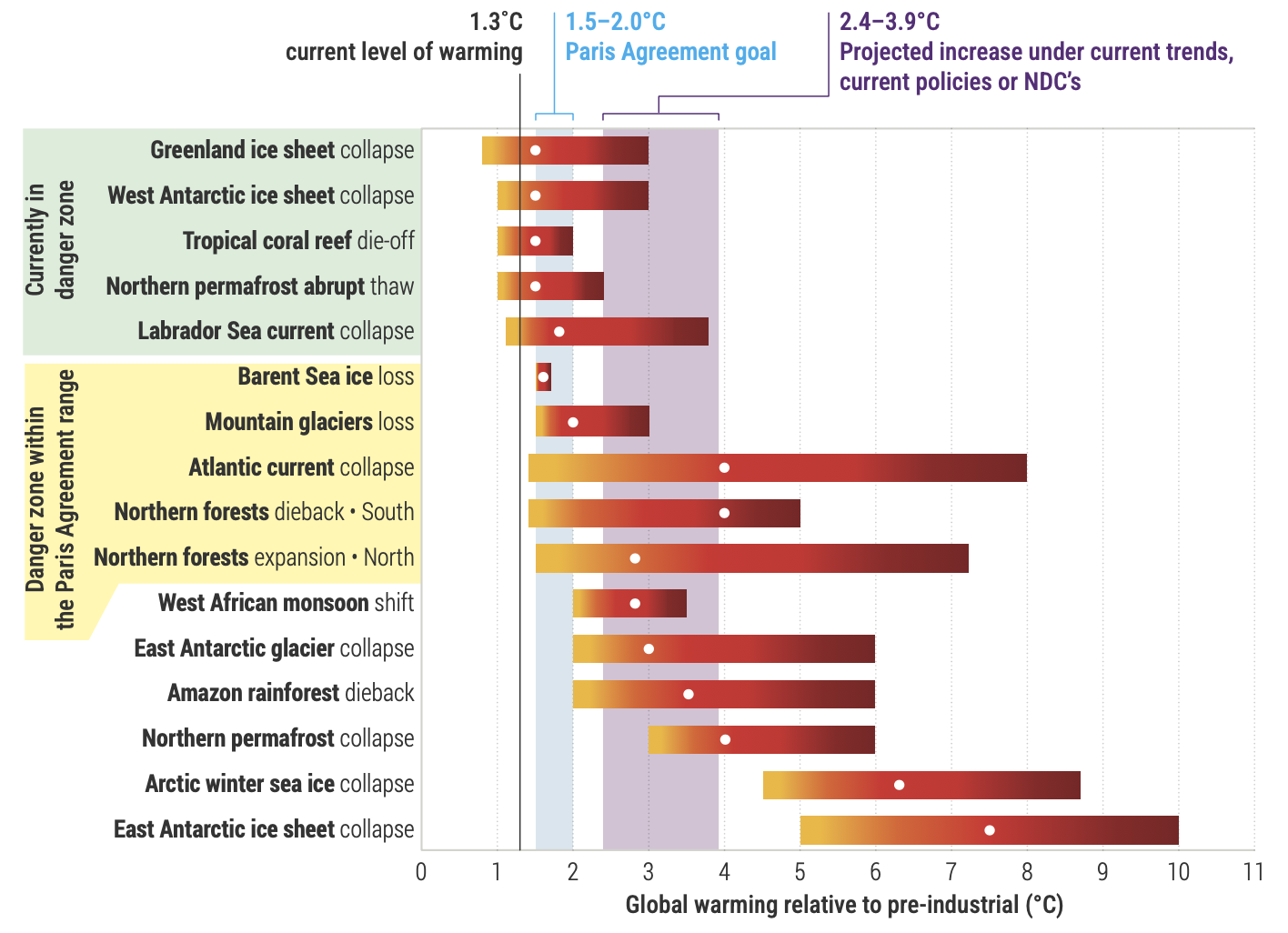
The diagram above displays the levels of warming at which some environmental tipping points are likely to be breached. For instance, the most likely degree of warming for triggering the tipping point that will foreshadow the collapse of the Greenland ice sheet is 1.5oC (the white dot), but it’s possible it started when warming hit 0.8oC or it may not happen until warming reaches 3oC. By contrast, the tipping point for the collapse of the East Antarctic ice sheet is unlikely to occur under 5oC and may not happen unless warming reaches an unimaginable 10oC. (It’s likely that the current level of warming is much closer to 1.5oC than the 1.3oC shown, by the way.)
A couple of other points are worth noting:
- Every 0.1oC of warming makes a difference. The lower the level of maximum overshoot and the shorter the time that temperatures remain high, the greater the chance of avoiding tipping points.
- The very nature of tipping points is that they are unlikely to start and proceed in a predictable, linear fashion, or even that we’ll know one has started until long after it has.
- Once one or two Earth systems pass their tipping point, there may well be a cascade effect involving many tipping points.
- Several Earth systems will add fuel to the fires already driving global warming once their tipping point is exceeded. For instance, loss of polar ice sheets will reduce the amount of the sun’s energy that is reflected back into space.
- There is a rapidly closing window for action to prevent tipping points being exceeded.
Australians mammals love the nightlife
Around 70 per cent of Australian mammals are nocturnal or crepuscular. Many of the mammals that before 1788 were plentiful and widespread across Australia are now greatly diminished in number and greatly restricted in range. No wonder it’s so difficult to see the little critters. But why do so many of our mammals, just like Alicia Bridges, love the nightlife?
Cooler nighttime conditions reduce the risks of overheating and dehydration, major problems especially for smaller mammals in much of Australia. Darkness provides some protection from native predators (although maybe not quite so effective against cats and foxes) and also allows animals to access habitats and food sources that might be much busier in the daytime.
The development of a predominantly nocturnal existence probably began 200–250 million years ago when our very early, very small mammalian ancestors shared Earth with the predominantly daytime dinosaurs. Day-dwelling individuals were likely to become prey but individuals with a characteristic that helped them roam around during darkness had better chances of surviving and reproducing and developed an evolutionary advantage. Over time the day-dwellers disappeared and the species became nocturnal.
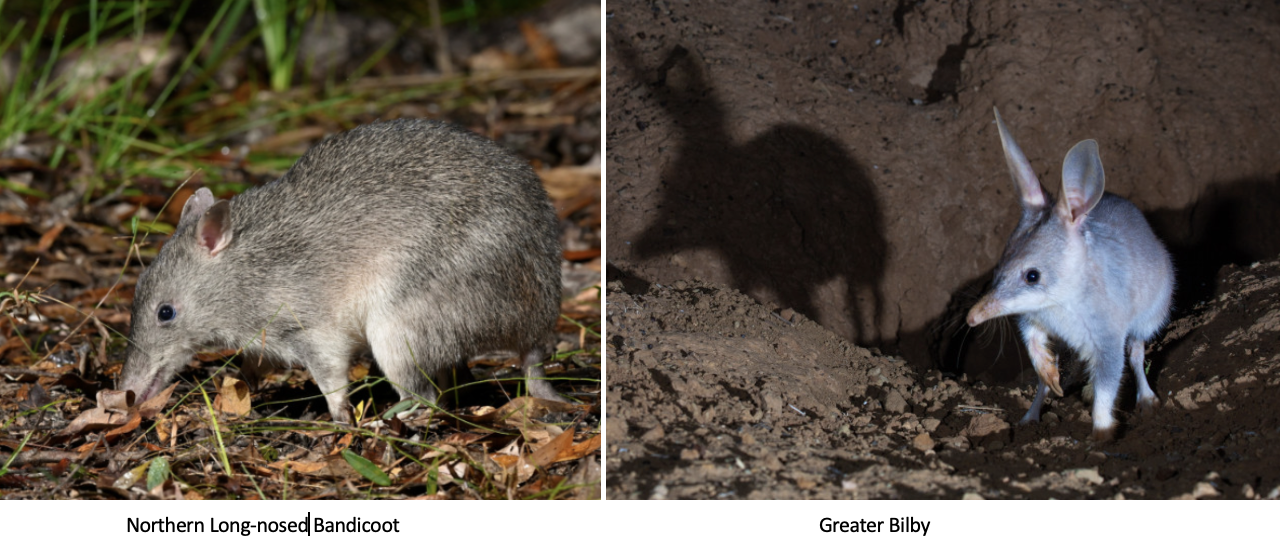
What characteristics gave the night owls the edge? Bigger ears for acute hearing, larger eyes for specialised night vision, a better developed sense of smell and more sensitive whiskers for a good sense of touch – features that developed further in many of our native mammals long after their predecessors waved goodbye to the dinosaurs and long after Australia’s fauna became separated from the rest of the world.

Of course, these characteristics have co-evolved in a never-ending arms race with predators and prey, so it’s no surprise that many Australian frogs, reptiles and insects (moths, beetles and crickets, for example) are also active at night.
Green coercive colonialism
“We hold these truths to be self-evident, that all men are created equal, that they are endowed by their Creator with certain unalienable Rights, that among these are Life, Liberty and the pursuit of Happiness.”
This iconic, oft-quoted sentence from the second paragraph of the Declaration of Independence “of the 13 united States of America” (note the small u in “united” signifying an adjective not a proper noun) is as loaded with hypocrisy now as it was when it was signed on 4 July 1776. Native Americans, slaves and women were self-evidently not considered worthy of consideration by the Declaration’s signatories, who included Benjamin Franklin, Thomas Jefferson and John Adams – the nation’s white Founding Fathers! Within the US today, Native Americans, African Americans, migrants and many other groups are still denied these truths.
Overseas the hypocrisy is increasingly obvious in the manner in which the US is conducting negotiations with developing countries regarding finance, trade and the construction of infrastructure and US military facilities. For instance:
- US officials have warned Zambia that access to essential medicines for HIV, TB and malaria, medicines previously funded by the US, could in future depend on access to Zambia’s copper reserves – medicines for minerals.
- In Kenya and Zimbabwe, the US has been demanding access to health system data as part of trade negotiations.
- Across Central and East Africa, the US is locking critical minerals such as copper, cobalt, lithium and rare earths into financing mechanisms for infrastructure such as railways and ports.
- The minerals-rich Democratic Republic of Congo has accepted migrants deported from the US as part of deals for access to their resources.
Unions and grassroots organisations across Africa are beginning to coordinate their activities to resist this new phase of colonisation, which seeks to exert US control over sovereignty, land, labour, resources and the direction of development.
See also Eugene Doyle’s recent article in P&I.
What about knees when it’s hot?
With much of North America and Europe suffering sweltering temperatures, Bloomberg Green Daily (2 July 2026) fearlessly strode into the crutch (sorry crux) of one of the most difficult dilemmas: Is it ever appropriate to wear shorts to work?
A poll of Bloomberg’s trader, portfolio manager and strategist clients (no information on the gender of the respondents) found that 45 per cent said yes. But the majority was unconvinced: “unprofessional”, “too casual”, “not for finance”, “We must hold the line on decorum and propriety”, and the clincher: “AI is taking all our humanity, all we have left is pants.”
But fashion designers have smelt the wind and are already preparing for more global warming.


Peter Sainsbury is a retired public health worker with a long interest in social policy, particularly social justice, and now focusing on climate change and environmental sustainability. He is extremely pessimistic about the world avoiding catastrophic global warming.