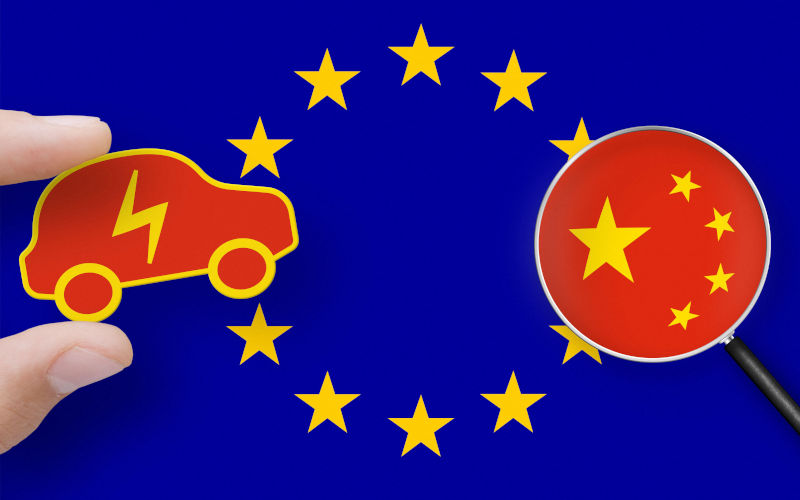
Europe is alarmed by Chinese overcapacity, deindustrialisation and US pressure, but remains divided over how to turn tough China rhetoric into policy.
Europe’s current ‘China shock’ debate is delicately poised. While a growing sense of alarm over deindustrialisation, Chinese overcapacity and rapid job losses grips much of the continent’s policy elites, the tough talk is yet to translate into an aligned policy response.
This lack of agreement was the key takeaway from discussions in Brussels and Berlin in May and June 2026 with EU and German officials, policymakers and analysts.
Europe is in a defensive crouch, with stress mounting on all sides. US President Donald Trump’s taunts and tariffs, Russia’s war on Ukraine and China’s economic challenge reveals the limits within the EU’s strategic capacity to deal with multiple pressures at once.
This doesn’t necessarily mean complete policy stasis. To be sure, Brussels and Berlin are formally pursuing certain lines of effort in reaction to the ‘China shock’. The European Commission is set to develop a dedicated instrument supporting companies in key sectors to diversify their supply chains. Safeguard tools like reduced tariff quotas and high out-of-quota duties are being used and industrial re-expansion has been envisaged through legislated instruments such as the 2026 Industrial Accelerator Act.
Proposals have also been made for new rulemaking at the World Trade Organization that would afford policy space to combat negative trade spillovers from distortive state interventions. And the first EU–China Trade and Investment Consultation meeting in June 2026 identified trade and investment rebalancing as an initial workstream.
Given this context, a stronger response on China was expected to emerge from the June 2026 EU Council meeting in Brussels. Ahead of the summit, the centre–right European People’s Party issued a statement urging the EU to ‘stop naivety towards the long-term ambitions of China’. German Chancellor Friedrich Merz was also widely seen to be in favour of stronger protective measures, intoning before the meeting that ‘where others do not abide by common rules, we will not stand by idly’.
Yet this tough rhetoric in the leadup to the summit did not translate into further, concrete policy action. The crux of the European dilemma, as one official in Brussels noted, is the idyllic ambition of ‘want[ing] to raise the costs for China but without inflicting pain on ourselves’.
The inaction is also a consequence of domestic policy paralysis. In Germany’s case, there is no unified position on the kinds of diversification tools that might be used in response to Chinese overcapacity, even as the country is losing around 10,000 industrial jobs a month. While some in Berlin push for trade defence measures and regulations on investment screening or localisation requirements, others advocate for a more hands off approach, fearing retaliation from China.
The challenge which Chinese ‘overcapacity’ poses to Germany’s industries is widely acknowledged. It augments industrial difficulties due to domestic structural factors like high energy costs following Russia’s invasion of Ukraine, slower productivity growth, regulatory burdens and demographic challenges.
But the European policy community has not yet settled on a coherent narrative which balances economic and national security. Without that alignment, the tough conversation with the average voter on the trade-offs needed for economic security priorities cannot begin, nor can de-risking be operationalised. The far-right Alternative for Germany party have not yet weaponised the China threat, but that could change swiftly given that anti-China sentiment has been rising in eastern Germany, particularly among trade unionists.
A notable shift does seem to be underway in Berlin, with the parliament forming a special commission in November 2025 to ‘review the security-relevant economic ties between Germany and China’. One anonymous participant remarked on the change in attitude that has taken place over the past five years alone, when ‘to say that one needed an industrial policy would invite the allegation [that] you were a communist!’ Still, German trade unions believe that the solution is a fairer playing field, potentially levelled by local content measures – not a reversion to protectionism wholesale.
China’s ‘awakening’ is also precipitating an ‘identity issue’ for Germany, one seen primarily through the connection between the German automobile industry and national self-confidence. The country’s postwar growth model – which rested on auto exports to China and cheap energy imports from Russia – has reached its limits. In one analyst’s words, ‘China’s success in electric vehicles is not all because of state subsidies or unfair practices, but because of their superior integration of supply chains’, leading to the conclusion that Germany is likely the soft entry point for China’s EU strategy, since ‘they deindustrialise us but do it so politely’.
This question of identity goes to the core of Europe’s China dilemma, though responses diverge. Some policymakers are telling counterparts in Beijing not to let China become an identity issue in Europe, fearing the emotionally charged debate that could ensue. Others in Brussels and Berlin look admiringly at Australia’s response to China over the past decade and even seek to emulate Canberra’s model of ‘pushback’ followed by ‘stabilisation’. That view has been stimulated by briefings from Australian diplomats in Europe and hawkish analysts delivering fire-breathing sermons across the continent.
Yet the circumstances differ widely. China poses a deep structural challenge to the very industrial model for Europe’s economic wellbeing. And while Beijing imposed export controls over Canberra’s positions on matters of foreign investment, critical infrastructure, telecommunications and COVID-19, at no point did even the most hawkish Australian politicians bring up the iron ore trade with China as leverage, nor did Beijing contemplate self-harm by doing so. These differences should be born in mind.
Those in Brussels and Berlin might find it useful to first build out its industrial policy as well as deterrence tools in the form of economic security instruments before sitting down in earnest with the Chinese. Just as arms control do not precede but follow the development of deterrence capability, so will the EU find better bargains to be had at the table once it builds out its toolkit prudently. This would likely result in a process of genuine derisking rather than Washington-style root-and-branch decoupling.
Republished from East Asia Forum

James Curran is Professor of Modern History and senior fellow at Sydney University’s US Studies Centre. He is writing a book on Australia’s China debate for New South Press.
James Curran is the AFR’s International Editor and Professor of Modern History at the Sydney University.