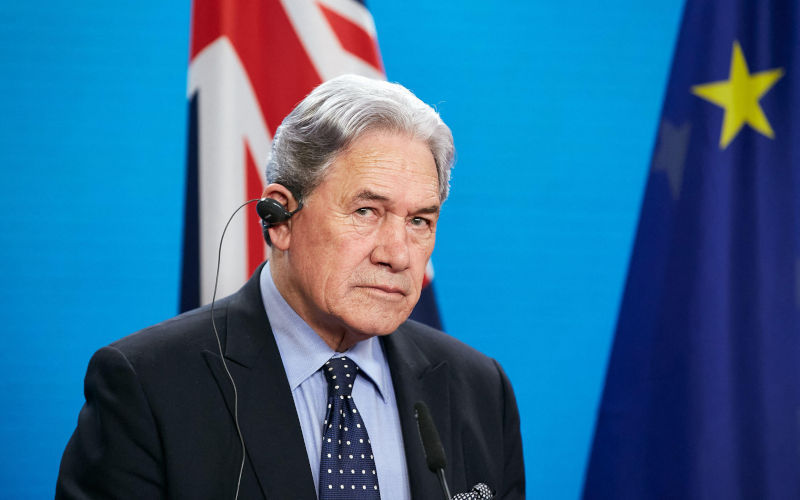
Winston Peters’ comment to a Chinese-born MP has drawn a formal rebuke from Beijing and exposed the political cost of relying on New Zealand First as Christopher Luxon heads towards a difficult election.
The New Zealand foreign minister’s inappropriate dislike for foreigners has caused a racism row that has reverberated around the world and drawn a rare formal rebuke from New Zealand’s biggest trading partner, China.
Part of the problem is New Zealand’s Mixed Member Proportional (MMP) voting system. It was introduced when it became apparent that first past the post didn’t always produce the result for which the majority voted.
MMP has, after three recent elections, handed the power to choose governments to one minor party, the populist New Zealand First led by the foreigner-averse and discipline-resistant Winston Peters. His latest outburst has been disruptive and damaging to the country for which he is foreign affairs minister.
An irritated Prime Minister Christopher Luxon has failed to act against Peters but has aired the possibility of a referendum on the future of MMP. After the elections in 1996, 2005 and 2017, Peters has held the balance of power. He has brooded, sometimes for weeks, over whom to support. His usual fee has been a handful of cabinet seats for his MPs, including for himself the role of foreign affairs minister and minister of racing.
Coalition with New Zealand First has often ended in friction and fracture. National prime minister Jenny Shipley ended up sacking him from all cabinet positions, Helen Clark stood him aside as foreign minister over questions about the disclosure of a large donation, while Jacinda Ardern kept a firm hand and seemed to have his respect.
In 2008 New Zealand First was wiped out and Peters lost his seat. National’s John Key relied on three other minor parties for confidence and supply.
In 2023 Peters was not the kingmaker because National and ACT had the numbers, but he joined their coalition, the current government.
In the latest incident, 81-year-old Winston Peters started a diplomatic crisis for New Zealand with a racist slur directed at a Green Party member of parliament, Lawrence Xu Nan, who was born in China but moved permanently to New Zealand at age 11.
During a parliamentary debate about foreign interference and the Covid pandemic, Xu Nan interjected with a question that triggered Peters. He said, “Have you been vaccinated?”
The interjection aggravated Peters because when he was in coalition with Jacinda Ardern’s Labour government he supported strong but often controversial measures to keep New Zealanders safe. Later he found an enthusiastic constituency among anti-vaxxers and science sceptics, so he now disowns his role in the Ardern government.
Peters responded, “Go back to your own country (China) where they lie like flat fish.”
Within hours, China’s ambassador lodged a formal protest and urged New Zealand to “value the equal and mutually beneficial relationship between China and New Zealand and to do more things conducive to bilateral relations rather than the other way around”.
Former New Zealand prime minister Helen Clark said the row, which was reported around the world, reflected on New Zealand’s reputation and threatened trade with its most important trading partner.
Green Party members have condemned the comments against their colleague as xenophobic, unacceptable, racist and far beneath the dignity of a senior member of the New Zealand government. The Labour Party opposition leader, Chris Hipkins, has finally and officially ruled out working with New Zealand First in any government he leads.
Prime Minister Christopher Luxon has taken no action against Peters. With fewer than 90 days until the election on 7 November, dumping or demoting Peters could destabilise the coalition with New Zealand First.
It is concerning for the National-led coalition that New Zealand’s critical economic indicators are trending in the wrong direction. These include GDP and per capita GDP showing multiple negative quarters, unemployment is rising and job vacancies are falling, construction activity and manufacturing output are declining, household consumption is subdued, and business investment and wage growth are down.
This contradicts the commonly held view that National is a better economic manager than Labour. This view was supported by an IPSOS New Zealand Issues Monitor poll of New Zealanders’ opinions on which party is most competent to handle the most important issues. In May 2026 National held a five-point lead over Labour on economic competence. However, in July the IPSOS poll found Labour was seen as the better economic manager, with a four-point lead over National. Labour continued to lead over National on competence to handle the cost of living, health care, petrol prices and housing.
Other recent polls show Labour and National about equal within a few points of 30 per cent each. The Greens were firm at around 11–12 per cent. New Zealand First and ACT hovered around 8–9 per cent.
The centrist Opportunity Party, led by the articulate and energetic Qiulae Wong, has made a dramatic rise in just a few months from around 3–4 per cent to 8 per cent in two recent polls. Opportunity has suddenly become a potential kingmaker.
Luxon’s failure to deal with Peters, a series of gaffes and a general impression of incompetence surrounding his government have led to speculation about the prime minister’s leadership. This week (Wednesday 12 August) he survived a confidence vote in the National Party caucus, the second in three months. Not a good look in an election year.

Max Hayton is a New Zealand journalist who worked as a political correspondent in the Parliamentary Press Gallery in Wellington in his younger days. He then traveled to London to specialise in foreign television news. In 1989 he became Foreign Editor at the start-up private channel TV3 New Zealand. After some years he became the Foreign Editor at Television New Zealand where he worked until he retired.