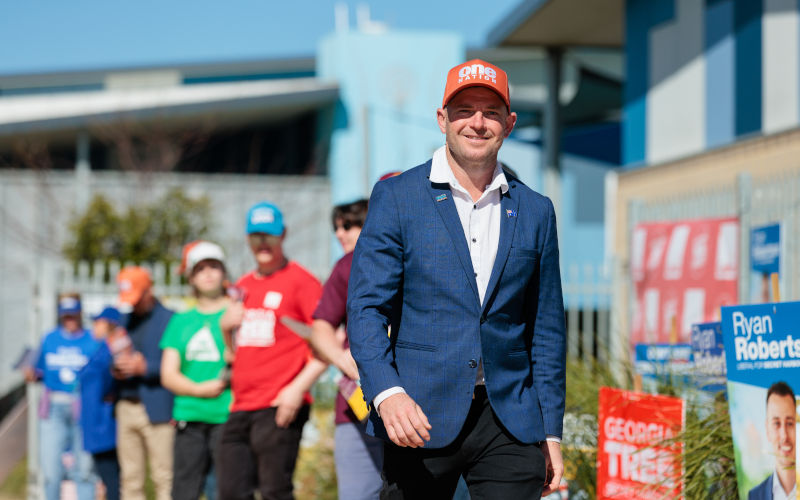
One Nation’s victories in WA and NSW tell us that Australia’s electoral landscape is shifting fast. Relying on One Nation to implode is not enough to stem the populist tide.
Last Saturday’s Western Australian by-election in the state seat of Secret Harbour was worse than diabolical for Labor.
A couple of weeks ago I wrote that Labor’s rating in opinion polls at 28 per cent made its position diabolical. But now we see that in a real vote in a real seat Labor’s position is even worse. On Saturday, it got just 24.5 per cent of the vote and turned a safe seat with an 11.5 per cent margin into a 43–57 loss.
Yes it was a by-election. Yes it was a state seat, but . . . .
One Nation candidate Luke Herdegen’s assertion that no Labor seat is safe, portends badly. Worse for Labor, Labor does not seem to recognise what a dangerous position it is in, at least until now. It seems to assume that its massive House of Representatives majority will be big enough to withstand any swing to One Nation or the Coalition.
Forget the polling, we now have two real elections (Farrer and Secret Harbour) in which One Nation has topped the primary vote and then won on preferences. More significantly, one of the seats was a Coalition one and the other was Labor. One Nation is taking from both sides. Moreover, in both seats, One Nation got around 50 per cent of the preference flow.
And given the Coalition gave One Nation preference over Labor on its how-to-vote cards in both by-elections, we can conclude definitively that the Coalition has inadvisedly given these two seats to One Nation over Labor and an independent respectively.
Preferences are critical. Last election, around 90 per cent of the seats went to preferences. With preference flows running 50 per cent its way, it means that whenever One Nation gets the most primary vote, it would win the seat.
These two by-elections now clearly indicate that One Nation, not the Coalition, is the de facto opposition.
The contest now is between Labor, Greens and teals on one side and One Nation, the Liberals, and the Nationals on the other. But the objective remains the same. You still need a majority on the floor of the House of Representatives to win government, whether that majority is made up of MPs from the same party or a combination of parties.
On the figures in the two by-elections and polling generally, the most likely outcome of an election held now would be a One Nation-Liberal-National government. But there are two years to go. And given these results and the polling, the behaviour of all parties is likely to change as a result.
The Liberals and Nationals will have to be careful not to alienate voters who might be inclined to vote One Nation in order to maximise their share of seats.
That poses a difficulty. Liberal leadership contender Andrew Hastie is vehemently opposed to accommodating, appeasing or preferencing One Nation. Saturday’s result will only harden that position. The Secret Harbour electorate overlaps his federal seat of Canning. Many who voted on Saturday were his constituents.
On Saturday’s figures, his seat is extremely vulnerable to One Nation. Hastie has been a special target of One Nation because he gave evidence in the Ben Roberts-Smith defamation action. That evidence was not helpful to Roberts-Smith, who is one of One Nation’s heroes, epitomising, in their eyes, the white Australian underdog (a corporal) doing the right thing and being victimised by the elite. Hastie was an officer. Roberts-Smith has also been championed by One Nation leader Pauline Hanson’s billionaire benefactor Gina Rinehart.
Hastie, by the way, was subpoenaed to give evidence under oath, and did so as the law required.
Labor has an equally tricky difficulty. It has to attempt to neutralise One Nation without alienating its own base, especially the young and women in the cities, without being seen to appease it. That is, to cut immigration numbers in a non-racist way.
At the heart of the One Nation surge is opposition to immigration. One Nation says that that opposition is based on the pressures high immigration puts on infrastructure and jobs, but whether coincidentally or consciously it appeals to voters who feel that immigration is changing the cultural nature of Australia – making it less white and less Christian.
In Secret Harbour, where One Nation did so well, the percentage of people who identify as of ‘British’ or ‘Australian’ heritage is fourth highest among WA’s 59 seats. It is an older demographic. Older people are more likely to have their own homes and less likely to see infrastructure pressure, so the anti-immigration appeal, alas, is more cultural and racial than economic or environmental.
The trouble for Labor is that, even if it reduces immigration, it will not shift the voter dial. The opinion of One Nation voters is mostly impervious to numbers and facts. In any event, reduced immigration numbers will take some time to relieve infrastructure pressure and even longer for voters to notice.
However, that the two-party system is seen as not addressing the electorate’s cost-of-living concerns gives Labor an opening. Medical costs are electorally sensitive. A promise to add dental care to Medicare, for example, could win a lot of otherwise One Nation supporters away.
What will not work is gradualism and sleep-walking to electoral loss. But given Prime Minister Anthony Albanese’s predilections and caution, that is a very likely scenario.
Gradualism and sleep-walking can only rest on the hope that One Nation will implode. But since the first surge in One Nation support eight months or so ago, a few inconsistencies and political bloopers from new and old One Nation members of parliament and the questioning about financial donations have had zero effect on the surge.
Even the extra scrutiny that comes with being the de facto opposition and with the prospect of being in government are unlikely to shift the voting dial. The more that happens the more One Nation supporters feel vindicated in their view that they are being unfairly victimised by the system.
For Labor that adds up to a mountain that will require a seismic shift on how it projects itself to the electorate. Labor has often risen to the occasion in the past. Maybe Albanese can repeat Paul Keating’s 1993 sweetest victory of them all – because right now 1993 is the best description of Labor’s position.
Albanese said, “We owe it to history to defeat right-wing populism.” But he should not underestimate the gargantuan nature of the force he faces.
Republished from Crispin Hull.com.au

Crispin Hull
Crispin Hull has written for The Canberra Times for 30 years on a huge range of topics, but mainly legal and constitutional. He was Editor for seven years. He taught journalism at the University of Canberra, and is the author of ‘The High Court of Australia 1903-2003’ and ‘Canberra – Australia’s National Capital’. He is also a marine rescue skipper on the Great Barrier Reef with Marine Rescue Queensland.