The build-up of deterrence, alliances and enemy thinking helped drive the catastrophe of 1914, and today’s great-power rivalry risks repeating the same dangerous cycle.
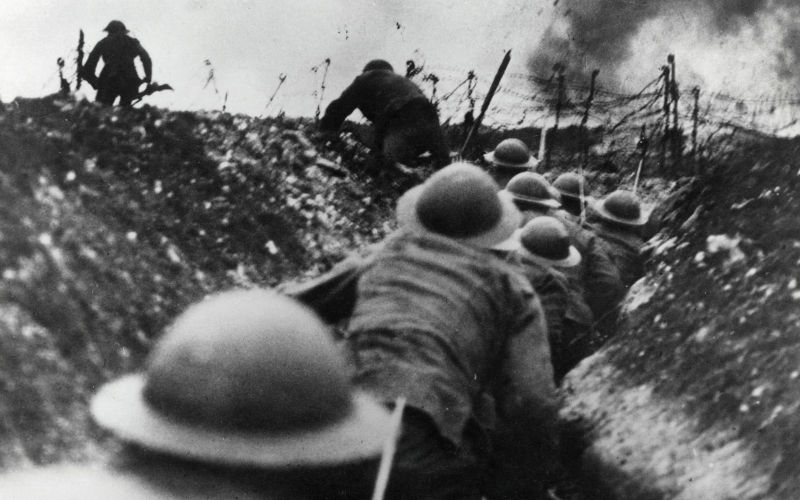
On 4 August 112 years ago, stupid decisions by the leaders of great powers at the time, Britain, Germany, France, Austria-Hungary and Russia, resulted in a catastrophic war that caused the deaths of millions and economic damage and dislocation that resonated for decades.
We are in a hauntingly similar situation today and we should strive to learn from the history so there is no repeat.
Today, national leaders talk about “national security” and “the increasingly challenging security environment”. They acknowledge that the primary aim of a government is to maintain the security of its people. Surely that aim is best achieved by avoiding war.
Yet avoidance of war has been turned on its head. The military-industrial complex which benefits most financially, constantly argues that the best way to avoid war is to build up deterrence. But the deterrence build-up by any nation is always seen as a threat by other nations.
Iran is a case in point. Its case for obtaining nuclear weapons is deterrence. Immediately, the US and Israel have labelled that a threat which has to be eliminated. In short, the very thing designed to prevent war – deterrence – becomes a catalyst for war – the elimination of threat.
The mistake made by the great powers in the early years of the 20th century was to build up deterrence. They did this not only through weaponry and naval forces, but also through alliances.
France thought an alliance with Russia would deter Germany from attacking it. Germany, of course, saw that alliance as a threat, for which it had to prepare.
Germany was the new power on the world stage, emerging in the 1860s. It grew rapidly economically and militarily, just as China had emerged as a new power from the 1990s. China sees US alliances with Japan, South Korea, the Philippines and Australia more as a threat than a deterrence.
France, Russia and Britain, viewed the rise of Germany with alarm. They saw Germany as a zero-sum competitor and challenger to their economic interests rather than as a contributor to the overall improvement in human well-being. It is similar to the way US leaders and others view China.
Britain was also bristling because it was slowly losing its relative position as the dominant power – the hegemon. Just as the US is bristling now because it is losing its position as the hegemon to the rise of China. The political-military-industrial leaders of both Britain then and the US now failed to acknowledge that, though their relative military and economic power was declining, the absolute state of their military and economy was still improving. They both wanted to be top dog, more than a better-fed, happier dog.
In that environment, British leaders saw Germany as “the enemy”, just as US leaders now see China as “the enemy”. In both cases it led to growing paranoia, not just then in Britain and now the US, but also then in Germany and now in China, respectively.
Germany, in the early years of the 20th century, was obsessed with being surrounded by a Britain-France-Russia alliance, just as Chinese leaders see the US as the architect of it being surrounded through its alliances with Japan, South Korea, the Philippines and Australia. The result was the build-up of deterrence through economic and military forces and more territory and alliances. In Germany’s case, that was in Africa, New Guinea and anywhere else it saw an opening. In China’s case it has been Tibet and the borderland between it and India and Vietnam and the South China Sea.
Western leaders now are making the same mistake as the great powers made in 1914. They are seeing the world through a competitive lens of deterrence and threat and dangerously building up militaries and perceptions accordingly. The more they see China as “the enemy”, the more likely they are to see that “getting in first” is vital. In that environment the danger of a trigger incident escalates. There is less time for talk, thought, and diplomacy.
In 1914, the trigger incident was the assassination of the heir to the Austro-Hungarian throne by a Serbian nationalist. Russia then was a great supporter of fellow-Slavic Serbia. An outraged Austria, which was aligned with, and backed by, fellow German-speaking Germany, made a list of unacceptable demands on Serbia or face war. Austria attacked Serbia and actions on the ground raced ahead of diplomatic possibilities until all powers were engulfed meeting the threats of their enemies with the excessive deterring forces they had built up.
A quarter way through the 21st century we are in a similar, though not identical, position. With China being seen as “the enemy” and a threat, a trigger incident – such as an accidental collision and sinking or a shooting down in the South China Sea – could result in the world descending into a great-power war that nobody wants.
An accidental sinking or shooting down with loss of life, or a terrorist assassination for which no nation is responsible demand, in the eyes of the leaders of national governments, face-saving action to avenge the insult to national dignity. And as the mobilisation to respond to the indignity in the heat of the moment begins, the other side sees the importance of getting in first or the need to defend allies against the threat to preserve national security.
Yet in 1914 no-one in France or Britain foresaw the complete breakdown in national security and dignity that would occur later as 20,000 lay dead at the end of the first day of the 1916 Battle of the Somme. In the lead-up to the declaration of war, national leaders did not ask what their people wanted, or even ask what their congressional or parliamentary representatives wanted – certainly not the subsequent death, misery and destruction.
The prevention of war should be the primary aim of any government and not preventing war its greatest failure. And wars of choosing are the worst.
The job of governments now is to unwind the deterrent-threat-enemy cycle.
As the world transitions from the US being dominant to a world where China has a greater role, the big question is whether the US will make as poor a job of it as Britain did when it had to move from being an empire – controlling, meddling, influencing and directing events in all parts of the world – to being just one nation among many.
If each nation, including Australia, could declare the abandonment of any form of aggression and a retreat to a position of only using force to respond to a direct attack, it would be a good start in preventing a repetition of the destructive horror that began on 4 August, 1914.
This article first appeared in The Canberra Times and other Australian media on 4 August 2026.
Republished from Crispin Hull

Crispin Hull
Crispin Hull has written for The Canberra Times for 30 years on a huge range of topics, but mainly legal and constitutional. He was Editor for seven years. He taught journalism at the University of Canberra, and is the author of ‘The High Court of Australia 1903-2003’ and ‘Canberra – Australia’s National Capital’. He is also a marine rescue skipper on the Great Barrier Reef with Marine Rescue Queensland.